Mayer Multiples: The Metric That Helps Call Bitcoin Bubbles and Bottoms
Calling precise market tops and bottoms is next to impossible in the volatile cryptocurrency markets. That said, some traders believe identifying speculative bubbles and moments of bearish exhaustion can be made possible through the use of a fairly new metric known as the Mayer Multiple.
Created by noted investor and podcast host , the Mayer Multiple is “the multiple of the current bitcoin price over the 200-day moving average.”
Mayer Multiple Formula:
bitcoin market price / 200 day MA value = Mayer Multiple
In technical analysis, it’s generally considered a bullish (or positive) indicator when prices are above the long-term moving average (MA), whereas it’s considered bearish (or negative), when the price is below the moving average.
However, the implications are not that binary. For example, if the price is significantly higher than a long-term moving average, it’s often a sign that the underlying asset has become overvalued or what is commonly referred to as “overbought.” The opposite is the case when the price falls excessively below the moving average.
The Mayer Multiple essentially quantifies the gap between the price and 200-day MA to identify historical values at which point bitcoin enters a speculative bubble. In other words: when its price significantly exceeds its intrinsic value or points of seller exhaustion.
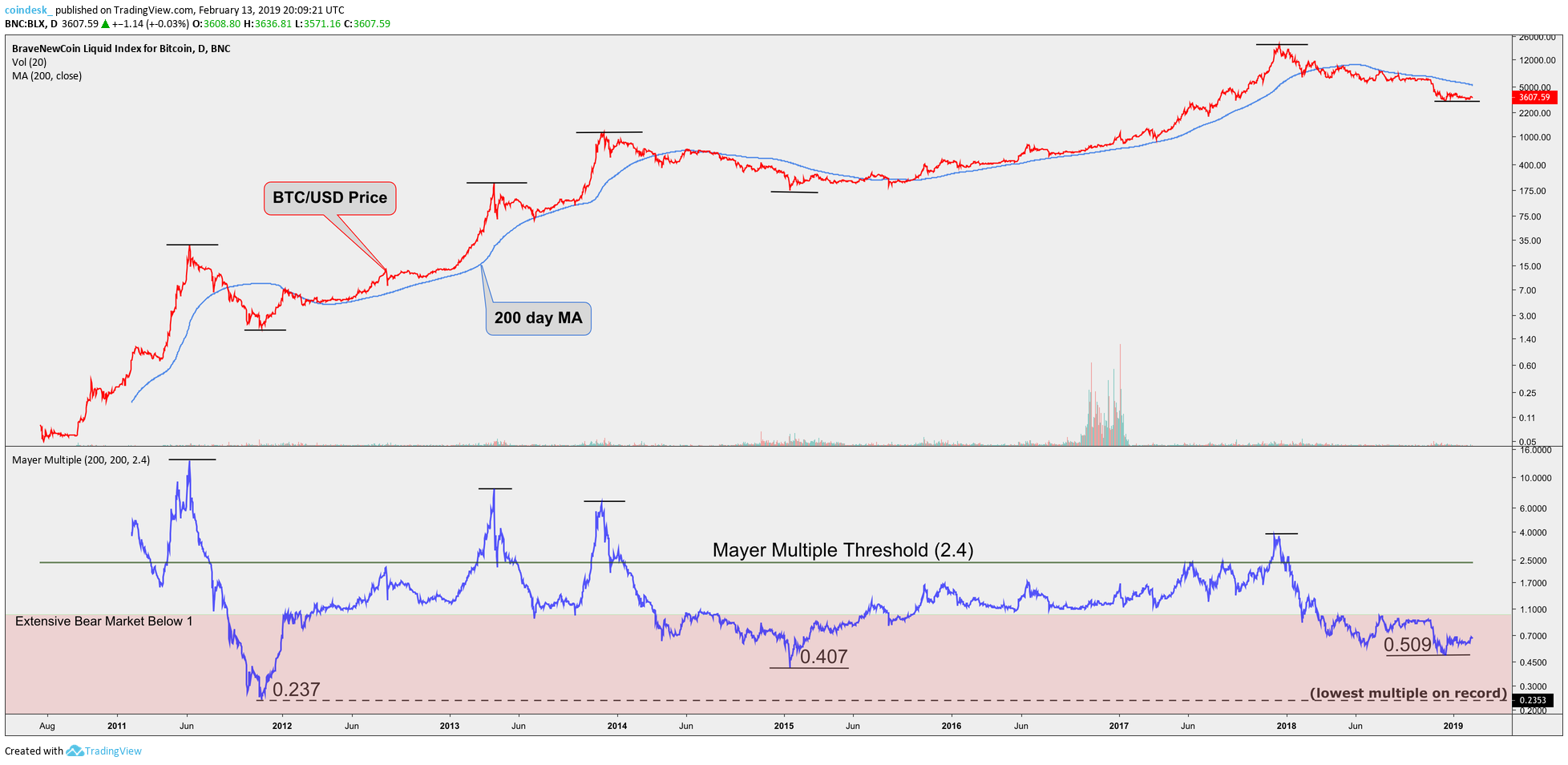
When using Mayer Multiple, the two specific values to pay keen attention to are 1 and 2.4. The significance of a 1 multiple is simple: any value above 1 means bitcoin’s price has risen above the 200-day MA and any value below 1 means price has fallen beneath it.
By comparing multiples below 1 to its corresponding price action, it is evident that extensive bear markets take place when price finds acceptance below the 200 MA. On the other hand, bitcoin’s market favors the bulls when the Mayer Multiple is above 1 – but there’s an exception.
Any multiple above the 2.4 threshold has historically shown to signify the beginning of a speculative bubble, which is significant because all bubbles eventually burst, causing a rapid depreciation. By based on historical data, Mayer deduced that the best long-term results were gathered by accumulating bitcoin when the Mayer Multiple was below 2.4.
As can also be seen above, the Mayer Multiple has never fallen below 0.237, the value that marked the bottom of bitcoin’s first significant bear market in 2011.
For reference, the 2013-15 bear market reached a price bottom when the multiple showed 0.407 and the lowest multiple since then was 0.509, when bitcoin’s price fell to $3,122 on Dec. 15, according to pricing data.
As the data suggests, bitcoin’s price is now reaching historically oversold levels so its presumed a bottom is in sight, but is still capable of falling further away from the 200-day MA, which is currently sitting at $5,343. Further, evidence suggests that it’s highly likely the price finding acceptance above the 200-day MA, creating a Mayer Multiple above 1, would confirm the beginning of a bull market.
And finally
An above-1 Mayer Multiple could be considered a sign of a bull market.
A very high number represents extreme overbought conditions or bubble. BTC, therefore, could see a corrective pullback or an outright sell-off, in which case prices may eventually drop below the 200-day MA, driving the Mayer Multiple below 1.
However, that could turn out to be a bear trap, as a sharp drop from extreme overbought conditions to levels below 200-day MA is usually accompanied by short-term overbought conditions.
An unusually low number could be considered an advance indicator of bitcoin nearing a major bottom.
Disclosure: The author holds BTC, AST, REQ, OMG, FUEL, ZIL, 1st and AMP at the time of writing.
Canada’s securities regulators are paying attention to ICOs. Last week they released a that explains their approach to token sales/ICOs/ITOs/crowdsales, officially titled “CSA Staff Notice 46-307: Cryptocurrency Offerings.” Here is what this notice means and what it doesn’t mean.
In the that accompanied the Staff Notice, Louis Morisset, the chair of the Canadian Securities Administrators (CSA) and the head of the Quebec securities regulator, is quoted as saying: “The technology behind cryptocurrency offerings has the potential to generate new capital-raising opportunities for businesses and we welcome this type of innovation …” The press release recommends the Staff Notice to anyone “… planning to raise capital through an ICO or ITO, or that is seeking to establish a cryptocurrency investment fund.”
The global legal backdrop to Staff Notice 46-307 is increased regulatory scrutiny of token offerings, including the on “The DAO” issued last month and the of a regulatory position.
Before diving into what the Staff Notice says, it’s important to understand what a Staff Notice is. The author of the Staff Notice is the CSA, an association of provincial and territorial securities regulators. Regulation of securities is conducted on a provincial basis and is not done at a country-wide level like in most jurisdictions. The CSA is a national forum for harmonizing securities rules and this Staff Notice is essentially a joint position on how Canada’s many securities regulators view ICOs.
The Staff Notice is interesting but it is not a legal change. It does not create any new rules in Canada but it does provide some clarity for anyone seeking to understand how Canadian securities law applies to token sales.
Here are ten key takeaways from the CSA Staff Notice:
1. Regulators will treat each token using a case-by-case approach
A widespread fear in the blockchain industry is that regulators will somehow “shut down” token sales. The Staff Notice assuages that fear:
“Every ICO/ITO is unique and must be assessed on its own characteristics. For example, if an individual purchases coins/tokens that allow him/her to play video games on a platform, it is possible that securities may not be involved. However, if an individual purchases coins/tokens whose value is tied to the future profits or success of a business, these will likely be considered securities.”
This is a great paragraph to see. The regulators are communicating what any lawyer working in this area would have confirmed for a client: Some tokens are securities and some aren’t. This means that the regulators aren’t interested in a knee-jerk response that paints all token sales with the same broad brush.
2. Substance will trump form when it comes to ICOs
A security is not a security because of the words used but because of what it is. The Staff Notice includes a warning to this effect:
“Staff is aware of businesses marketing their coins/tokens as software products, taking the position that the coins/tokens are not subject to securities laws. However, in many cases, when the totality of the offering or arrangement is considered, the coins/tokens should properly be considered securities. In assessing whether or not securities laws apply, we will consider substance over form.”
An illegal securities offering can’t be dressed up to make it a legal product. A high-level staffer in the Ontario Securities Commission was in the Globe and Mail on the same day that the Staff Notice was issued: “So what we’re trying to do is raise awareness that just because you’ve called something a coin or token doesn’t mean it’s now a loophole and you can go and promise your investors great returns, not provide any sort of documentation and not ensure what you’re selling to them is actually suitable for them.”
3. The CSA thinks many ICOs are securities offerings aimed at retail investors
Products are purchased. Capital is invested. When a store sells a good, they don’t consider that sale to be “investment.” Yet the world of ICOs is filled with references to token investors rather than token buyers. Many people speak of “raising capital” when they sell a token, while resisting the characterization of that transaction as the sale of securities. As the Staff Notice points out:
“ICOs/ITOs are generally used by start-up businesses to raise capital from investors through the internet. These investors are often retail investors.”
Many ICOs are being done in order to “raise capital,” rather than to create revenue through the sale of products, and the securities regulators have taken notice. The reference to “retail investors” acknowledges that most of the activity is taking place at the individual level rather than through institutional, large corporate or fund investments. This paragraph indicates that the CSA may view most ICOs/ITOs as securities offerings.
4. The existing legal framework for securities will be applied: Pacific Coin
A critical case in Canadian securities law is the 1978 Supreme Court decision of . This is the leading case on what a “security” is in Canada and it’s explicitly mentioned in the Staff Notice. The case lays out the following test:
“1. An investment of money 2. In a common enterprise 3. With the expectation of profit 4. To come significantly from the efforts of others.”
This test is similar to the in the United States. Note that this isn’t a “test” in the way that most people would understand that word. A legal test is a framework for decision-making that requires understanding the facts, circumstances and recent cases. Consultation with a lawyer will be necessary in order to understand how this test applies to any given situation — and even then it may not be clear.
Essentially, this section of the Staff Notice shows that they’re not planning a unique approach to ICOs. Token sales will be integrated into the existing legal rules for securities.
5. The Regulated System (or why white papers aren’t sufficient disclosure under Canadian securities law)
If a token is a security, that doesn’t necessarily mean that it can’t be sold. It does mean that if it’s sold there will be many rules to follow. The CSA helpfully explains the system in Canada for selling token-securities at a high-level:
“To date, no business has used a prospectus to complete an ICO/ITO in Canada. We anticipate that businesses looking to sell coins/tokens may do so under prospectus exemptions. Sales may be made to investors who qualify as ‘accredited investors’ as defined under securities laws, in reliance on the accredited investor prospectus exemption. For retail investors who do not qualify as accredited investors, sales will typically need to be made in reliance on the offering memorandum (OM) prospectus exemption.”
The above section is followed by a note that “white papers” are not sufficient disclosure to meet Canadian securities rules.
6. There are can be civil as well as regulatory consequences for non-compliance
What happens if Canadian securities rules aren’t followed? The CSA reminds people that beyond regulatory penalties there may be civil penalties:
“It should also be noted that investors may also have civil remedies against persons or companies that fail to comply with securities laws, including a right to withdraw from the transaction and/or damages for losses on the grounds that such transactions were conducted in breach of securities laws.”
The above warning applies to securities-related penalties/remedies. There may also be other civil causes of action generated by an improper sale. Canadian law has many opportunities for buyers to sue sellers for tricking them or not properly explaining what they were selling.
7. Cryptocurrency investment funds ought to follow the rules for funds too
One of the explicit audiences for the Staff Notice is people running or considering running cryptocurrency investment funds. Pages 5-6 have excellent information on what the legal compliance steps are for properly running a crypto fund in Canada.
8. Some token sales are securities offerings, and some token-securities are also derivatives
Securities can also be derivatives and there may be additional rules that apply. The CSA notes that there might be two sets of rules to follow:
“We note that these products may also be derivatives and subject to the derivatives laws adopted by the Canadian securities regulatory authorities, including trade reporting rules.”
9. Resale restrictions need to be considered for tokens that are securities
There is a paragraph in the Staff Notice that could be easily overlooked but contains a very useful tip for anyone designing token systems:
“Allowing coins/tokens that are securities issued as part of an ICO/ITO to trade on these cryptocurrency exchanges may also place the business issuing the coins/tokens offside securities laws. For example, the resale of coins/tokens that are securities will be subject to restrictions on secondary trading.”
This paragraph is a challenge to lawyers who are working on ICOs that are or may be securities. They will have to consider how the rules that apply to securities will be enforced by the system being deployed. How will resale restrictions imposed by securities laws be reflected in the technical system? Will we end up with a new ERC standard for regulated tokens that don’t permit transfer? Or that locks the token for a period of time? A token that doesn’t include the legal rules in its technical rules could end up creating legal trouble for the proponents.
10. The regulatory focus has shifted from crypto investment risks to tokens as securities
In 2014, the securities regulators (specifically, the Ontario Securities Commission) through the lens of transactions and speculation:
“Virtual (or digital) currencies like bitcoin are being used as a type of money and offer a novel way to make purchases and transact business online. However, it remains unclear what virtual currency truly represents. Is it actually money? An investment? Something else? This is still a largely uncharted and unsupervised area, and no protections are likely available to you if you become involved with virtual currency and something goes wrong.”
The Staff Notice is a shift in thinking, away from the “buyer beware” stance that they held before and a recognition that blockchain development is rapidly moving beyond payments and into many other areas of the economy.
This is a guest post by Addison Cameron-Huff, a Canadian blockchain technology lawyer. The views expressed are his own and do not necessarily reflect those of bitcoin Magazine. This article is for informational purposes only and should not be construed as legal advice. As always, consult with a legal professional before undertaking any activities described.
My First Bitradio Stake Reward Get started with Bitradio for free: http://bitrad.io/?ref=23565 Get 3% off with https://www.genesis-mining.com with code: g6fpKc Start mining with Hashflare: https://hashflare.io/r/CCA8C500 Invest With Bitconnect: https://bitconnect.co/?ref=duckmast3r Start mining with Eobot: https://www.eobot.com/user/55177 Earn […]
bitcoin News Floyd Mayweather-Backed ICO Co-Founders Arrested for Fraud In what is turning into a real cautionary tale for the cryptocurrency community about the need to be wary of celebrity’s power, along with skepticism about […]