January 22, 2026

Capitalizations Index – B ∞/21M

Mastercard Had An Outage, So Crypto Had a Field Day

Mastercard had an outage, so crypto had a field day

Mastercard Had An Outage, So Crypto Had a Field Day

Payments giant Mastercard suffered a severe outage last week that led to a hold-up in transactions.

As reported on July 12 by the Financial Times, it had a global impact, sparking a round of complaints from the payment firm’s customer base.

Mastercard had an outage, so crypto had a field day

As might be expected, those affected quickly took to social media to voice their frustration with the credit card giant, which eventually was able to resolve the situation and resume service for its customers.

In most cases, that would have been the end of the story. This time, however, Crypto Twitter took notice, and that made all the difference for what was likely a hectic day for the credit card giant’s press team.

In fact, the company’s Twitter threads soon filled up with comments from cryptocurrency supporters and enthusiasts, who were all too eager to point out the perceived benefits of their preferred payments rail.
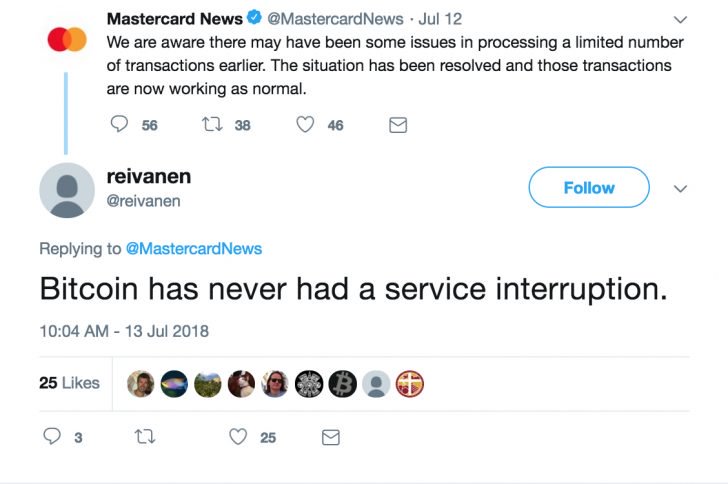
Mastercard had an outage, so crypto had a field day

Mastercard had an outage, so crypto had a field day

What could be considered an inevitable question was eventually posed: why isn’t Mastercard using bitcoin?

Mastercard had an outage, so crypto had a field day

To be sure, the payments firm has very publicly moved to explore and test applications of blockchain, even going so far as trying to hire more developers to work on the tech. And as CoinDesk has reported, Mastercard is seeking a number of patents around cryptocurrency use (including one it won this week) – a suggestion, if anything, that the idea is on its radar.

But even still, critics of the company argued amid the outage that Mastercard will face a “huge rival” from either bitcoin or another cryptocurrency.

Mastercard had an outage, so crypto had a field day

Supporters of specific cryptocurrencies also came out to heckle the payments giant, including supporters of XRP and the technology developed by distributed ledger startup Ripple, and those backing the cryptocurrency Dash (formerly known as darkcoin). 
Mastercard had an outage, so crypto had a field day

Mastercard had an outage, so crypto had a field day

But would the utilization of blockchain or cryptocurrency have prevented the situation Mastercard found itself in?

Journalist David Cox tackled the question in an article for PaymentsSource, arguing that existing blockchain tech would likely be infeasible for Mastercard’s present needs.

Mastercard had an outage, so crypto had a field day

Whether the technology as applied to Mastercard could have helped is perhaps an open question, but nonetheless, the situation was an opportunity for the crypto faithful to throw a little shade the company’s way.

Mastercard had an outage, so crypto had a field day

Image via Shutterstock

The leader in blockchain news, CoinDesk is a media outlet that strives for the highest journalistic standards and abides by a strict set of editorial policies. CoinDesk is an independent operating subsidiary of Digital Currency Group, which invests in cryptocurrencies and blockchain startups.

Published at Sun, 22 Jul 2018 11:40:56 +0000

Features

Previous Article

CyberMiles – Should you invest or not?

Next Article

Crypto the WonderDog Show

You might be interested in …

Crypto Featured for First Time in US Congress Economic Report

Altcoin Today Crypto Featured for First Time in US Congress Economic Report Crypto Featured for First Time in US Congress Economic Report A new report from Congress that dubbed 2017 “the Year of Cryptocurrencies” calls […]

Supercluster Funding Bid Could Supercharge Blockchain Development in Canada

Supercluster Funding Bid Could Supercharge Blockchain Technology in Canada

Four organizations in Canada’s blockchain tech sector are going all out this week to submit their application letter to the federal Ministry of Innovation, Science and Economic Development (ISED) before the July 21 deadline to be considered for funding under the government’s new Innovation Superclusters Initiative.

A representative for Innovation, Science and Economic Development Minister Navdeep Bains told bitcoin Magazine that “the Innovation Superclusters Initiative will invest nearly $1 billion to strengthen up to five of Canada’s most promising clusters,”  and confirmed that “federal contributions to selected superclusters will have to be matched with private sector investment for maximum impact.”

The Blockchain Research Institute (BRI), ColliderX, the Blockchain Association of Canada (BAC) and the Information and Communications Technology Council (ICTC) have teamed up to apply for some of the $950 million offered by the Canadian government for the best bids in future technologies that the government says will create “Silicon Valley-style hubs of industry key to future growth and jobs.”

ColliderX aims to accelerate core technical R&D at levels that will support innovation in Canada and position the sector as a tech leader overseas. BRI contributes the business-level use cases, setting the agenda for strategy leaders. BAC is a major advocacy organization, and ICTC is a long-time, established industry player, well known to high-tech businesses in Canada.

Blockchain Association of Canada: Call to Action

Kyle Kemper, Executive Director of the Blockchain Association of Canada, is working on the supercluster application letter of intent and told us the only thing they’re short of is time to get their application in to the ministry.

He pointed out that it is imperative that blockchain companies and organizations express their support for and commitment to the bid before the application deadline.

“This supercluster initiative is an opportunity to take blockchain technology mainstream and for Canada to take a lead role,” Kemper told bitcoin Magazine. “In the bid process we are receiving unanimous support from public, private, academic, philanthropic and non-profit organizations.”

If the group manages to secure $50 million in funding commitments from these organizations as part of a successful bid, the federal government will match the next $50 million for each supercluster. The commitments and matched funds will be spread over 5 years, according to the proposal.

Blockchain Research Institute: No Room for Complacency

Don Tapscott, Executive Director of the BRI, notes that many of the other bids like AI, machine learning, the Internet of Things and Quantum are all dependent on blockchain technology as a foundation.

“The blockchain supercluster proposal is late to the table in part because this extraordinary technology is just becoming mainstream,” Tapscott told bitcoin Magazine. “But it’s no less important than any of the others. In fact, it’s foundational to everything else.”

In a report called The Blockchain Corridor: Building an Innovation Economy in the 2nd Era of the Internet, Don and Alex Tapscott lay out a blueprint for a blockchain tech supercluster and Centre of Excellence in the already highly active “corridor” between Toronto and Waterloo, Ontario.

The report says:

“We cannot afford to be complacent, nor is time on our side. Canada’s leading position in the Blockchain Revolution could quickly evaporate as other hotbeds around the world, such as Berlin, Singapore, Shanghai, Tokyo, Sydney, London and New York (to say nothing of Silicon Valley) race ahead. The time to act is now.”

According to the report, the corridor could collectively generate around 170,000 new jobs and around $17 billion in GDP by the year 2025.

Tapscott added:

“Blockchain represents nothing less than the second era of the Internet. The first was based in Silicon Valley. As we show in the Blockchain Corridor Report, the second could be based in Canada.

“I’m convinced that we can find $50 million from the private sector for this initiative. So I sure hope that governments will ensure we have a seat at the table going forward to make our case.”

ColliderX: The Underdog Challenge

Bid partner ColliderX is a new non-profit social enterprise working to promote and develop R&D initiatives in the Canadian blockchain tech sector.

ColliderX founder and CEO Iliana Oris Valiente notes that the four bid partner organizations complement each other to create a dynamic supercluster.

“Being considered by ISED to move on to the next stage of the selection process will be a win for the blockchain industry as it will signal Canada’s support of this ecosystem,” Valiente said to bitcoin Magazine.

“We’re certainly the underdog in this scenario but are promoting a truly new industry, rather than continued investments in areas that are already more established.”

Information and Communications Technology Council

ICTC is an established industry player that brings a wealth of experience in economic development activities and will be involved in bridging the gap between the blockchain industry and a wider segment of the business and political community.

Namir Anani, President & CEO of ICTC, believes that competition to win supercluster funding will be tough but notes that small- and medium-sized entreprises (like most blockchain startups) represent the large majority of Canada’s competitive businesses.

Anani says they will make the point that blockchain technology is a cross-industry enabler and a key catalyst for heightening small business growth and competitiveness in Canada.

Anani told bitcoin Magazine:

“The global blockchain market is growing at a staggering CAGR [Compound Annual Growth Rate] of 58.7 percent, according to Transparency Market Research. Capitalizing on this fast growth market is key for Canada’s economy and employment potential going forward.

“As Canada continues to expand its trade agreements in an increasingly global market, such as with the newly ratified Canada-European Union Comprehensive Economic and Trade Agreements (CETA), blockchain is a pivotal trade enabler for fast-tracking Canada’s place in the global economy.”

Making the Deadline

Valiente is confident that crowdfunding will bring in the needed amounts. To date, she has raised $2 million in pledges on behalf of ColliderX, which will be rolled into the supercluster. 

Anani is also confident the private sector will come forward and is passionate about selling the supercluster bid.

“Blockchain has the potential of reshaping all aspects of the global economy in the next number of years, building Canada’s comparative advantage in this space is paramount going forward. The Blockchain Supercluster is a powerful pan-Canadian collaboration that will unleash cross-industry innovations, new economic opportunities and employment prospects for Canadians.”

Kemper reiterated the need for industry support in order for the initiative to succeed. “I urge all organizations that support Blockchain technology and organizations looking to better understand the potential to go to blockchainsc.ca, fill out a letter of commitment and share this news to rally more people to the cause by 12:00 EST on Friday, July 21.”

Thus far, C4 and the Institute on Governance are among those supporting the bid as sponsors.

The group has until December 31, 2017, to raise the remaining supercluster-specific private-sector funding.

The post Supercluster Funding Bid Could Supercharge Blockchain Development in Canada appeared first on Bitcoin Magazine.