January 26, 2026

Capitalizations Index – B ∞/21M

Market Update and Ripple XRP Price Analysis: February 25, 2019

Market update and ripple xrp price analysis: february 25, 2019

Market Update and Ripple XRP Price Analysis: February 25, 2019

The total crypto market cap is down $5 billion since, February 22 and now stands at $129 billion in the early trading hours of February 25. bitcoin is trading at $3,780 while ether fell to $138.

bitcoin successfully broke above its 2019 high at $4,169 on February 23 and was chasing $4,320 and $4,400 on its long way up to $6,000.The trading session on February 24, however, was catastrophic for bulls as the most popular cryptocurrency lost nine percent in a sudden drop.

Ether made an almost identical move to hold above this year’s peak at $161 and was eyeing $175 in a run towards $200. It declined by 16 percent on February 24, however, erasing all the gains from the previous six days.

XRP/USD

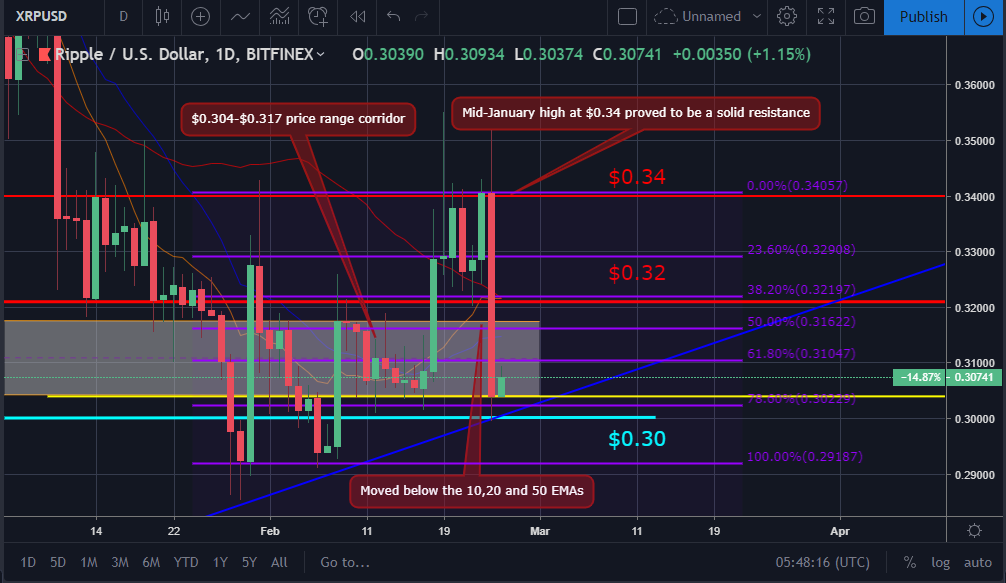
The Ripple company token XRP could not close above the mid-January high at $0.34 and made a slight correction to $0.326 on February 21. The 3.2 percent drop was the first red candle on the Bitfinex daily chart since February 16 when XRP/USD was at $0.305.

Trading volumes have been slowly declining after they reached a 60-day high at $1.33 billion on February 20. On February 22, the pair was trading as low as $0.32 during the day session, but bulls were able to turn the tide and close in green, at $0.328.

The Malta-based cryptocurrency exchange OKEx has reportedly listed XRP and bitcoin Cash (BCH) to its Customer-To-Customer platform. The decentralized arbitration system allows users to buy and sell digital assets directly in the form of Virtual Financial Assets, much like the peer-to-peer model, without transaction fees.

One of the largest exchange in terms of trading volume, launched the platform two months ago offering bitcoin, Tether, ether and litecoin, which users can exchange for five supported fiat currencies: British Pound (GBP), Chinese Renminbi (CNY), Vietnamese Dong (VND), Russian Ruble (RUB) and Thai Baht (THB).

Eurex, one of the world’s leading derivatives exchanges, is considering the launch of a cryptocurrency futures exchange.

The Germany-based platform will most likely add futures contracts tied to bitcoin, ether, and XRP as per local media Wirtschaftswoche. Eurex is a public company wholly owned by the German stock exchange operator Deutsche Börse AG, which has been looking for a way to introduce crypto-related products for more than a year.

As per company representatives, the exchange operator is “thinking about futures, with which private investors and institutional investors can protect existing investments in bitcoin or set for falling prices of the cyber currency.”

Earlier this month, the country’s second-largest stock exchange, Boerse Stuttgart, announced it would launch a new crypto trading app, called BISON.

The weekend of February 23 to 24 started with a 3.6 percent jump on February 23, to $0.34, right above the Fibonacci 50 percent and the earlier mentioned mid-January high.

The XRP coin lost ten percent of its value on February 24 as all the top cryptocurrencies experienced significant price corrections. It was almost flat for the seven-day period.
Xrp market movement chart

Like BTCMANAGER? Send us a tip!
Our bitcoin Address: 3AbQrAyRsdM5NX5BQh8qWYePEpGjCYLCy4

Published at Mon, 25 Feb 2019 11:00:46 +0000
Previous Article

Bitcoin’s Uptrend At Short-Term Risk After High-Volume Price Dump

Next Article

Flash 1-Hour Crash: Except Bitcoin other coins like Ethereum, Litecoin, EOS, Bitcoin Cash see double digit drop

You might be interested in …

Bitcoins future

Bitcoins future [unable to retrieve full-text content] Dont forget to subscribe Published at Sat, 13 Apr 2019 22:21:01 +0000

Bitcoin Lightning Network Is Coming: Test a Transaction Now

Although bitcoin has managed to gain credibility and legitimacy in the financial world, skyrocketing transaction fees and long transaction times are becoming an increasingly severe handicap. The good news is that developers are making progress towards the bitcoin Lightning Network (LN) implementation. LN promises to reduce bitcoin’s transaction fees dramatically, and achieve near-instant transactions. You can test a bitcoin LN transaction right now.


Lightning Network Promises to Reduce Transaction Costs and Confirmation Delays

bitcoin users are unhappy about the high costs of transaction fees. bitcoin average transaction fees have spectacularly surged from about $0.69 USD in January 2017, to over $28 USD on December 18, as shown in the chart below. BitInfoCharts provide this chart.

Lightning Network Promises to Reduce Transaction Costs and Confirmation Delays

Moreover, the bitcoin network traffic has become clogged due to the rising demand for transactions per block. As a result, confirming bitcoin transactions is taking an extremely long time. Bitpay explains:

Block sizes are limited, so this means that transactions which exceed the capacity for a block get stuck in a queue for confirmation by bitcoin miners. This queue of unconfirmed transactions is called the bitcoin mempool.

Now, bitcoin enthusiasts and cryptocurrency experts are centering their hopes on the LN approach to reduce transactions fees and long time-delays.

Solving bitcoin Scalability Problem

Solving Bitcoin Scalability Problem

The bitcoin Lightning Network is essentially a decentralized system where users can set up trustless micropayment channels to conduct one or multiple payment transactions off-blockchain.

These channels reside outside the bitcoin blockchain. However, once the payment channel is closed, the transactions that occurred between the channels are then broadcast, as a single transaction, to the main blockchain network. Thus, no matter the number of micro-transactions conducted, the blockchain is accessed only twice, when the channel is opened and when the channel is closed. Obviously, this approach would significantly reduce the load on the blockchain.

Presently, three teams are independently working on the LN implementation: ACINQ, Blockstream, and Lightning Labs. In early December 2017, they announced that their respective systems had completed payment tests on the main bitcoin network. Moreover, these tests achieved interoperability across all three implantations.

Right now, to educate potential LN users, the website https://htlc.me/ allows you try a testnet bitcoin LN transaction. Reddit user Nabugu provides the details of the test here.

As demand for bitcoin continues to grow, transaction costs and time delays are bound to get worse. However, many bitcoin enthusiasts and experts are excited about LN. For example, Ryan Radloff, co-founder, and principal at CoinShares, explicitly told CNBC that LN was the solution, adding:

[LN] is a technological implementation that, later this year, is going to solve this [problem], and we’re very excited about that.

What do you think would be the impact on the cryptocurrency ecosystem when bitcoin Lightning Network starts allowing users to make cheap micropayments at near-instant speed? Let us know in the comments below.


Images courtesy of AdobeStock, ACINQ, BitInfoCharts

The post Bitcoin Lightning Network Is Coming: Test a Transaction Now appeared first on Bitcoinist.com.