October 9, 2026

Capitalizations Index – B ∞/21M

Manufacturer Holds Cryptonight ASIC Firesale after Monero Hard Forks

Manufacturer holds cryptonight asic firesale after monero hard forks

Manufacturer Holds Cryptonight ASIC Firesale after Monero Hard Forks

Bitcoin price sell off
Advertisement

Join our community of 10 000 traders on Hacked.com for just $39 per month.

Mining hardware manufacturers have begun selling Cryptonight ASIC miners for next to nothing after privacy-centric cryptocurrency Monero carried out its threat to adopt a hard fork to maintain ASIC resistance.

Last week, Monero activated its semi-annual hard fork, an update that included an alteration to its instance of the Cryptonight Proof-of-Work (PoW) consensus algorithm.

This particular update had one purpose: ensure that no currently-existent Application Specific Integrated Circuit (ASIC) miners are compatible with the Monero network.

The hard fork came weeks after Bitmain — the dominant ASIC manufacturer and a subject of scorn among many cryptocurrency communities — unveiled the Antminer X3, its first Cryptonight ASIC miner.

At least one other manufacturer — lesser-known company Baikal Miners — claimed to have developed a Cryptonight ASIC, an announcement it made several days before Bitmain went public with the much more powerful Antminer X3.

Though vastly more efficient than GPU-based miners, ASICs have a critical vulnerability — they cannot currently be reprogrammed. Consequently, fundamental changes to a PoW algorithm can “brick” them permanently.

While the devices are still compatible with other Cryptonight coins, there is little consumer demand to mine an algorithm headlined by Electroneum, Bytecoin, and Sumokoin.

Consequently, Bitmain and Baikal are sitting on piles of now nearly-worthless devices, and while Bitmain can likely stomach the losses due to its reported $4 billion in profits last year, Baikal may have bitten off more than it can chew.

To wit, the Hong Kong-based firm is now offering a five-for-one deal on its Cryptonight ASICs in a bid to recoup something — anything — from the funds it poured into researching, development, and manufacturing for the nascent product.

Meanwhile, at least five different projects claim that they will continue to develop the old Monero blockchain, including two named “Monero Classic” and one that has been promoted by Bitmain’s official Twitter account.

Monero is not the only major cryptocurrency that has considered using a hard fork to maintain ASIC resistance. Ethereum, the second-largest cryptocurrency, recently began this debate in response to Bitmain’s announcement that it had developed an Ethash ASIC miner. While the fork appears wildly popular among users, developers have thus far been hesitant to pursue the potentially “chaotic” course.

Featured image from Shutterstock.

Follow us on Telegram.
Advertisement

Published at Mon, 09 Apr 2018 20:08:40 +0000

Altcoin Mining

Previous Article

UFO Coin (UFO) Price Alert, Chart & News on BitScreener.com

Next Article

Police Officers Charged in $1.3 Million Bitcoin Extortion Scheme

You might be interested in …

6 weeks intense Pensacola blockchain development bootcamp for beginners – ethereum blockchain developer training for beginners, how to develop ethereum blockchain application, smart contract, solidity programming, DAaps

6 weeks intense Pensacola blockchain development bootcamp for beginners – ethereum blockchain developer training for beginners, how to develop ethereum blockchain application, smart contract, solidity programming, DAaps This is the most comprehensive blockchain course for […]

Chinese Bitcoin Exchanges Will Now Require Video Verification

Chinese bitcoin exchanges are gearing up to resume cryptocurrency withdrawals following the implementation of a video verification procedure.


Know-Your Customer via Video

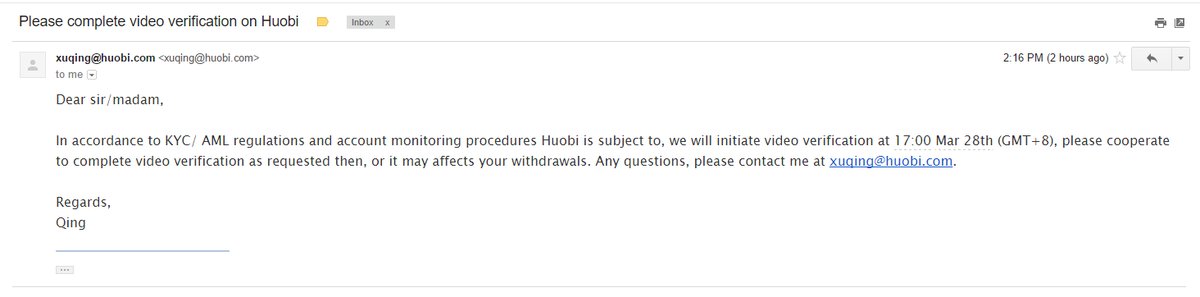
Following the emails in which Chinese exchanges detailed the information required from clients in order to process their withdrawals, users are now receiving emails announcing video identity verification in accordance with the latest KYC/AML procedures imposed by the People’s Bank of China (PoBC).

The email reads:

In accordance to KYC / AML regulations and account monitoring procedures Huobi is subject to, we will initiate video verification at 17:00 Mar 28th (GMT +8), please cooperate to complete video verification as requested then, or it may affect your withdrawals.

bitcoinist_videoconfimation_cny_exchange

Namely, two of the so-called “Big Three” exchanges Huobi and OKCoin have started implementing video verification.

//platform.twitter.com/widgets.js

Recently, the PBoC proposed a draft that exchanges in the country considered acceptable except for one: on-site verification prior to opening an account, a practice that is common to traditional banks but not to bitcoin exchanges.

However, the latest move by the exchanges suggests that on-site verifications will not be implemented, at least for the time being. It also means that if the PBoC and exchanges have finally reached an agreement on AML (Anti-Money Laundering) procedures, cryptocurrency withdrawals should resume very soon. 

Chinese bitcoin Exchanges Now Heavily Regulated

The return of cryptocurrency withdrawals should help exchanges regain some of the customers that have been flocking towards peer-to-peer alternatives in recent months. However, with the removal of margin trading and zero fees, it’s unlikely that the Chinese market will regain its 90%+ share of the global bitcoin trading market.

Exchange operators will require users to provide their personal information along with explanations of the sources of the funds to be withdrawn and their intended withdrawal destinations.

Now, with the addition of video confirmation, China has become one of the most heavily-regulated countries for bitcoin exchanges.

China Withdrawals

While some traders may feel drawn to the clarity these regulations provide, others may choose to stick with p2p alternatives like LocalBitcoin and BitKan who offer greater privacy and which have experienced record trading volumes since the PBoC clampdown.

In the long-run, the regulations imposed on exchanges may make for a healthier, more decentralized bitcoin market and help boost bitcoin’s overall reputation within the country.

Furthermore, the introduction of clear rules and guidelines may make way for alternative cryptocurrencies to be added on these exchanges that have, so far, only dealt with bitcoin and Litecoin. 

//platform.twitter.com/widgets.js

Can Chinese exchanges recover from the blow dealt by the PBoC and return to their old selves? Will they add new cryptocurrencies? Let us know what you think in the comment section.


Images courtesy of Shutterstock, Twitter

The post Chinese Bitcoin Exchanges Will Now Require Video Verification appeared first on Bitcoinist.com.