January 26, 2026

Capitalizations Index – B ∞/21M

Malta: Does Europe’s ‘Blockchain Island’ Really Live up to the Hype?

Malta: does europe’s ‘blockchain island’ really live up to the hype?

Malta: Does Europe’s ‘Blockchain Island’ Really Live up to the Hype?


Malta blockchain island
Advertisement


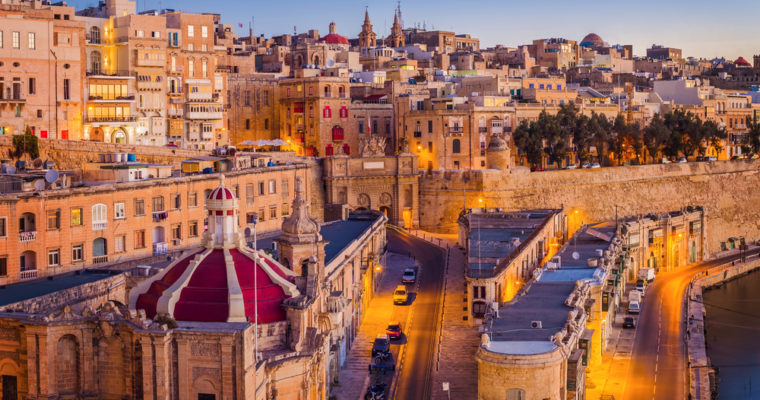
Malta. The Blockchain Island. A postage-stamp-sized nation nestled in the Mediterranean famous for its rocky coastline, Baroque cathedrals, Megalithic temples, and centuries of culture. It’s a veritable mishmash of graying British expats, luxurious hotels, exotic women, cars that drive on the left, and a host of other legacies left by the various civilizations that invaded the rock over the years.

In more recent times, however, Malta has become famous for more than its rich heritage. It’s made a welcoming home for the iGaming sector (a booming industry worth around $1.4 billion — 12 percent of Malta’s GDP).

In the face of a long and drawn-out European crisis and deficits year after year, Malta was finally able to register a surplus of €182 million for 2017 — its second year in a row.

And the country is being talked about in blockchain regulatory circles for its progressive stance on cryptocurrency, even rebranding as “The Blockchain Island.”

Its government is open-minded, and its Prime Minister Joseph Muscat gave a compelling speech to the United Nations about how countries should work together to solve the world’s problems.

However, Malta has a few problems of its own — and a less-than-impeccable past when it comes to some very sticky issues, money laundering among them.

Malta the Blockchain Island

On the surface, Malta looks to be a pioneer in the cryptocurrency regulation space. On July 4, 2018, it became the first and only country to officially pass three new crypto bills into law.

This established a regulatory framework for cryptocurrencies, blockchain, and DLT in general. 2018 was also the first year that the country held its long-anticipated Malta Blockchain Summit.

When asked about the significance of this for Malta and the crypto community in general, Steve Tendon, blockchain strategist and member of Malta’s National Blockchain Task Force said:

“It will be the first event ever where Malta’s intention to recognize “Legal Personality” to the innovative technology arrangements (like DAOs) will be presented to a broad international audience. This is an innovation in lawmaking that will support innovation like no other law has ever done.”

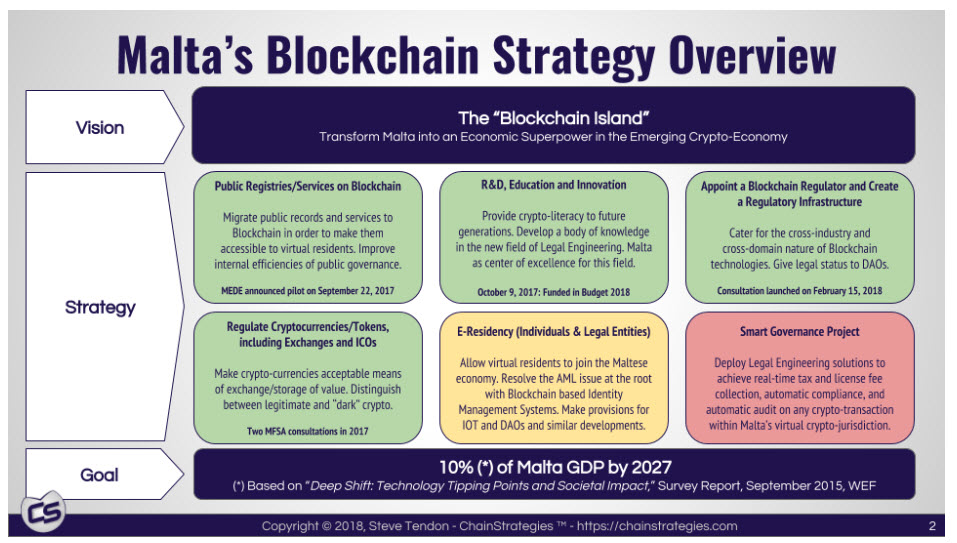
Malta didn’t just pass three laws as the headlines tend to focus on, they have a whole National Blockchain Strategy penned by Tendon, with six pillars that show a deep understanding of the technology and where it’s going. It covers initiatives like moving public registries to the blockchain, e-residency and digital identity, and smart governance.
Blockchain strategy

Said Tendon:

“This will undoubtedly attract all the developers and entrepreneurs who are working on decentralized technologies of all kinds, such as new generation of blockchains, decentralized exchanges, decentralized ICO platforms, decentralized banking services, and so on.”

You can see clearly that this is just the beginning. Malta is not just aiming to lead the way in regulating ICOs but showing governments the need to understand rather than fear the technology. At the same time, the country is positioning itself as open for business among a sea of tightly-shut doors.

Attracting Major Crypto Businesses

This forward-thinking regulatory stance has already inspired an influx of blockchain companies to its shores, most notably Binance and a litany of other crypto exchanges.

It’s not that Malta is easy on crypto companies — according to Tendon, its KYC requirements are among the toughest out there — but at least it provides companies with a stable environment in which to operate, one in which their business isn’t at risk of being shut down from one day to the next, their token declared a security, or their government known for its hostility to crypto.

Malta’s progress is undeniable. I was recently at the Summit that attracted some 8,500 delegates. The place was packed at the seams and momentum sky-high.

Muscat gave a speech. Sophia the robot was there, even John McAfee delivered a keynote commending Malta’s stance…and then pretty much concluding that governments had no place regulating crypto at all.

John mcafee crypto
John McAfee at Malta Blockchain Summit

But it’s one thing laying the foundations for a new future. It’s another if you’re still scrambling to cover up your past.

The Money Laundering Issue and Lack of Crypto Banks

There is certainly positive rhetoric, a buzzing atmosphere, real legislation, and the promise that Malta will see crypto-friendly banks in 2019. But legacy banks are still not coming around. Their standards are higher, along with the fear of being slapped with a massive fine for being too lax on their AML policies. Just ask Deutsche Bank if you want confirmation of that.

While Binance is working on the first decentralized bank in the world, crypto businesses may have to wait a bit longer. And if they think that Malta is their meal ticket to a safe haven, they may also need to dig a little deeper.

Malta has a history of working with less-than-desirable individuals. It seems that beyond gaming, innovation, and technology, the country’s name is also somewhat synonymous with money laundering.

Malta has been mentioned in a number of cases including that of Matthias Krull, a German banker working for the Swiss private bank Julius Baer, who admitted to laundering money for “Los Chamos,” thought to be connected with Venezuela’s President Nicolas Maduro.

There’s also the tragic assassination of Maltese journalist Daphne Caruana Galizia who, before she died, had accused the Pilatus Bank of Malta of laundering money. This thrust Malta into the global spotlight over freedom and safety of the press and the Pilatus Bank under the microscope of the European Central Bank (ECB).

Caruana Galizia had also accused the bank of making suspicious payments to senior Maltese and Azerbaijani figures. The bank had its accounts frozen in March and was eventually shut down by the Maltese FSA later in the year.

Then there’s the issue that the EU is currently furious with Malta over Muscat’s latest public blunder. According to Bloomberg:

“The union’s least-populous member nation has become a cryptocurrency and online gambling hub plagued by allegations of corruption and money laundering. And it’s selling passports.”

While the country was on a high after announcing its second year turning in a profit, Muscat announced that the government would donate €5 million to a cancer charity. This turned out to be a move welcomed by no one after it emerged that the donation would come from a fund that sells Maltese passports to foreigners for €650,000 apiece.

Once again, the whole touchy subject of Malta’s tenuous relations with undesirable individuals reared its ugly head, calling Maltese AML practices into question and rekindling the flame on the aforementioned issues.

So is Malta, the Blockchain Island, More than Just Hype?

Clearly, Malta’s presence on the global money laundering stage is a fairly large and potentially concerning one.

Some governments, according to Bloomberg, even argue that Malta could pose:

“a serious threat to global efforts to track money laundering, enforce economic sanctions, and maintain fair transnational standards.”

There’s also the fact that many banks will not work with crypto companies yet and some businesses may not want to associate themselves with Malta and its sketchy past (or should we say present?).

But then again, there’s no denying the progress being made. Malta’s new regulator, the Malta Digital Innovation Authority, is about more than just blockchain or Bitcoin. It’s about innovation itself and other emerging technologies, positioning the country as advanced and open to a world of possibilities.

Blockchain takes a beating from all sides for failure to attract the masses, for not being simple enough to use, and for being unregulated and unsafe. So, it’s encouraging to see countries diving into the depths, displaying a deep understanding, and welcoming crypto to its shores — even if it is a little lenient on who it does business with.

Disclaimer: The views expressed in the article are solely those of the author and do not represent those of, nor should they be attributed to, CCN.

Featured Image from Shutterstock

Get Exclusive Crypto Analysis by Professional Traders and Investors on Hacked.com. Sign up now and get the first month for free. Click here.

Advertisement


Published at Sun, 25 Nov 2018 21:50:50 +0000

Previous Article

How To Start a Blog And Make Money Online – Webinar – Stuttgart

Next Article

How to Mine Ethereum (ETH) – Step by Step Guide

You might be interested in …

Telegram’s Privacy-Focused User Base Could Become TON Blockchain’s Killer App

Telegram ton

In December 2017, an interesting rumor surfaced: According to “sources familiar with the matter,” the messaging app Telegram, very popular among crypto-enthusiasts for its strong encryption and privacy features, would launch its own blockchain platform and cryptocurrency.

On January 8, 2018, TechCrunch reported that several unnamed sources had confirmed the news and quoted a secret Telegram white paper. According to TechCrunch, “the potential for a cryptocurrency inside a widely adopted messaging app is enormous.”

Of course, a leaked executive summary of the white paper is now available. The document has been shared by Cryptovest, and its authenticity has been independently confirmed by TNW. The 23-page executive summary often refers to an unreleased technical white paper which, according to TechCrunch, has 132 pages.

“This paper outlines a vision for a new cryptocurrency and an ecosystem capable of meeting the

needs of hundreds of millions of consumers, including 200 million Telegram users,” reads the white paper. “Launching in 2018, this cryptocurrency will be based on a multi-blockchain proof-of-stake system — TON (Telegram Open Network, after 2021 The Open Network) — designed to host a new generation of cryptocurrencies and decentralized applications.”

Scaling and Adoption

According to Telegram, while cryptocurrencies and other blockchain-based technologies have the potential to make the world more secure and self-governed, no consensus-backed currency has been able to appeal to the mass market and reach mainstream adoption. Despite the utility of bitcoin and Ethereum, “there is no current standard cryptocurrency used for the regular exchange of value in the daily lives of ordinary people.” This is what the TON project wants to change. According to Telegram, the world needs an electronic “decentralized counterpart to everyday money — a truly mass-market cryptocurrency.”

Scaling transaction throughput to the tens of thousands of transactions per second supported by major credit card networks such as Visa and Mastercard is an important requirement for a mass-market cryptocurrency. While bitcoin and Ethereum developers are working toward achieving higher throughput, the Telegram white paper notes that bitcoin and Ethereum are currently limited to a maximum of only seven transactions per second for bitcoin and 15 transactions per second for Ethereum, resulting in insufficient speeds and higher transaction costs. The white paper does not seem to take second-layer protocols into account, however.

Existing cryptocurrencies face other roadblocks as well, according to Telegram. For example, they are still too complicated for average merchants and consumers, the demand for crypto-assets comes mainly from investors rather than consumers, and there’s no critical mass for the ecosystem to grow and “eventually become adopted by hundreds of millions of users.”

“Telegram will use its expertise in encrypted distributed data storage to create TON, a fast and

inherently scalable multi-blockchain architecture,” states the white paper. “TON can be regarded as a decentralized supercomputer and value transfer system. By combining minimum transaction time with maximum security, TON can become a VISA/Mastercard alternative for the new decentralized economy.”

The Tech Specs

The TON blockchain will consist of a master chain and (eventually) a huge number (2**92) of accompanying blockchains (shards) that can dynamically split and merge to accommodate changes in load and achieve optimal throughput. TON will use a proof-of-stake approach based on a variant of the Byzantine Fault Tolerant protocol and instant hypercube routing to partition the workload among shards. Network protocols for storage, TOR-like privacy and micropayments will be released after the TON blockchain core.

Of course, TON will be fully integrated in the Telegram messaging network. According to the white paper, this will permit leveraging Telegram’s massive user base and developed ecosystem to provide a clear path to cryptocurrencies for millions of people, with light wallets implemented in Telegram applications. The white paper notes that 84 percent of blockchain-based projects have an active Telegram community, more than all other chat applications combined, which makes Telegram the “cryptocurrency world’s preferred messaging app.”

According to the roadmap in the white paper, a Minimal Viable Test Network for TON will be launched in Q2 2018. Then, after a testing phase and a security audit, a stable version of TON and a Telegram wallet will be deployed in Q4 2018.

Funding with Grams

The TON coins will be called Grams. To fund TON, Telegram will launch a token sale in Q1 2018. Initially, 44 percent of the total supply (2.2 billion) of Grams will be sold at a price that will start at $0.10 per Gram and gradually increase, with each Gram priced one billionth higher than the previous one, reaching $1 per Gram once 2.2 billion tokens have been sold. Based on these projections, it seems that Telegram’s token sale could easily become the biggest in history.

Of the total supply of Grams, 52 percent will be retained by the TON Reserve “to protect the nascent cryptocurrency from speculative trading and to maintain flexibility at the early stages of the evolution of the system,” and the remaining 4 percent will be reserved for the development team.

According to current plans, the token sale will use a Simple Agreement for Future Tokens (SAFT), to be converted 1:1 to native TON Grams after the deployment of the TON Blockchain.

Telegram wants to serve as a launch pad for TON, but it plans eventually to transfer ownership and governance of the TON system to a non-profit TON Foundation. “By 2021, the initial TON vision and architecture will have been implemented and deployed,” states the white paper. “TON will then let go of the ‘Telegram’ element in its name and become ‘The Open Network.’ From then on, the continuous evolution of the TON Blockchain will be maintained by the TON Foundation.”

The TON Killer App: A Privacy-Focused User Base

TON’s killer app is Telegram’s ability to leverage the enthusiasm of millions of cryptocurrency fans among the app’s 200 million users. At the same time, however, it’s worth noting that the greater population doesn’t really care much about encryption or cryptocurrencies. Many other messaging apps, such as Facebook’s Messenger and Whatsapp, are much more popular than Telegram.

Telegram is independent, self-funded and privacy-focused. The popularity of Telegram among cryptocurrency enthusiasts can be explained by the fact that the messaging app was founded “by libertarians to preserve freedom through encryption.” These features make it more attractive than other platforms, like Messenger or Whatsapp, to users who feel strongly about privacy protection.

It’s then interesting to speculate about possible moves of Facebook toward developing a cryptocurrency integrated with its social network and messaging platform.

In a recent post, Facebook co-founder and CEO Mark Zuckerberg notes that, contrary to the once widespread belief that technology could be a decentralizing force that puts more power in people’s hands, it now appears that technology’s net effect is that of centralizing power in the hands of large corporations and governments.

“There are important counter-trends to this — like encryption and cryptocurrency — that take power from centralized systems and put it back into people’s hands,” says Zuckerberg. “But they come with the risk of being harder to control. I’m interested to go deeper and study the positive and negative aspects of these technologies and how best to use them in our services.”

In as speech by FBI Director Christopher Wray on January 9, 2018, to the International Conference on Cyber Security, he highlighted his concerns over encryption, pointing out that last year, 7,800 devices were rendered inaccessible to law enforcement.

“This problem impacts our investigations across the board — human trafficking, counterterrorism, counterintelligence, gangs, organized crime, child exploitation and cyber,” he stated.

He called on the private sector to find ways that would allow them to “respond to lawfully issued court orders, in a way that is consistent with both the rule of law and strong cybersecurity.” It is these sorts of access measures that Zuckerberg will probably be considering.

While it doesn’t seem plausible that Facebook could become a staunch champion of privacy like Telegram, it will definitely be interesting to watch Facebook’s moves in the cryptocurrency space.

The post Telegram’s Privacy-Focused User Base Could Become TON Blockchain’s Killer App appeared first on Bitcoin Magazine.

An Informal Deep Dive – Medium

Crypto New Media An Informal Deep Dive – Medium Crypto New Media Press Now that we have set up the basics of how blockchains work (The Basics) and outlined the main foundation of distributed computing […]