
May 7, 2026

Capitalizations Index – B ∞/21M

Mainstream: $7.2 Trillion Asset Manager Fidelity Will Help Customers Invest in Bitcoin

Mainstream: $7. 2 trillion asset manager fidelity will help customers invest in bitcoin

Mainstream: $7.2 Trillion Asset Manager Fidelity Will Help Customers Invest in Bitcoin


Fidelity bitcoin cryptocurrency
Advertisement

One of the biggest names in financial services wants to help institutional investors add bitcoin and other cryptocurrency assets to their multi-billion dollar portfolios.

Citing proven institutional demand for cryptocurrency products, Fidelity Investments, the fifth-largest asset manager in the world with 27 million clients and $7.2 trillion in customer assets, has announced that it will launch a separate company to provide cryptocurrency custody and trade execution services for institutions.

Dubbed Fidelity Digital Asset Services, CNBC reports that the company will serve as a bridge between institutional investors and the heretofore retail-focused cryptocurrency industry, which has lately sought to roll out the red carpet for institutions.

“Our goal is to make digitally-native assets, such as bitcoin, more accessible to investors,” Fidelity Investments Chairman and CEO Abigail Johnson said in a press release. “We expect to continue investing and experimenting, over the long-term, with ways to make this emerging asset class easier for our clients to understand and use.”

The new venture will be led by Tom Jessop, who, according to his LinkedIn profile, spent 17 years at Goldman Sachs before joining blockchain startup Chain as president in 2017 and then Fidelity in 2018 as head of corporate business development.

“We saw that there were certain things institutions needed that only a firm like Fidelity could provide,” Jessop told CNBC. “We’ve got some technology that we’ve repurposed from other parts of Fidelity — we can leverage all of the resources of a big organization.”
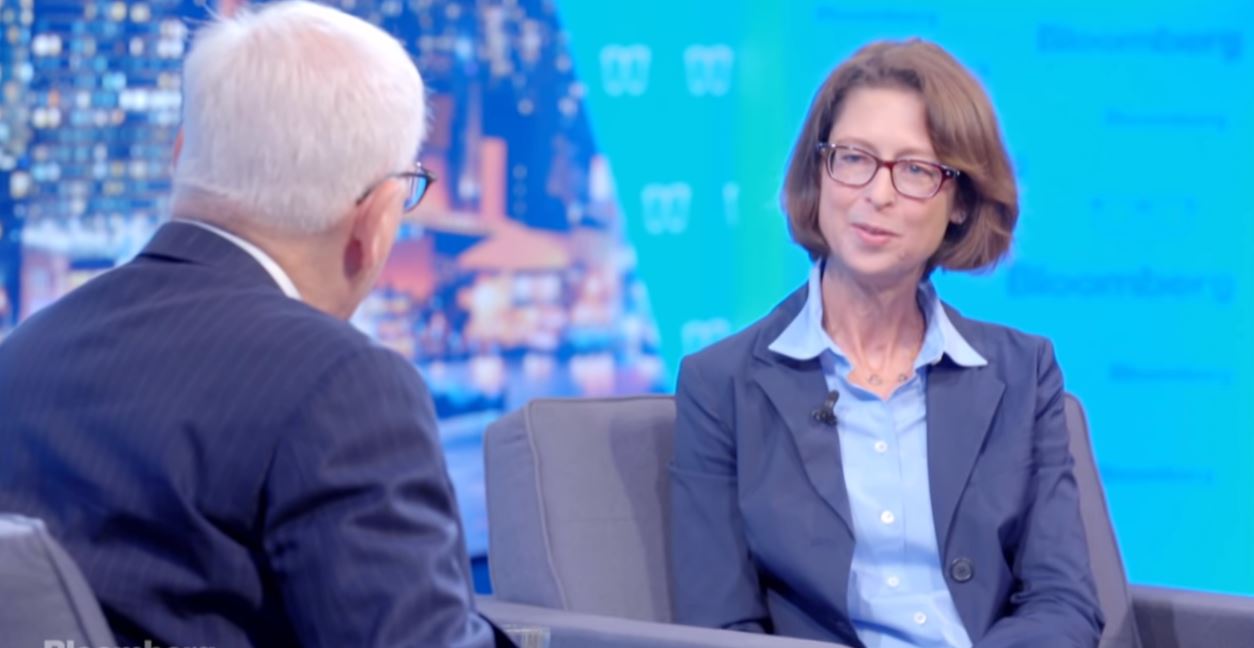
Abigail johnson fidelity
Fidelity CEO Abigail Jonson | Source: Bloomberg/YouTube

CCN reported earlier this year that Fidelity appeared to be building a cryptocurrency exchange, as the firm had advertised internally for developers to help build a “Digital Asset exchange.” Departing from the public comments of many CEOs in the mainstream financial industry, Abigail Johnson not only attended a cryptocurrency conference last year but also told the audience that she was a “believer” in the technology.

That open stance has enabled Fidelity to position itself as a potential leader in the burgeoning cryptocurrency market, which has reportedly begun to attract major university endowments such as Harvard and Yale.

“You might look at the crypto world and say ‘wow is this a new thing’ but we’ve been managing key materials for a long time,” Jessop continued in the CNBC interview. “We took our learnings in how to run enterprise security, then through our exploration of bitcoin and some of the people we’ve hired, quickly developed some of the crypto native expertise and federated the two those things.”

Fidelity joins a growing list of legacy financial giants who have seen enough potential in the cryptocurrency space to justify investing in the resources to produce products tailored for this nascent marketplace. Intercontinental Exchange (ICE), Goldman Sachs, Citigroup, and Morgan Stanley are just a few of the names that plan to roll-out digital asset services within the near future.

Of course, the 2018 bear market may have dampened enthusiasm in some boardrooms. Barclays, as CCN reported this morning, is said to have quietly placed its cryptocurrency trading desk project “on ice,” while Goldman Sachs shelved its trading desk plans to prioritize a cryptoasset custody service.

Fidelity, though, has not been dissuaded by the massive drop in prices that has occurred over the past 10 months.

“No one said when some of these early stage Internet companies in 2000 were going out of business ‘gee the Internet is toast’,” Jessop concluded. “We don’t focus too much on the price. It’s a foundational technology — people are trying to get exposure to the trend, and expect volatility in the assets themselves.”

Featured Image from Shutterstock

Follow us on Telegram or subscribe to our newsletter here.
Join CCN’s crypto community for $9.99 per month, click here.
Want exclusive analysis and crypto insights from Hacked.com? Click here.
Open Positions at CCN: Full Time and Part Time Journalists Wanted.

Advertisement


Published at Mon, 15 Oct 2018 18:02:48 +0000

Previous Article

Bitcoin Payment Processor BitPay Launches Stablecoin Settlement [Tether’s Not Invited]

Next Article

Bitcoin Price Intraday Analysis: BTC/USD Goes Haywire as USDT Declines

You might be interested in …

Lambda Protocol: Decentralizing Access to Decentralized Applications

Lambda Protocol: Decentralizing Access to Decentralized Applications

The Lambda Protocol has announced a decentralized, open-source solution for unrestricted access to decentralized applications (DApps). Utilizing the Lambda Protocol, DApp developers can leverage existing browsers such as Chrome or Safari to open up their applications to millions of devices currently being used. The Lambda Protocol plans to launch with support for both the Ethereum and bitcoin blockchains, adding support for permissioned blockchains such as Hyperledger Fabric in the future.

The Lambda Protocol team, based in Singapore and Australia, is headed by CEO Taiyang Zhang. Team mentors include Santiment COO Dorjee Sun, KyberNetwork CEO Loi Luu and Liquidity.Network co-founder Arthur Gervais.

In an interview with bitcoin Magazine, Zhang explained that there are two main problems when it comes to DApps: centralized access points and lack of interoperability between browsers and wallets.

Currently, most browsers for the decentralized web are centralized. For example, Google Chrome extensions and iOS applications allow users to access and interact with DApps on the Ethereum Network. These DApp browsers are controlled by private corporations, and they all share a common weakness: a single point of failure. They can easily be removed at a corporation’s discretion, no questions asked.

Zhang compared this single point of failure to a hypothetical in which a portal to search the entire web is hosted on a single website.

All it takes is for an ISP/Government to block one website, which defeats a core premise of decentralization.

All decentralized applications require a cryptocurrency wallet to function. Because of this restrictive prerequisite, desktop users must either integrate a wallet into a browser such as Chrome or Firefox by installing an add-on or create a new wallet by installing a new browser.

Users seeking to access DApps on mobile devices face greater limitations. Native iOS and Android apps do not support third-party browser/extension embedding, and popular mobile web browsers such as Chrome and Safari do not support add-ons.

The Lambda Protocol

The Lambda Protocol is an open-source internet protocol. “Our goal is to allow users to access the decentralized applications of the future in the browsers of today,” said Zhang.

To facilitate this access to DApps, the Lambda Protocol plans to develop a decentralized messaging layer. This messaging layer has the capability to connect browsers such as Chrome and Safari to cryptocurrency wallets such as Ledger Nano S, Trezor, imToken and Jaxx. By utilizing the Lambda Protocol, DApp developers can open their applications to the millions of devices and applications that users currently use.

Conversely, users can connect to DApps via the Lambda decentralized protocol. For example, users can trade bitcoin on decentralized exchanges using hardware wallets without downloading additional software. And they can use decentralized applications on mobile devices without downloading additional applications.

Previously, it was impossible to access any DApps without downloading software that acts as a centralized point of access. But with the Lambda Protocol, users are offered a frictionless, decentralized entry point to the “Web 3.0.”

How the Lambda Protocol Works

DAP (Decentralized Application Particle) tokens fuel the Lambda Protocol. Zhang described the protocol’s basic structure from three standpoints: developers, users and relayers:

“Developers utilizing the Lambda Protocol pay DAP tokens to request a user’s wallet to sign a transaction. Users sign transactions, which are then broadcast to the network. Relayers (users who facilitate the execution of a transaction) earn DAP tokens by broadcasting and generating a proof.”

The amount of DAP required for an individual transaction varies and is calculated dynamically. A staking and rate-limiting mechanism is employed to ensure developers are only charged for on-chain transactions.

The Lambda Protocol plans to launch its testnet in Q1 of 2018.

The post Lambda Protocol: Decentralizing Access to Decentralized Applications appeared first on Bitcoin Magazine.