Yesterday we were informed that Bittrex are going to be delisting MaidSafeCoin. The suddenness of the news, which takes effect on the 9th of March, came as a surprise. The rapidly changing regulatory landscape in the US (where Bittrex are based) is evidenced with the SEC taking a greater interest and more proactive approach in cryptocurrencies. While we can’t say too much about the process that led to the decision (as we had been asked to sign NDAs) the reason provided was MaidSafeCoin’s current lack of utility on the SAFE Network.
What next
We appreciate liquidity is very important to MaidSafeCoin holders and moving forward we are currently having discussions with multiple exchanges and have already put plans in place to list with a large exchange outside the US. We will be working with them on promoting the new listing and we’ll make a joint announcement about this as soon as we can. MaidSafeCoin continues to be traded on Poloniex, HitBTC, Upbit, Cryptopia and CoinSpot.
For those who have coins listed on Bittrex they on their website that they will give users “…up to 14 days to withdraw any delisted tokens, but in certain instances the withdrawal period may be shortened. Users should withdraw any tokens before the posted withdrawal deadline.”
Focus remains on product
This announcement comes at a time when things are going well within the company and the community. Our team has continued to grow with quite a few new recruits being hired in recent weeks. The company is also well funded and there is more than sufficient resources to facilitate Network beta launch and market the network.
We’re also looking forward to hosting on the 23rd of April 2018 in Ayr, Scotland as it represents a fantastic opportunity to spend some time with part of our 7,500 strong community who are actively developing a number of apps that include decentralised content management systems (SAFE CMS), a decentralized music player (JAMS), file storage (SAFE FS), mail applications and many more. Many of these apps are already designed to support the SAFE Networks new bespoke web browser which is currently being community tested.
This continued focus on ‘the product’ is where we believe we provide real value, both to the world at large and to holders of MaidSafeCoin.
So despite this setback, there is much to be optimistic about in the near future. We will update you with additional exchange listings in collaboration with our partners and keep you updated with development updates weekly via the .
The recent SegWit upgrade at major exchanges aimed at speeding up transactions is clearly working as intended, with adoption reaching new highs and doubling in under 48 hours to above 30 percent of all transactions.
The popular software upgrade, released on February 15, 2018, had started the rollout for full SegWit support in the wallet and user interfaces. August 2017 saw the SegWit release, but it was only after these recent upgrades that it began to gain some traction. The number of SegWit enabled transactions have increased recently as some key service providers and cryptocurrency have integrated support.
Segregated Witness, or , is a more optimized way for utilizing available space in each block on the . It achieves this by bundling transactions together and thereby enabling faster processing.
SegWit Adoption Gathers Pace
According to data available at , there has been an increase pushing the transaction proportion to more than 30 percent over the bitcoin network. Consequently, the higher utilization has led to a decrease in the number of pending transactions in the . As there is less pending workload on the network, it has also led to a significant decline in transaction fees.
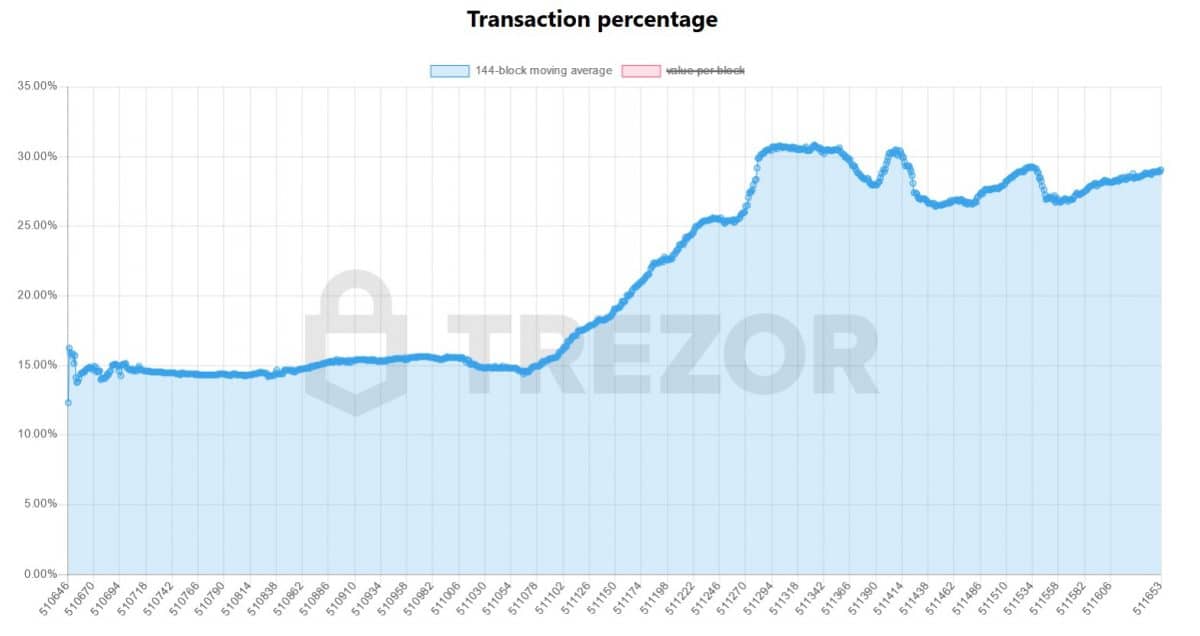
Segwit percentage over the past seven days, Source:
SegWit is important for the bitcoin blockchain network as it first dynamically adjusts the block size limit, from 1MB, and also fixes the transaction malleability bug.
Two of the largest cryptocurrency exchanges, and Bitfinex already announced their upgrade to SegWit.
Bitfinex, on February 20, 2018, had announced that it was upgrading its user wallets to SegWit. Later, on February 23, 2018, Coinbase followed suit and said that it would do a phased rollout of SegWit upgrades for all its users. Both exchanges cited that upgrading to this new technology would help lower BTC transaction fees for their users and also help in improving transaction time on the platform.
bitcoin developer and Metaco CTO Nicolas Dorier in 2016, “Segregated Witness is a net win, there is not any downside to adopt it at all,” further adding, “I am also very excited by the new method to sign transactions, which now includes the value of outputs being spent. This is huge from a security perspective for web wallets and hardware wallets, as it prevents (the) user from adding too much fees by mistake. And last but not least, it increases the capacity of bitcoin. I expect Segregated Witness adoption to follow an ‘S-curve,’ (I believe) wallets will jump on it (SegWit upgrade) very quickly.”
The SegWit upgrade has been well received in the blockchain and industry, from several developers who believe that in recent coming months, more transactions will adopt SegWit. Currently, the total percent of SegWit transaction stands at 30 percent, but if there is any significant change to easing the traffic on the blockchain network, then it must be ideally around 60-65 percent of the total transactions.
Brain Amstrong of Coinbase believes SegWit, along with the , will solve on the network and , “From learning more about SegWit I think we should activate it. It’s probably the best path forward for bitcoin at this point. Let’s come together and move forward as an industry. Activating SegWit can help us get there, and it has a number of good features.”
The post appeared first on .
