April 16, 2026

Capitalizations Index – B ∞/21M

Litecoin (LTC) Price Analysis: Risk of Downside Extension Below $70

Litecoin (ltc) price analysis: risk of downside extension below $70

Litecoin (LTC) Price Analysis: Risk of Downside Extension Below $70

Litecoin (ltc) price analysis: risk of downside extension below $70

Litecoin price failed to gain strength
above the $80.00 resistance against the US Dollar. LTC started a fresh decline
and it could even break the $70.00 support in the near term.

Key Talking Points

  • Litecoin price failed to break the $80.00
    barrier and declined recently (Data feed of Kraken) against the US Dollar.
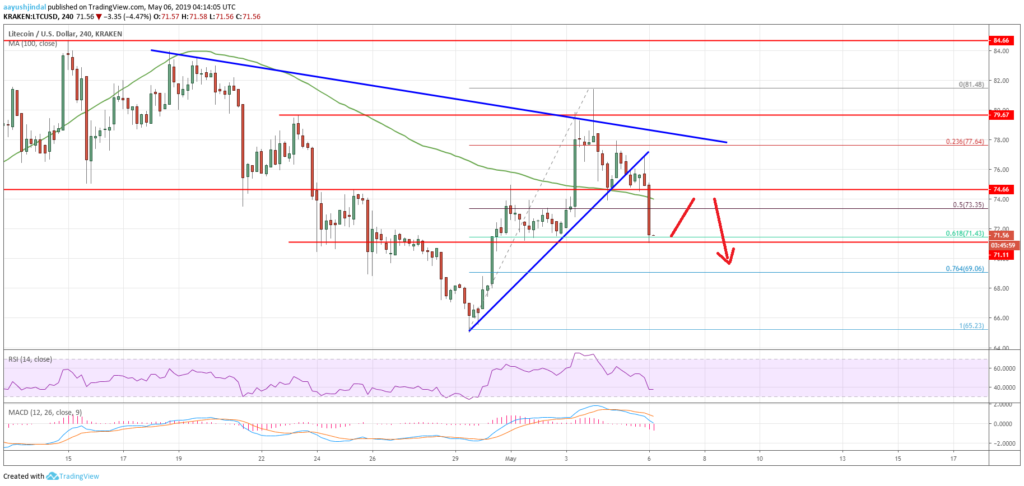
  • There is a major bearish trend line formed with
    resistance near the $77.60 level on the 4-hour chart.
  • LTC price recently declined below the $74.80
    support and a connecting bullish trend line.

Litecoin Price Analysis (LTC)

This past week, there were strong gains in bitcoin, but most altcoins such as Ethereum, EOS, ripple, litecoin and others struggled against the US dollar. The LTC/USD pair faced a strong selling interest near the $80.00 resistance and recently started a downward move.

Looking at the 4-hour chart, LTC price topped near the $81.50 level and later declined sharply. There was a break below the $78.00 and $76.00 support levels to push the price back in a bearish zone.

During the decline, the price traded below the $74.80
support and a connecting bullish trend line. Moreover, there was a close below
the $75.40 support and the 100 simple moving average (4-hour).

Besides, there was a clear break below the 50% Fib
retracement level of the last wave from the $65.23 low to $81.48 high. The
price declined below $72.50 and recently tested the $71.20 support area.

It seems like the 61.8% Fib retracement level of the last wave
from the $65.23 low to $81.48 high is currently acting as a support. If there
is a downside break below $71.20, there is a risk of more losses below the
$70.00 support level.

The next key support is near the $68.00 level, where the
bulls may appear. On the upside, there is a major bearish trend line formed with
resistance near the $77.60 level on the same chart. To start a fresh increase
litecoin price must break the $74.80 and $77.60 levels. As long as LTC is below
$74.80, there is a risk of more losses below $70.00.

The market data is provided by TradingView.

Published at Mon, 06 May 2019 04:26:48 +0000

Previous Article

Facebook Kicks Off Cryptocurrency Project Libra

Next Article

Sessia Market Segmentation Strategy – David mark –

You might be interested in …

EU’s Bitcoin Database Could Make Privacy a Thing of the Past

The EU may set up a bitcoin database to keep track of crypto users’ identities and wallet addresses in its bid to combat terrorist financing and money laundering.


bitcoin has had its fair share of controversy, previously being seen as the preferred medium of exchange for criminals on the black market. In addition, its high level of anonymity has raised concerns that it could be used to finance terrorism, as well as to aid in money laundering schemes.

money laundering, euro

These negative associations are exactly why the European Union (EU) has been working towards to implementing regulatory processes with regard to cryptocurrencies. This year’s phenomenal increase in crypto prices and popularity might also have something to do with it though.

The crypto industry reached a record-breaking $600 billion market cap, with bitcoin being responsible for more than half of that. The most well-known digital currency has had an impressive year, peppered with drastic price surges and forays into mainstream adoption, thanks to futures contracts.

A Comprehensive Database for Crypto Users

The EU’s proposal mean that crypto exchanges will have to follow strict rules with regard to reporting any suspicious activity and will also have to adhere to customer identity regulations.

According to The Telegraph, the newest addition to the Fourth Anti Money Laundering directive states that the EU has the option of creating a “central database registering users’ identities and wallet addresses.”

The updated amendment went on to state:

The report shall be accompanied, if necessary, by appropriate proposals, including, where appropriate, with respect to virtual currencies, empowerments to set-up and maintain a central database registering users’ identities and wallet addresses.

This new proposal will have to wait until 2019 to be considered, the same time that the effectiveness of the new money laundering rules will be discussed. The information on these databases will be available to authorized institutions, such as the National Crime Agency and asset recovery authorities.

No More Hiding Behind bitcoin

These databases will completely rip off the veil of secrecy that shrouds bitcoin. This might be good news for regulators, but not for users. Even though their user information may be private, their transactions made with bitcoin are not.

In addition to exchanges, regulators also have their eye on ICOs for any related fraud or cybercrime. The IRS in America is also on the lookout for any sign of tax avoidance activity made possible with the help of digital currencies.

The irony is that bitcoin’s huge increase in popularity may actually be acting as a deterrent to cyber criminals as the currency’s network is under pressure, resulting in payment delays and high transaction fees.

Exchanges Could Embrace These Changes

Even with its secretive nature, some experts surprisingly believe that exchanges will be on board with the new regulations. Jacek Czarnecki, a lawyer specializing in digital currencies at the Polish law firm, Wardynski & Partners, had this to say:

The new regulatory framework might bring some civilization into the wild west of cryptocurrency and improve interconnections between the blockchain world and traditional financial systems, which have been rather shady so far.

Whether these new policies will have any effect on the popularity, and price, of digital currencies remains to be seen, as does the belief that it will possibly encourage faster mainstream integration.

What do you think about the recent increase in regulatory processes? Will it affect bitcoin’s price and popularity? Let us know in the comments below!


Images courtesy of Pexels, Bitcoinist archives, and Pixabay.

The post EU’s Bitcoin Database Could Make Privacy a Thing of the Past appeared first on Bitcoinist.com.