August 10, 2026

Capitalizations Index – B ∞/21M

Lightning Strikes! LN Mainnet Reaches 1,000 Nodes

Lightning strikes! Ln mainnet reaches 1,000 nodes

Lightning Strikes! LN Mainnet Reaches 1,000 Nodes

Bitfury flare lightning network bitcoin scaling
Advertisement

Get Trading Recommendations and Read Analysis on Hacked.com for just $39 per month.

The Lightning Network (LN) notched another historic achievement over the weekend, as the LN mainnet reached 1,000 active nodes for the first time in its short history.

Lightning Network Mainnet Reaches 1,000 Active Nodes

That’s despite the fact that this nascent second-layer technology, thought by many to be a solution to Bitcoin’s scaling dilemma, remains in alpha-stage testing and has yet to receive a production release.

Lightning network
Lightning Network Nodes and Payment Channels | Source: Twitter/Armin van bitcoin

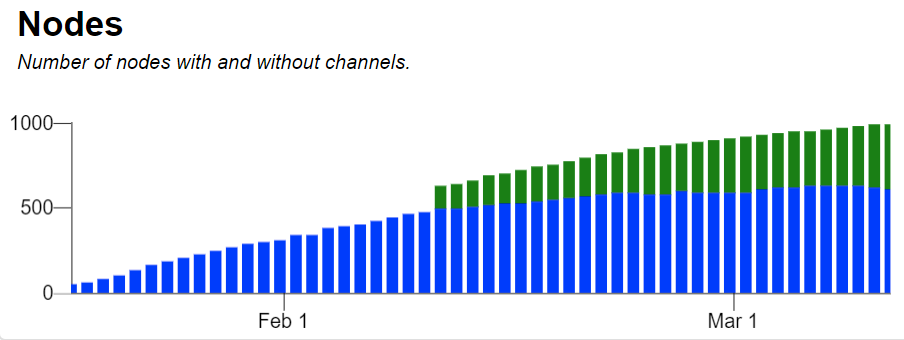
Owing to this fact, users have yet to use it to transact meaningful capital. The network is only holding about 4.5 BTC, worth about $43,000 at the present exchange rate. Moreover, nearly forty percent of network-connected nodes do not have any active payment channels.
Lightning network
Ln nodes with (blue) and without (green) open payment channels | source: bitcoinvisuals

Nevertheless, this level of mainnet adoption is remarkable for a technology that, officially, is still in testing. For reference, there are currently just over 11,000 active nodes on the bitcoin network, according to according to CoinDance data. bitcoin Cash, whose departure from the main bitcoin blockchain was largely in response to its embrace of Lightning and off-chain scaling solutions, currently has 1,883 active nodes.

Lightning Speeds Toward User Adoption

Even more remarkable is how quickly users have flocked to the LN mainnet, a clear indication that enthusiasm for this scaling technology remains high.

As CCN reported, the LN testnet launched in December, but it was not long before brave (or perhaps foolhardy) users began setting up mainnet LN nodes as well.

In January, VPN provider TorGuard began accepting mainnet LN payments, and before long the company had received the first verified LN transaction that included the sale of a physical product.

Last month, Austrian startup Coinfinity executed the first LN-based bitcoin ATM transaction. Then, the LN mainnet added its 1,000th payment channel, a development that occurred shortly before Zap — a cross-platform LN wallet — received a beta release. Finally, Laszlo Hanyecz — better known as the early bitcoin user who spent 10,000 BTC on a pizza in 2010 — christened the Lightning Network with a similar transaction.

Meanwhile, the beta version of the Lightning software appears to be nearing its release, though it is unclear when this will occur.

Follow us on Telegram.
Advertisement

Published at Mon, 12 Mar 2018 20:10:45 +0000

bitcoin Technology[wpr5_ebay kw=”bitcoin” num=”1″ ebcat=”” cid=”5338043562″ lang=”en-US” country=”0″ sort=”bestmatch”]

Previous Article

Thomson Reuters is Charting Bitcoin Adopters’ Emotions as Data for Traders

Next Article

Goldman Sachs: Bitcoin 'Has Potential' To Drop Below February Low Of $5,922

You might be interested in …

Scaling Bitcoin Releases This Year’s Program and Announces a New Developer Bootcamp

Scaling Bitcoin Just Released This Year’s Program and a New Developer Bootcamp

Today, Scaling Bitcoin, the international engineering conference focused on bitcoin and blockchain research, released its program for the 2017 edition. The conference, to be held in Stanford, California, in the first weekend of November, will also introduce a new side event this year: Bitcoin Edge, a bootcamp for starting bitcoin developers.

“The program is extremely interesting because it delivers cutting edge research on different blockchain scalability approaches, fungibility, consensus, data propagation, alternative techniques for handling blockchains and many other topics,” said Anton Yemelyanov, chair of the Scaling bitcoin Planning Committee.

Scaling bitcoin Stanford

After events in Montreal, Hong Kong and Milan, the fourth edition of the Scaling bitcoin conference is taking place at Stanford University on November 4 and 5 of this year.

Where the first two editions of Scaling bitcoin were mainly focused on scaling and scalability, the third edition broadened the scope of the conference to include a more diverse set of topics. This trend will continue in Stanford, where talks will range from highly technical topics concerning privacy and fungibility, to fee markets and fee estimation, censorship resistance and more.

bitcoin is the origin of all distributed ledger technology,” said Yemelyanov. “Scaling bitcoin has been fortunate to act as a vehicle for bringing the audience technologies such as Segregated Witness and MimbleWimble, all of which have been adopted or incorporated into various blockchain projects. We hope that other material presented by our participants will be of similar value and help the industry advance the research and development of blockchains.”

Yemelyanov added that another key goal for Scaling bitcoin conferences is to bring engineers and other technical minds together in a physical space where they can discuss their work in person.

“It is through collaboration where a lot of ideas are born and have potential of becoming reality,” he said.

bitcoin Edge Dev++

In addition to the conference itself, Scaling bitcoin is also introducing a two-day technical bootcamp for experienced developers getting into bitcoin: bitcoin Edge.

This nonprofit initiative is an effort to help scale the development capacity of the industry, Yemelyanov explained:

“One of the approaches of helping the industry scale is to scale the much needed development capacity of the industry. There is a clear talent deficit and we are trying to help all industry participants by running a nonprofit workshop that will allow developers to gain complete understanding of primitives that comprise bitcoin and blockchains in general and be able to start working in this field.”

bitcoin Edge will be led by well-known bitcoin developers and academics Anditto Heristyo, Ethan Heilman, John Newbery, Karl-Johan Alm, Nicolas Dorier, Thaddeus Dryja and Jimmy Song. They’ll introduce participants to a range of technical bitcoin-related topics, including Elliptic Curve cryptography, transaction structures, difficulty calculation and adjustments, and much more.

This workshop will take place on the November 2 and 3. For more information on the bitcoin Edge initiative, visit bitcoinedge.org.

See here for the full Scaling bitcoin Stanford program.

The post Scaling Bitcoin Releases This Year’s Program and Announces a New Developer Bootcamp appeared first on Bitcoin Magazine.