Despite having severe scalability problems, remains the most important with the largest market cap. Its high value has resulted in extremely high fees, and its high level of resulted in transactions taking a long time to confirm, especially in 2017, when the network clogged and reached ATH.
Lightning Network aims to solve this problem by developing a technology that runs on top of the allowing almost instantaneous transactions with fees of less than one penny.
Despite being a technology attacked by some members of the community (especially by users of Cash and its fork SV), the lightning network has a substantial number of advocates who are optimistic about the contribution that this development can have for the future of once it is fully functional.
How Good is Lightning Network in Real Life?
One of these supporters is Anthony Pompliano, Founder and Partner at Morgan Creek Digital. In one of his tweets, he published an open invitation to prove how efficient LN transactions were versus payments using traditional technologies.
The Lightning Network is so fast.
I wouldn’t be surprised if transactions go from to faster than the time it takes for a credit card machine to process the chip on a card that gets inserted.
Someone should run a test to time it and record the whole thing on video.
— Pomp 🌪 (@APompliano)
A researcher identified as JP Thor decided to answer Pompliano’s call and meticulously compared both technologies. were quite interesting, mostly because he studied different areas instead of focusing on one single case.
JP Thor began by mentioning that taking the transaction processing capacity per second in isolation, Lightning Network is undoubtedly the winner, but to rely on this aspect alone would be unfair.
“Sending a payment across the LN will always be faster than Visa because a Visa payment involves an auth with a third party. LN payments can be processed as fast as a TCP/IP connection between two peers. A single channel has been shown to process over 250 TPS, so the network can scale to no real upper bound.”
The researcher concluded that there is not much difference at the level of payments, transactions, and UX. Apple (the fastest form of payment) is “a few seconds” faster although it may not be very noticeable; however, he clarifies that LN has the opportunity for significant improvements.
Regarding the possibility to start with the service, the result is “Days faster for . Getting an Eftpos terminal will always be slower.”
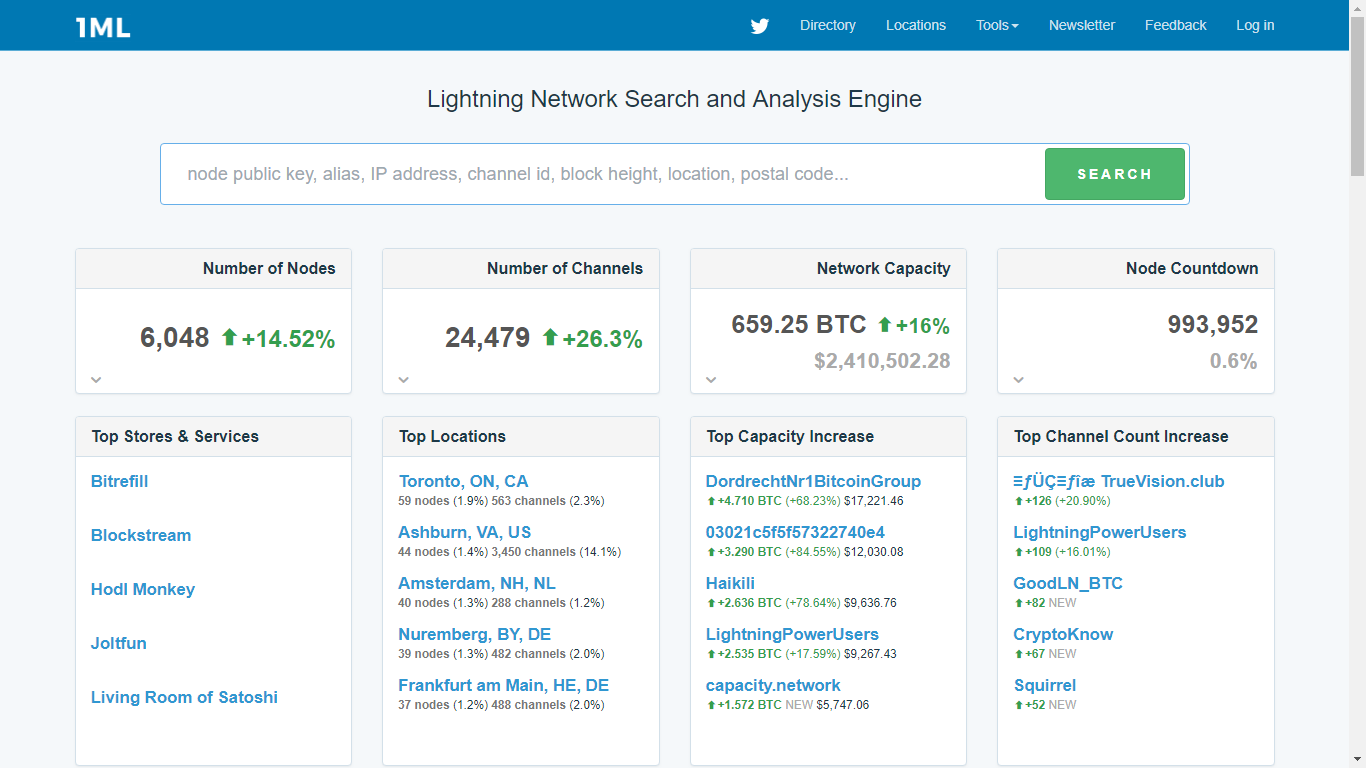
Lightning Network is currently under development; however, the number of payment channels and the processing capacity of the network. According to currently, the LN has improved its processing capacity by 16% in the last 30 days, with 24479 payment channels and 6048 active nodes.
Published at Sat, 09 Feb 2019 13:41:57 +0000