 is the Operations Director for , and Operation Director for the
Antonie has been with the public policy and research organization, Coin Center since August 2014 but bought her first bitcoin in January 2013 — a true OG. Her colleague had been goading her for 6 months before to buy, so you could say she’s been drinking the Kool-Aid since mid-2012.
So you got into bitcoin in 2013, huh? That’s pretty early. What happened?
In 2013, my colleague at my previous job kept talking about how fantastic bitcoin is, from a variety of angles: economic, financial, technological, and philosophical. Finally, after months of hearing this babble, I finally downloaded a wallet and bought from him. (Thank you, Patrick O’Sullivan.) My world has never been the same since. I would post on Facebook (Facebook was cool in 2013!!) about using the creepy red phone you’d use to buy on BitFloor and I took a photo at the first U.S.bitcoin ATM in Albuquerque, NM.
This caught the eye of Jerry Brito, who was working at the Mercatus Center, a sister organization of my nonprofit. When he started Coin Center in 2014, he asked me to join his team and maybe do some marketing automation and database work, but I one-upped him and told him I’d run all operations and events for him. He foolishly hired me, and here we are, almost 4 years later.
My second position came because of my work at Coin Center. I met Josh Cincinnati and the Zcash crew through my work with Coin Center. When the Zcash Foundation was getting off the ground, Josh asked for help setting up many operational aspects of the Foundation. Then he also foolishly asked me to run all operations for the Foundation.
What did you do before you got into this?
I worked in marketing automation, database design, and processes improvements for IT at another policy-focused nonprofit.
So you run operations for two non-profits. Are you a glutton for punishment? Why do you feel passionate about the work these two organizations do?
Cryptocurrencies like bitcoin are leaderless, open source technologies that are maintained by a community of enthusiasts, some via their own companies. Just like there is no way to pick up the phone and call “the internet” there is no way to call bitcoin. But policymakers need someone to call. That’s where Coin Center comes in. We are an experienced resource that can help them think through the nuances of the technology and how it interacts with the law.
Coin Center advocates for open blockchain technologies like bitcoin, Ethereum, Zcash, and any other decentralized cryptocurrency. We help policymakers understand how uses of the technology fit with the law and how regulators can achieve their goals without squashing innovation. These technologies don’t always fit neatly into existing legal frameworks. Where those gray areas exist, we develop and advocate for sound policy solutions that minimize the regulatory burden on the developers actually building on open blockchains.
The Zcash Foundation (my second position) aims to improve the online public infrastructure for the future by building an Internet payments and privacy infrastructure for the public good. It’s a distinct organization from the Zcash Company, which built and currently stewards the Zcash Protocol. The Foundation has lofty and important goals of engaging in public education about online privacy technology, supporting peer-reviewed scientific research, and building a decentralized Zcash network as an open, public infrastructure for private Internet payments.
What are some ideas you’re excited about in the crypto / blockchain space? Why do you think these ideas are exciting or transformative?
Any of the open, decentralized, and permissionless blockchains that allow for greater security, privacy, and freedom for its users; e.g., Zcash and other privacy protocols, Blockstack and their identity component to a decentralized internet by taking security to the edges (in the hand of the users, instead of trusted intermediaries), Orchid and their anti-censorship, anti-surveillance open-source network. Oh, and Lightning is a great project for scaling and cross-token exchanges since it’s super fast and low-cost.
What’s been the most interesting experience you’ve had in the crypto space thus far?
The people I have had the honor to work with in cryptocurrencies are the smartest, noblest, and most passionate people I have met. They see the world as place where thoughtfully implemented technology can improve current systems of privacy, censorship, and speech, ultimately leading to more liberty for all.
As you think about this industry, what do you think will happen in the short term that will blow people’s minds?
Right now, the focus is on the money-making aspects of cryptocurrencies. In my mind, the tokens are an important incentive to the whole technology, but the true innovation is the layers that are being created on top of internet protocols that can ease payments, allow for greater privacy, and ultimately empower it end users.
What aspects of cryptocurrency do you think will be disappointing?
As we are seeing today, there are folks who are solely interested in short-term financial gain, which is short-sighted, and will lead to irrational speculations, rises and falls in prices, scams, frauds, and reactionary regulation. As the pendulum swings back in the other direction (the “bitcoin is dead” direction), we might see an exodus of these folks.
What changes do you think cryptocurrencies will accelerate in our world?
The people who are passionate and smart about cryptocurrency’s technological implications will stick around and continue to build great infrastructure and sound business models without the distractions of the price volatilities, ICO celebrity endorsements, and blockchain snake oil salesmen. The future is still unknown, and the many products and future technologies have yet to be imagined.
Thank you to Antonie for participating!

was originally published in on Medium, where people are continuing the conversation by highlighting and responding to this story.
In the late 1990s, the .com bubble was in full swing. A company that had no relationship with the internet could add a .com or an internet prefix in its name and see the stock jump. A good example of this is e.Digital Corporation (EDIG). It changed its name from Norris Communications to in January 1999 when the stock was trading at $0.06 per share. Subsequently the stock price rose dramatically to $2.91 per share on December 31, 1999 and then to a high of $24.50 on January 24, 2000.
The parallels between the .com bubble and the new blockchain craze are evident with the January announcement that Kodak would be launching an ICO. This immediately led to a
Of course if readers take the time to read the entire press release they will note that this is actually a partnership between Kodak and a company called Wenn Digital. A Google search for ‘Wenn Digital’ only pulled up press releases of the deal with Kodak. It is unclear how Kodak is involved in this deal except for having its name associated with a blockchain based token. Despite the red flags over this deal, it only portends a trend towards the tokenization of existing businesses. Businesses everywhere naturally want to increase their stock prices. In this age of blockchain mania, a good way to do this is to tokenize an existing part of the business.
What is Tokenization?
Tokenization is the task of taking an existing business and introducing an internal currency (better known as a ‘token’) to support business activity. The tokens will be built on top on an existing blockchain platform such as Ethereum or Neo.
Why Tokenize?
Beyond the obvious stock jump effect mentioned earlier, there are compelling reasons to add a token to a business.
Reduced Costs
Unlike international SWIFT money transfers, tokens can be transferred globally between two parties at low costs and high speed. Smart Contracts can eliminate paper and make transfers of value fair and easy.
Removing Intermediaries
Smart Contracts also make transfers of value trustless. No notary or lawyer needs to be involved in transactions between two parties when a Smart Contract enables trustless transactions.
Extract Value
One of the most compelling reasons to tokenize a company involves value creation. The value of existing companies is driven by equity. A company is valued using a traditional metric such as a discounted cashflow. This valuation is then applied to value an entire company. All the value of shares in a company should combine to equal the company’s total value. With the advent of the blockchain, there is a new for founders to extract value from a business via tokens and ICOs to sell tokens.
If a company removes its revenue generating activities from the traditional financial system and puts them onto a blockchain platform with an internal currency, there is an additional store of value that they can profit from: the token.
The implications of this are staggering. Essentially every business that can support an internal currency can enrich its founders and users in a new way. Founders will now not just be getting equity in their company, but will also be receiving token awards. As tokens can increase in value based on demand and because supply is fixed, this is an extremely attractive business model for businesses to adopt.
Case Study: Props by Younow
Props recently held an ICO which was heavily oversubscribed. I wrote a of the company and was impressed with their offering. Props offers a good template for how an existing business can transform their model to integrate tokens.
Existing Business: Younow
The current business is called Younow and is a live-streaming platform. Users can set up their own live streams and make them available to the public.
New Business: Props
Props is the name for the token that will be used on Younow. The Props token is used to reward content creators. It serves as a ‘status’ token, and unlocks functionality depending on how many are held by a given user. There are five use cases for the token:
· Premium Experiences: PROPS will unlock premium experiences or ‘gameplay advantages. Some features may be exclusive to token holders and require premium access using PROPS.
· Status Signalling: Indicates the elevated status of PROPS holders.
· Influence and Curation: Influence is a function of economic power. PROPS holders may promote use cases and content they like and vote on platform-wide rules and guidelines.
· Compensation: Tokens will be used to compensate platform contributors (e.g. content contributors, curators, developers etc.). PROPS tokens are rewarded to users who are calculated as contributing the most to the platform.
· Content Promotion: Users of all types can use PROPS to promote or elevate their own content.
Tokenization Benefits
While some platforms reward large content contributors for their work, contributors enjoy only a fraction of the financial value they collectively create. The large companies end up controlling content distribution and contributor income and often end up cannibalizing their earnings with their own content and product offerings. Meanwhile, developers wishing to create new experiences and digital media distribution channels face an uphill battle against overwhelming network effects and economies of scale.
Tokenization Framework
Using the cases studies above, we can develop a framework for how to tokenize an existing business.
Define Current Business Model
In order to tokenize an existing business, it is critical that the current way the business operates is defined and recorded. This means fully understanding how the current business works and where revenue is being generated. Because tokens represent a means of payment, defining payment touchpoints is critical.
Define Tokenized Business Model
Once the existing business model has been defined and payment touchpoints identified, the process of designing the tokenized business can begin. The goal of tokenization should be a lower cost business model that can also possibly raise capital. Not only should costs be lower to the business, but also to those that use the service being tokenized (e.g. consumers).
There are many questions that need to be asked here, but the principal ones are as follows:
1. How can I incentivize people to use my token? This question is important because using tokens may be hassle for people that are new to crypto. They may have to download a new app, possibly learn about keys and hold a new kind of currency. These are all extra things that people may not want to do.
2. How can I incentivize people to hold my token? Maintaining a is important otherwise there is no real potential for token price increase. Investors in an ICO will look for potential price increases as a key matric in an investment decision, so incentives to hold a token are important.
3. Should I decentralize my business? The blockchain makes possible a . A token makes a decentralized business model possible, but a centralized business can also benefit from tokenization. This is a very challenging question because the decentralized business model has not been proven. Governing an organization by code has the advantage of eliminating bureaucracy, but has the disadvantage of a loss of flexibility.
Integration
Once the decision has been made about how to tokenize the business, planning for how to integrate the tokens begins. The most critical question here is whether the business will have an ICO. For some companies the answer will be ‘no’. The benefits of adopting an existing token are still strong enough to justify tokenization without an ICO.
Besides the ICO, there are planning considerations. One of the biggest items is technology development. Integrating a token within an existing business may be time-consuming and disruptive. It is critical that a detailed plan with a timeline and multiple releases is designed.
Launch
The final phase occurs when the business is ready to formally launch the new business model. The scope of the launch depends on how large the project is. For a smaller business, it may be possible to do everything at once. However, a large business may choose to launch tokenized parts of their business in different phases. During the launch period, existing clients may need to be helped transition to the new model. Marketing may be required here to inform users of the benefits of using the token.
Final Thoughts
The influence and impact of blockchain technology on business is just getting started. We have seen an increasing number of ICOs conducted by existing businesses (Kik, Telegram) and one that are planned (). I predict that a trickle will soon become a torrent as crypto matures.
OMG, this is the most incompetent perspective I’ve read in a while…
Do you happen to be associated with the establishment? Elite government offiicals or a few incompetent actors at the SEC?
Lemme educate you with a few facts so that people can see how flawed your information is…
Venmo actually charges 3% of transfer fees through credit cards and just FYI allowing for the fact that Paypal owns Venmo, Paypal can only handle 24 000 transactions per second. While EOS, NEO, Hashgraph and a few other blockchain projects have already proven to hit 100, 000 transactions a second in trusted networks which in the near future will be available on public networks. Not to mention that Paypal servers (not an account) have been hacked before while it is literally impossible to hack the blockchain. On top of that EOS is ENTIRELY FREE moron!The Silkroad bs is the worst argument ever and believe it or not, unless you use privacy coins, thanks to the evolution of smart contracts, blockchain is THEE WORST place in the world to buy or sell drugs because you can be tracked and put in jail. I highly suggest keeping the good old hand to hand cash route to minimize your chances of being arrested.Speaking of smart contracts, you have noooooooo idea what you are talking about LOL! You are using an example of an eBook?!!! Mangoes?!! LMAO!! bitcoin and blockchain technology was built in response to the financial crisis in 2009 specifically to address issues in financial markets that deal with highly sensitive data and sophisticated audits and therefore need a smart contract! We need an immutable contract to avoid another 22 trillion dollar lose to the global economy.
Now grab yourself a glass of water, relax and focus on topics that you actually understand newbie!
PEACE!
1) Sign up on the platform with your email, and a strong password. Password must contain at least 8 characters, one lowercase letter, one uppercase letter, and one digit. Review and check “I agree with Terms of Service”, press Continue. You will receive an email confirmation to confirm your account.
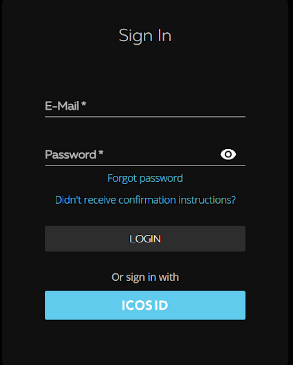
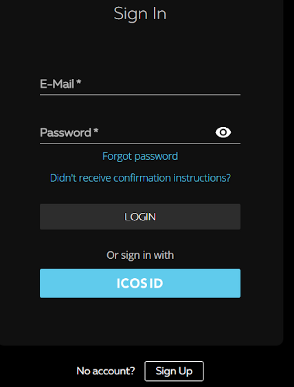
2) After confirming your account you will be prompted to sign in using your credentials.
3) The contribution dashboard contains your referral link to share with other parties that may be interested in contributing to the project. The dashboard also contains a token calculator, the tool to purchase tokens, access to the KYC procedure, My Account information, and a log of all payments made.
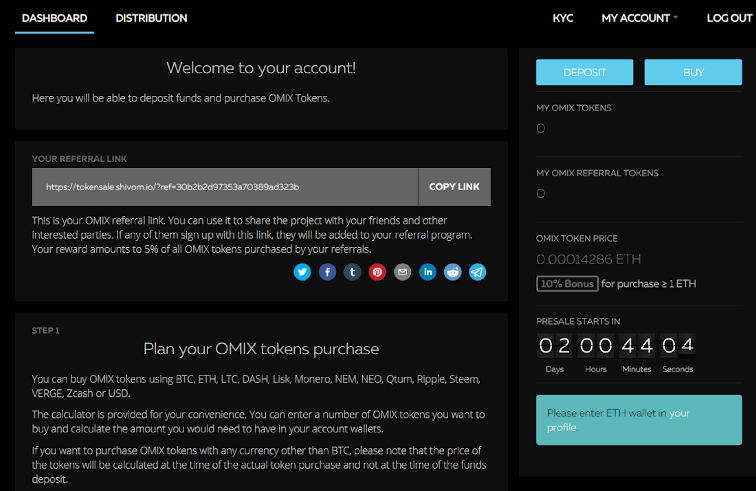
4) KYC verification must be completed before tokens can be received. Tokens can still be purchased before KYC has been verified, however you will only receive your OmiX tokens AFTER KYC verification has been completed. The KYC verification tab can be found in the top right hand side of the dashboard. Complete all the information in the KYC verification tab. You will be asked to upload a document and a selfie photo, after which you can submit documents to verify KYC.


5) OmiX tokens can be purchased using all of the following currencies: BTC, ETH, LTC, DASH, Lisk, Monero, NEM, NEO, Qtum, Ripple, Steem, VERGE, Zcash, USD. A currency calculator is provided for your convenience.

6) Once you calculate the required amount to purchase OmiX tokens with your currency of choice you can make a deposit of those funds to the platform, to a unique address generated only for you. Do not share your address with anyone. Funds can be deposited from any existing wallet for which you hold private keys.

7) The deposited funds can then be used to purchase OmiX tokens. For simplification, select “Spend all funds in your account to buy tokens.”

8) The Payments tab under “My Account” records information about your previous transactions in the platform, and keeps a tracking of tokens previously purchased.

9) Go to the Profile tab under “My Account” to access your account information. Enter your ETH wallet information to ensure that your tokens get deposited to your ERC-20 compatible wallet. You must enter the ETH address of an ERC-20 compatible wallet in order to receive OmiX tokens. Failure to do so may prevent you from receiving tokens.

10 ) If you have a previous ICOS ID account you can directly connect it here. This will simplify your KYC process.

11) Enable 2-factor authentication using the Google Authenticator app to ensure the highest level of security for your account. Click on Enable 2FA and scan the QR barcode. Enter the 6-digit code from the Google Authenticator app to generate backup codes. Store your backup codes in a safe place.