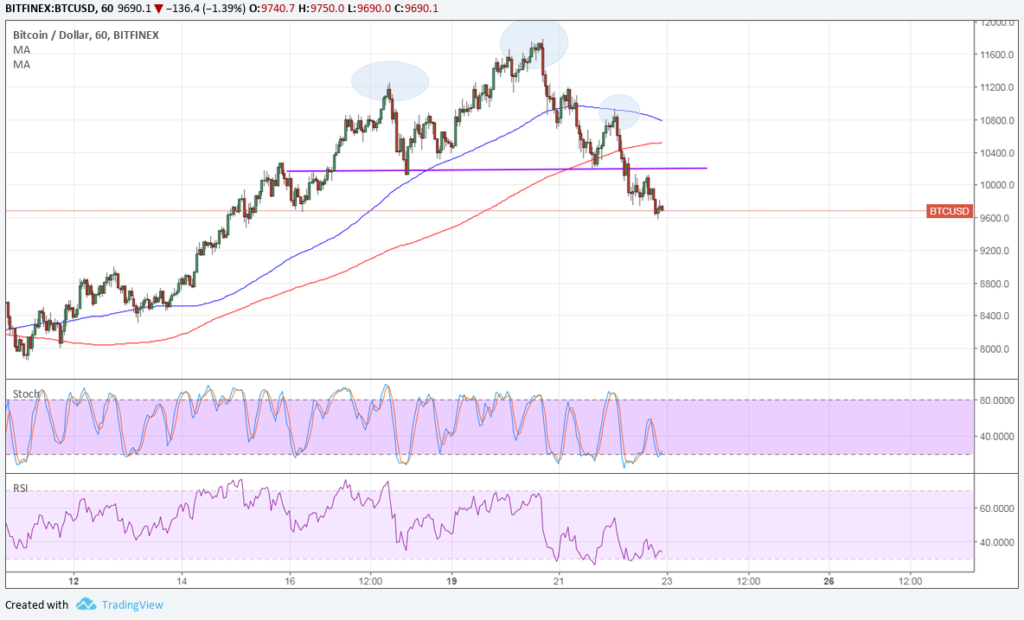
In the current gradual climb in the , a trader has exited a short position worth a blistering $119 million. As bitcoin slowly regains both respectability and value with almost genteel trading over the last few weeks, previous short positions are evaporating. Although the price rise has been gradual, it was enough for the holder of a massive short position to have to cash in.
A short position is a common trading ploy, and virtual coins and virtual exchanges are not exempt from the tactic. In essence, “shorting” involves betting on a price dipping and thus borrowing stock of whatever nature (in this case ) and replacing it later for cheaper, after that price tumble. The short position never has to outlay buying capital as the assets are borrowed, but can score handsomely when their replacement value dips by pocketing the difference.
The Risks of Short Selling
The margins and futures market is risky because there are other considerations to any short position. The owner may call the deal at any point, and in the worst case scenario, prices actually go up, not down, and the short position holder then is obliged to replace the borrowed goods at whatever current market value might be, even at a personal loss.

Source:
The OKEx exchange was launched by OKCoin and has maintained a clean bill of health, in spite of that forced it to halt trading on occasion.
The top-listed short spot on OKEx has now bailed on any further HODL strategies and exited the position, possibly losing substantially.
Trader, in this case, would have lost $1.9 million if leverage was 100x or $19 million if leverage was 10x. In either case, that’s a lot of money to lose.
The second weightiest short position on OKEx was worth $73 million and has also closed with bitcoin now hovering around the $10,000 mark. In the far more volatile altcoin market, short positions become even riskier than they typically are in other markets. Shorting sees a trader borrow at, say, $8,000 in the anticipation that it will still plummet to $4,000 in value.
The trader sells the bitcoin immediately at the prevailing price, even though it is borrowed, and waits for the price to plummet. Once the price has dipped substantially, from the proceeds of the original sale, the trader will buy and replace the borrowed bitcoin and declare a profit of whatever is left, as a difference between what they made selling borrowed goods and what they spent replacing them.
Will Hong Kong Rival Pamplona With a Bull Run?
In the example above, it’s easy to see that the short seller’s theory held and the value plummeted to $4,000, they would have made $4,000 when they sold at that predicted point. Conversely, had the market moved against short positions, and the price rose to anything from $8,001 and up, the short position trader would have immediately started losing.
With such massive figures, there has been speculation that some of the players in the deal were institutional. That remains unclear, but it has been noted that in spite of the weight of the two largest shorts, demand is rising and moving against the doomsayers. Managing to largely avoid extreme volatility and without much of the fanfare of 2017, bitcoin is rising in value. That the bitcoin price rode roughshod through the heavy shorts could be indicative of a bullish sentiment forming. The price of bitcoin is at $9,502.
The post appeared first on .
Bermuda’s efforts to emerge a hotbed for FinTech innovation and entrepreneurial success continues as the government intensifies policy reforms to make room for an empowered blockchain industry.
The push to embrace the still-nascent industry is being spearheaded by the Bermuda Business Development Agency (BDA) under the guidance of a group of senior ministers including Premier of Bermuda, , and Minister of National Security, Wayne Caines.

Team Bermuda in New York, from left: Premier David Burt, BDA Emerging Tech consultant John Narraway, National Security Minister Wayne Caines, BDA Head of Business Development Sean Moran source:
A Holistic Approach
The Bermuda government’s friendly outlook towards cryptocurrency and the technology at its heart – blockchain – was evident when Caines invited a group of blockchain enthusiast to his home turf on the sidelines of the (Davos, Switzerland) earlier this year.
This seemingly small gesture turned out to be a big leap forward as a number of blockchain entrepreneurs accepted Caine’s invite and traveled to Bermuda at their own expense. They met government officials and industry stakeholders in the North Atlantic island to prepare a roadmap for making Bermuda the world’s first regulated hub for blockchain business and digital assets.
Over the course of the next few months, the self-governing island focused on for a blossoming cryptocurrency ecosystem. Not only that, Premier Burt and National Security Minister Caines both took it upon themselves to address the media briefing about how embracing the digital economy could further boost Bermuda’s growth.
“We shared the progress Bermuda is making in our new government’s mission to grow the economy,” said the Premier in one of his interviews. He added:
“We’ve demonstrated that Bermuda is open for business and we’ll continue to spread the message that Bermuda is the ideal place for future economic growth. The island is a place for stable regulation and legislative clarity around these new industries, and we intend on leveraging our legacy of blue-chip innovation to solve new problems in financial markets and digital assets.”
Premier Burt’s interviews were aired on Bloomberg’s TV program , as well as on , a national radio program.
Regulatory Sandbox for Encouraging Innovations
The government understands that establishing an apt regulatory and legal foundation is key to achieving the goal of becoming a global blockchain hub. To encourage innovation without the risk of being mired in messy bureaucratic affairs, the government also facilitated a “” that enables businesses to develop innovative financial technologies while continually remaining in touch with regulators.
Premier Burt told Bloomberg that unlike most countries where innovation and financial hubs are restricted to select few regions, all of Bermuda is a hotbed for to try out their innovations before expanding them to other markets; this is one feat about the island nation that wouldn’t be possible without an impactful regulatory sandbox.
Efforts to Handle ICOs in a Mature Way
Bermuda is also planning on creating a friendly atmosphere for . Unlike leading economies including the US and China, the island nation seems less skeptical about ICOs and their contribution to the economy.
However, the government and the BDA are not naive enough to give ICOs a free run. Instead, Caines has to categorize ICOs as a “restricted business activity that requires approval from the Minister of Finance.”
So what’s behind Bermuda’s friendly outlook towards the seemingly murky world of ICOs?
Well, the government seems to be of the view that adequately regulated cryptocurrency-based fundraising has the potential to emerge a vital tool to fuel national development.
Potential Risks
While enthusiasts and proponents of ICOs are hailing Bermuda’s move toward extending legal status to coin offerings, most analysts point out that the move is not without its risk.
ICOs raised more than $6 billion globally in 2017. But worryingly, a large proportion of all those ICOs didn’t even have proper documentation to appear legit. Worse even, a lot of them provided little or no return to investors, causing widespread concerns among investors and regulators alike.
Tough Anti-money Laundering Mechanism
Cryptocurrencies have become a common tool for shady elements to indulge in unlawful activities. Regulatory bodies all over the world are struggling to find an impactful solution to the problem of money laundering using .
However, Premier Burt seems confident that Bermuda has a robust-enough anti-money laundering mechanism to thwart misuses of digital assets. He emphasized that “Bermuda is an excellent place to raise capital, but a very bad place to hide it.”
Adding he claims that the country has a superior regulatory system that can be compared to that in the US and the EU, the Premier said that there would be adequate regulatory and legislative provisions in Bermuda to monitor, track, and freeze any transaction that breaches international anti-money laundering standards.
The post appeared first on .