July 19, 2026

Capitalizations Index – B ∞/21M

KPMG Survey: Half of Tech Execs Say Blockchain Will Change Their Industry

Kpmg survey: half of tech execs say blockchain will change their industry

KPMG Survey: Half of Tech Execs Say Blockchain Will Change Their Industry

Big Four auditor, KPMG, has released the results of its seventh annual Technology Industry Innovation Survey. The survey, of 740+ global tech leaders across twelve countries, shows an increasing belief that blockchain will change the industry.


Don’t Mind The Disruption

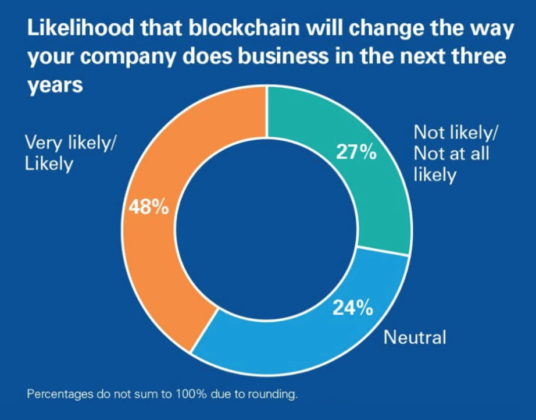
Nearly half of the respondents (76 percent of whom are C-level executives) thought that blockchain was ‘very likely’ or ‘likely’ to change their business within three years.

24 percent of respondents were neutral, and 27 percent felt this was “not likely” or “not at all likely.”
Kpmg survey: half of tech execs say blockchain will change their industry

For comparison, in last year’s survey, a similar 28 percent of participants said blockchain was unlikely to disrupt their business within three years, or were unsure. However, last year 42 percent of respondents were neutral on the matter, with only 30 percent thinking this was “very likely.”

So while it seems that hardcore blockchain naysayers are still saying “nay,” a large chunk of the neutrals have swung. The belief in blockchain’s potential to disrupt the tech industry is clearly growing.

Disruption? What Disruption?

On the question of which areas of business the blockchain was most likely to disrupt, the spread was very similar to last year.

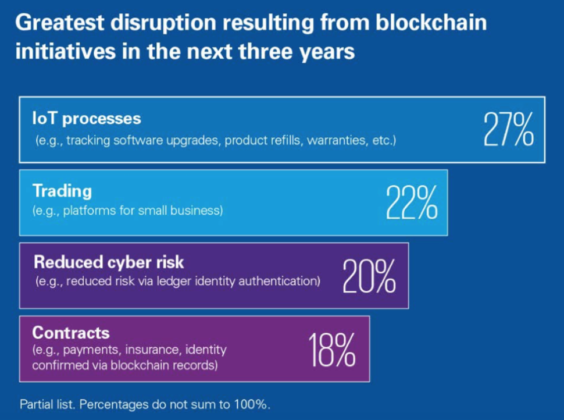
27 percent of respondents foresaw most disruption in internet of things (IoT) processes, such as software upgrades, product refills, and warranties. 22 percent thought the most disruption would be to trading (through platforms for small businesses).
Kpmg survey: half of tech execs say blockchain will change their industry

There was a slight swing away from “reduction of risk” (20 percent) towards disruption of contracts (18 percent). The latter gained 4 percent of the total respondents from the former, compared to last year.

According to Damien Ducourty, Co-founder of B9lab:

There are possible use cases in everything from supply-chain (where IoT features heavily) to entertainment.  The supply chain use case is one of the most obvious ones because of blockchains’ supposed immutability, and the ability to verify transactions in a trustless environment.

Challenges And Benefits

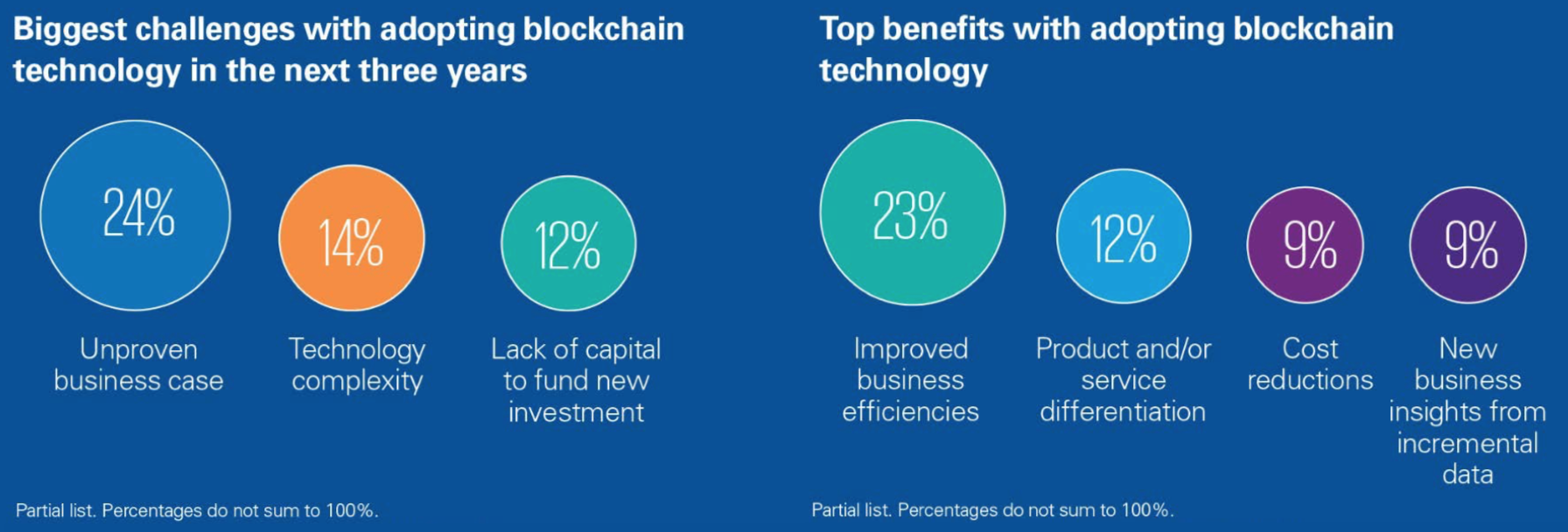
Key challenges highlighted in adopting blockchain technology included unproven business cases, complexity of the technology, and lack of capital for investment.

However, the perceived benefits of implementing blockchain centred around improved business efficiency and cost reduction.
Kpmg survey: half of tech execs say blockchain will change their industry

There was an additional belief that blockchain implementation would differentiate their company’s product and/or service. And almost 10 percent of respondents cited business insight gained from incremental data as their top benefit.

Jehan Chu, Co-founder and Managing Partner at Kenetic and Co-founder of Social Alpha Foundation, summed up:

In the 9 years since bitcoin was invented, blockchain experiments launched a thousand ships. In 2019, we are seeing the first of those ships land, and we expect waves of successful proofs of concept to demonstrate true value and utility from payments to data security to supply chain which will turn the tide towards mainstream adoption.

Do you agree with the KPMG survey that blockchain will disrupt business models? Share your thoughts below!


Images courtesy of Shutterstock, KPMG

Published at Fri, 01 Mar 2019 20:00:41 +0000

Previous Article

Angry Bitcoin Fans Delete Coinbase Accounts to Protest Neutrino Acquisition

Next Article

Bitcoin [BTC] proponent: There are going to be more state-sponsored cryptocurrencies because cash is going to be eradicated

You might be interested in …

Does Regulation Slow Down or Accelerate Adoption?

Recently, many countries and cities have published new laws and legislations to regulate bitcoin. Does this help contribute to mainstream adoption, or is it merely a hindrance to it?


Regulation Slowing Adoption

New York was the first state in the USA to tighten regulation on bitcoin and other virtual currencies, via its BitLicense. This is issued by the New York State Department of Financial Services, and it regulates businesses which work with virtual currency.

The implementation of this law caused some bitcoin companies to cease operations in the state, while some others decided to go through the regulatory process to operate legally. However, to date, only 3 BitLicenses have been granted. Circle, Ripple and Coinbase are the only companies with the right to operate, and they must collect information on New York residents and report it back to the NYSDFS.

Other companies, like BitFinex and Kraken, decided to cease operations in the area and ban New York residents from using their services. They deemed the BitLicense to be too complicated to work with, and simply moving out of the area was the simplest option.

In other countries like China, regulation has been a bit harsher. Major exchanges were forced to introduce fees, freeze withdrawals and disable margin trading to comply with new regulation from the People’s Bank of China. Zhou Xuedong, director of the PBoC’s Business Administration unit, stated:

“There is a significant risk, one is the risk of customer funds security, the second is the risk of money laundering, the third is the risk of leveraged transactions.”

Ways Around Regulation

However, the bitcoin community has developed solutions to avoid regulation. Decentralized, peer-to-peer marketplaces exist, where users can spend and obtain bitcoins without adhering to any official regulation since the platform isn’t run by a third party.

BitSquare is a decentralized bitcoin exchange, where users can buy and sell bitcoins without proving their identity. OpenBazaar employs a similar concept and allows users to set up stores to sell their products.

There are also other platforms that aim to promote decentralisation. For example, Blockonomics.co provides a free, detailed bitcoin invoice services for freelancers and businesses, as an alternative to Coinbase or BitPay. This means that again, users can enjoy the same services without having to go through long verification processes.

Regulation Fueling Adoption

Contrary to popular belief, regulation doesn’t necessarily have to slow down adoption. In some cases, regulation could help bring cryptocurrency technology to the masses; an excellent example of this is Humaniq.

Humaniq is a new platform which aims to bring mobile banking services to those who reside in emerging economies. The platform is powered by blockchain technology, but they aim to be compliant with KYC/AML laws in the countries they will operate in.

However, users no longer have to go through a complicated verification process. Instead, the users’ identity can be verified by simply having them take a photo of themselves or by reading a short piece of text.

Africa mobile

This could mean a significant step forward for blockchain technology. Users would be able to access all of its advantages without too much trouble, which is very important for those who live in emerging economies.

Nonetheless, any person can use Humaniq; their ICO (Initial Coin Offering) begins today, April 6th, which is a great chance to contribute to the project if you haven’t yet already done so.

[Disclaimer: This is a sponsored article. Publication does not constitute an endorsement and should not be considered as investment advice. Bitcoinist is not responsible for any outcome that may result from investing in this ICO.] 

Do you think that cryptocurrency businesses should be regulated? If so, why? Let us know your thoughts below!


Images courtesy of Blockonomics.co, BitSquare, Humaniq, NewsBTC, CoinFox and The Houston Free Thinkers.

The post Does Regulation Slow Down or Accelerate Adoption? appeared first on Bitcoinist.com.