A new crypto teller machine is now operational in South Africa’s largest city, Johannesburg. The ATM, which supports several digital coins, has been installed at a supermarket in the north-western part of the city’s metro area. It is the latest addition to a growing number of terminals offering automated crypto-fiat exchange services in the country and across the continent. Not all is rosy in the region, however. A crypto ban in neighboring Zimbabwe may deprive Harare of its bitcoin ATM. Nevertheless, crypto teller services are spreading in Africa.
Also read: ATM Machines Around Washington DC
Multicurrency ATM Installed in a South African Supermarket
 Johannesburg
The Republic of South Africa, the continent’s economic powerhouse, and neighboring Zimbabwe, one of Africa’s most troubled nations, have at least one thing in common – the growing interest in cryptocurrencies, although under different circumstances. In recent years, both countries have been experiencing their own versions of crypto development. The process has led to improved access to the crypto ecosphere but now their paths may diverge again.
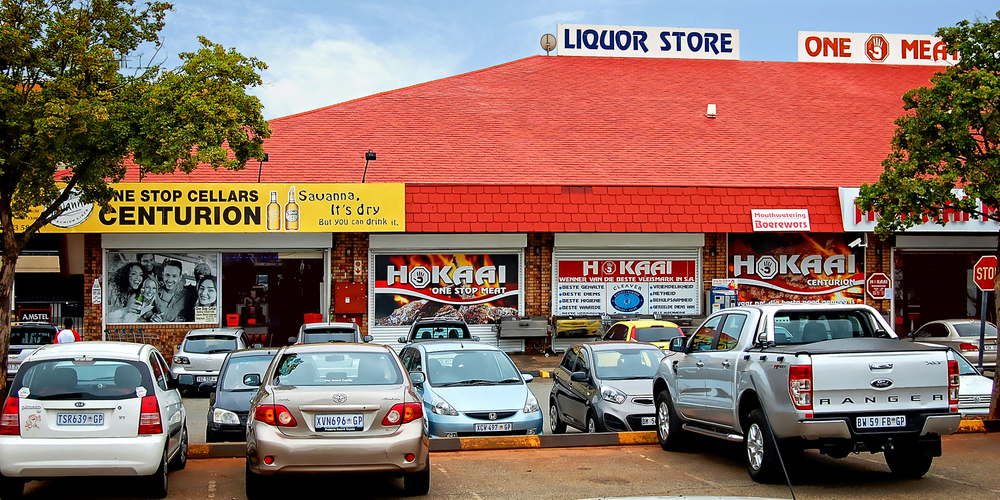
A South African outlet reported this week that the nation has got its “first” cryptocurrency ATM in its largest city. The teller machine has been installed at a store in Northwold, part of one of the biggest retail chains in the country – Spar. The automated terminal is a multicurrency device, according to Business Insider South Africa. Customers can buy bitcoin (BTC), ethereum (ETH) and litecoin (LTC) with fiat cash. Unfortunately, it supports one-way transactions, which means only purchases of cryptocurrency are available.
Of course, “the first” is almost always a doubtful label. Unsurprisingly, right after the report came out, the breaking news information was corrected by other media. “While this is undoubtedly a forward-looking move, it is most certainly not the first cryptocurrency ATM to go live in South Africa,” Mybroadband wrote in a piece putting forward another example. According to member of the local crypto sector, multiple cryptocurrency ATMs are operating in South Africa. Jacques Serfontein, CEO of mining hardware supplier Bitmart, said his company has installed one last year at its store in Nelspruit, east of Johannesburg. It supports multiple cryptocurrencies, as well, including bitcoin, ethereum, litecoin, dash, and zcash. Serfontein added he knew of several other crypto ATMs in Johannesburg, Cape Town, and Midrand.
The new Johannesburg’s ATM may not be the first in the country after all, nevertheless, it’s arguably the first one in Northwold. The good news is that the residents of another South African neighborhood will be able to buy digital cash with a simple QR scan and a fiat payment. The teller machine has been installed by the Spar store manager, George Neophytou, who is a crypto enthusiast and entrepreneur. “I asked permission to use this location because I work here. What better place to set it up, so that if a user required help, I’d be on-site to help,” Neophytou said. His initiative was supported by Vendibit, a company developing software and hardware blockchain solutions, and his partner, Daniel Cappiello, director of the Danish firm Copencoin.
The future of cryptocurrencies in South Africa is still unclear. A “self-regulatory approach” has been as part of the solution for the country’s crypto sector, while the central bank is expected to formulate a comprehensive regulatory framework. In April, the South African Revenue Service it expected residents to declare crypto gains on their tax returns, although cryptocurrencies are not regarded as currencies for income tax purposes. Despite the uncertainty, cryptos have been gaining popularity both as investments and as means of payment. Last year, the country’s second largest supermarket chain, Pick n Pay, started bitcoin payments. It has been reported that drivers can with cryptocurrency.
South Africa – Not the First and Only in Africa
The teller machine in Johannesburg is definitely not the first to offer automated crypto teller services on the continent, as well. bitcoin has been gaining ground in SA’s neighbor Zimbabwe, where cryptocurrency exchange Golix has recently installed a BATM in its Harare office, as . Another local trading platform, Styx24, has announced plans to introduce a second machine in Gweru. Neither of the two companies, however, are licensed to provide these services. Besides, Zimbabwe’s central bank issued this month a circular effectively all crypto-related activities.
According to recent reports by local media, some of Golix’s bank accounts have been closed already and the Reserve Bank of Zimbabwe has ordered the company to cease all crypto-exchange operations. If the trading platform shuts down, residents of Harare will probably lose the only bitcoin ATM in their city, which Golix has installed in its office.
Further north, an ATM in the Kenyan capital Nairobi supports four cryptocurrencies – bitcoin (BTC), ethereum (ETH), litecoin (LTC), and dogecoin (DOGE), according to data provided by Coinatmradar. Again, only crypto purchases are available. To the east, the tiny nation of Djibouti in the Horn of Africa offers a crypto teller machine operating 24/7. Customers can both buy and sell bitcoin (BTC) through the ATM located at the Appart Hotel Moulk in the capital city.
The Spanish Canary Islands, situated off the west coast of Africa, have at least three crypto teller machines. The one in Santa Cruz de Tenerife, capital of the largest island, offers support for two cryptocurrencies – BTC and LTC, but it’s a “buy only” terminal. The other two BATMs, in Costa de Adeje and Las Palmas de Gran Canaria, can be used for both purchases and sales.
Undoubtedly, many more cryptocurrency ATMs operate in Africa and its neighboring regions. Naturally, it’s up to local crypto communities and crypto media to spread the news about them.
Do you think ATMs increase the availability and popularity of cryptocurrencies? Tells us in the comments section below.
Images courtesy of Shutterstock.
bitcoin News is growing fast. To reach our global audience, send us a news tip or submit a press release. Let’s work together to help inform the citizens of Earth (and beyond) about this new, important and amazing information network that is bitcoin.
The post appeared first on .
Those who try to stay tuned with the news from the crypto sphere definitely know that bitcoin had some really crazy moments in its history. A number of them will stay forever in archived internet chat forums. There are also a lot of mysteries in its history, like the real name of its creator widely known as Satoshi Nakamoto.
Today, May 22 is another symbolic day in bitcoin’s mythology. This day is now called bitcoin Pizza Day. Eight years ago, on May 22, programmer Laszlo Hanyecz decided to buy some pizza. So, to get two Papa John’s pizzas he paid another bitcoin talk forum user just 10,000 BTC. At that time, it was only $25 which was quite a good price for those pizzas.
But in 2018 the situation is totally different. That 10,000 BTC is worth $82,078,100 (-3.33% from yesterday as it is informed by at press time) . Now it sounds really ridiculous, that’s why there is no surprise that such a deal turned into one of the strongest memes of the cryptocurrency world.
The pizza is worth $83,131,600 today. (-2% from yesterday) Today is bitcoin pizza day!
— bitcoin Pizza  (@bitcoin_pizza)
Just a year ago, when the crypto community was celebrating bitcoin Pizza Day, the amount of 10,000 BTC was worth over $21 million. And already at that time it seemed to be unbelievable.
Laszlo Hanyecz is now a well-known person in the crypto community. Giving an interview last year he explained the events of 2010 the following way: “It wasn’t like bitcoins had any value back then, so the idea of trading them for a pizza was incredibly cool. No one knew it was going to get so big.”
And in general, such his position is quite understandable. Even the creators of bitcoin were not confident about the future of this cryptocurrency. It was believed that bitcoin would either have an enormous value, or it would be worth nothing at all.
Today, it is possible to purchase practically anything you want with bitcoin, though it may take some time to find a necessary app to do it and to wait for a confirmation of your transaction.
Of course, it is also possible to buy pizza, but it is difficult to believe that today someone may want to purchase it paying an amount that could be enough to fuel between two and four ICO projects.
But if you think that this legendary purchase in 2010 is the only interesting thing about Hanyecz, it is not so. This year, he has made once again: he has bought pizza through the Lightning Network that is a second layer protocol developed atop the bitcoin’s blockchain network.
On February 25, Hanyecz announced that he had purchased pizza having made a payment using the Lightning Network. This time he paid only 649000 satoshis, or 0.00649 bitcoins which means that he paid nearly $62 for both pizzas.
The post appeared first on .