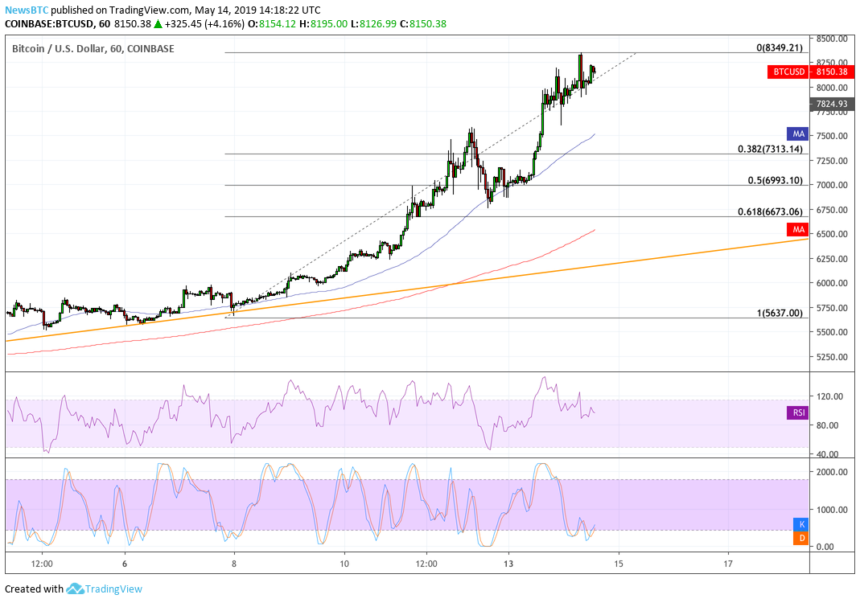
The on Tuesday clocked a new 2019 high of $8,350 on , its highest since July 2018.
The surge came as a part of an extended bullish action that picked momentum particularly after April 2, 2019. The /USD instrument, on the day, rose up to 23 percent, which started a series of similar buying actions throughout April and first half of May. The strengthening bullish bias assisted in breaking above crucial resistance areas, such as the ones lurking near $6,000, $6,400, and $7,500. As a result, the world’s leading had brought its net bottom-to-up recovery to 162 percent by the time of this publication.
Price Rose 101 Percent Since April 2 | Image Credits: TradingView.com
Artificial Pump?
The speed with which rose prompted many to call the move “manipulated.” Crypto skeptic David Gerard on Monday called the price a “proxy for margin ,” adding that one can make more money by manipulating the ’s “thin and ill-regulated market to ”
Preston Byrne, partners at New York-based Byrne & Storm, built up to the scenario laid by Gerard, why every price boom coincided with a significant exchange(s) having “banking, withdrawal, and possibly solvency problems.” To him, the ongoing BitFinex was in a spot of trouble owing to its management of $850 million of ’ funds. An event of such scale could have driven the market down. But instead, the reverse happened due to potential price manipulation.
“This was the case with, e.g., Mt. Gox in 2013, and some have argued was also the case with long-suffering crypto exchange Bitfinex in 2017 […] If you’re a trader or investor, tread carefully. It is possible that the current price of a bears some relation to, and is uniquely vulnerable to, regulatory developments,” said Byrne.
Everyone seems to forget that when Bitfinex received CFTC subpoenas the price went up 40% in two days, ultimately the price of doubled before crashing.
It wasn’t good .
— Bitfinex’ed (@Bitfinexed)
Tether Pumping bitcoin
Gerard iterated that he didn’t believe institutional investors were behind the price explosion. Instead, it was the Bitfinex’s additional 800 million USDT supply – each acting as a US dollar – that was piling into the market. Excerpts from Gerard’s article:
“Tethers are dollar-substitute — each a $1 liability on the books of Tether, Inc., hypothetically redeemable on demand for an actual dollar. The idea is that these are pretty-much-dollars — compare Eurodollars in the real financial markets — but move at the speed of crypto. Tether is owned and run by the same people as crypto exchange Bitfinex.
“There is the minor detail that nobody has ever verifiably confirmed being able to redeem a Tether for a dollar.”
The Other bitcoin Case
The last time broke $8,000:
Microsoft wasn’t building on it.
Congress wasn’t fighting it.
Bakkt wasn’t launching with it.
Square wasn’t selling it.
Fidelity wasn’t storing it.
TD Ameritrade wasn’t it.
Whole Foods wasn’t accepting it.
— The Rhythm Trader (@Rhythmtrader)
The price rise closely followed disturbance prompted by the US- trade war in the global markets. The move also came after mainstream financial companies like Fidelity Investments, E*Trade Financials, and TD Ameritrade announced new services for institutional investors. Fidelity’s digital asset services head Tom Jessop the Block that institutional interest in the market had grown in the past 12 months.
“We just completed a survey of about 450 institutions,” said Jessop, “so everything from family offices to registered investment advisors to hedge funds. It’s interesting, I think about 20% indicated that they currently allocate to digital assets with an intention to grow that.”
Published at Tue, 14 May 2019 16:20:07 +0000
