August 15, 2026

Capitalizations Index – B ∞/21M

IoT Crypto VeChain Price Surges 50% Overnight, Factors Behind the Spike

Iot crypto vechain price surges 50% overnight, factors behind the spike

IoT Crypto VeChain Price Surges 50% Overnight, Factors Behind the Spike


Vechain price lighting a match
Advertisement

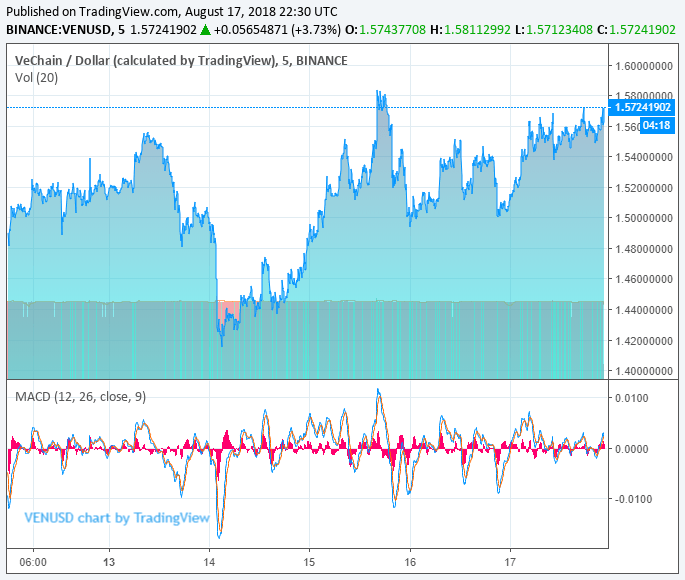
VeChain, a China-based Internet of Things (IoT)-focused crypto, has surged by more than 50 percent in value within the past 24 hours.

Analysts have attributed the increase in the price of VeChain to the successful series of partnerships the team has been able to secure since earlier this year and the improving momentum of tokens in the global cryptocurrency market.

Major Partnerships

Vechain price
Vechain/usd | source: tradingview

In May, CCN reported that Pricewaterhousecoopers, a “Big Four” auditor better known as PwC, acquired stake in the Chinese cryptocurrency with the intent of utilizing the VeChain IoT network to serve multi-billion dollar clients and conglomerates that rely on the services of PwC.

At the time, Raymund Chao, the chairman of PwC Asia Pacific and Greater China, said:

“We are glad to establish a deeper relationship with VeChain, which aims to build a trusted and distributed business ecosystem to help address long-standing challenges in supply chain management, food trust and anti-counterfeiting areas. VeChain’s mission aligns with PwC’s purpose of solving important problems and building trust in society.”

The involvement of PwC has been crucial for VeChain’s performance over the past three months because it meant large-scale conglomerates have to started to demonstrate interest in the VeChain blockchain protocol.

The strategic partnership between PwC and VeChain in May was especially valuable because PwC acquired a small ownership interest in the VeChain network, with the plan of collaborating with the VeChain development team as an investor, not as a client.

It is important to acknowledge the participation of PwC in the long-term growth of VeChain because the vast majority of partnerships secured by blockchain projects in the cryptocurrency sector are often deals that state multi-billion dollar conglomerates as the beneficiaries.

For instance, many projects have claimed to have secured strategic partnerships with major firms in the technology sector such as Google and Microsoft, but the actual nature of the deal revolved around the projects paying the conglomerates for their services, not the other way around.

Since May, VeChain has aggressively expanded its services internationally, winning a contract with the government of China to develop a vaccine tracing solution.

Despite the Chinese government’s ban on cryptocurrency trading, it has allocated more than $3 billion in 2018 alone to state-funded blockchain funds, primarily to finance blockchain startups and innovative technologies.

This month, China’s Ministry of Information Technology ordered local financial authorities and agencies to speed up the development and commercial implementation of the blockchain, which will positively impact companies like VeChain that are actively cooperating with the Chinese government.

“The industry remains in a nascent stage. While the technology has brought benefits, it could also bring risks such as technical loopholes, and challenges to current systems and norms, the ministry said. The ministry also said it will work with local authorities to push for healthy and orderly development of the industry,” the report of Xinhua, a state-owned publication, read.

Other Factors

The abrupt price surge of VeChain was evidently fueled by the general recovery of the cryptocurrency market and the re-established momentum of tokens. But, the valuable partnerships the company has been able to secure since early 2018 drove its recent momentum and will likely continue to positive impact its long-term growth.

Featured Image from Shutterstock

Follow us on Telegram or subscribe to our newsletter here.
Join CCN’s crypto community for $9.99 per month, click here.
Want exclusive analysis and crypto insights from Hacked.com? Click here.
Open Positions at CCN: Full Time and Part Time Journalists Wanted.

Advertisement


Published at Sat, 18 Aug 2018 00:21:39 +0000

Altcoin Analysis

Previous Article

Request Network Partners With Wikipedia (Request Network EXPLODING in 2018?)

Next Article

Simple Token OST Crypto Review – 🌙🚀Moonshot… Wednesday 😅 #7🚀🌙

You might be interested in …

Operator of Illegal Bitcoin Exchange Coin.mx Sentenced to Prison

coinmx.jpg

Anthony Murgio, 33, of Tampa, Florida, has been sentenced to five and a half years in prison for running a bitcoin exchange connected to hackers. The exchange was used to launder more than $10 million worth of funds, authorities reported.

Both Murgio and Yuri Lebedev, 39, of St. John’s, Florida, operated Coin.mx through a fraudulent company called “Collectables Club.” According to the U.S. Attorney’s Office for the Southern District of New York, the illegal bitcoin exchange used the firm’s misleading name to open financial accounts at banks pretending to be a “members-only association of individuals who discussed, bought, and sold collectible items and memorabilia.” Murgio and Lebedev, along with other co-conspirators, violated bank and credit card company rules and regulations by “deliberately misidentifying and miscoding Coin.mx customers’ credit and debit card transactions.”

“Lies conceived and deployed by Murgio permeated every aspect of Coin.mx’s operation, including its use of front companies, like Collectables Club and Currency Enthusiasts, to try to conceal the illicit nature of the operation,” the Department of Justice stated in its sentencing submission.

On January 9, Murgio pled guilty to three counts regarding operating Coin.mx, which processed over $10 million worth of illegal bitcoin transactions. Murgio ran the bitcoin exchange between October 2013 and July 2015 for Gery Shalon, 33, an Israeli citizen who was responsible for hacking at least nine companies, including JPMorgan Chase, E-Trade Financial Corporation and Dow Jones. Coin.mx sold bitcoins that came from illegal online transactions, such as victim payments to ransomware attackers who sought to launder the cryptocurrencies clean.

“I screwed up badly and made serious mistakes and misjudgments,” Murgio said, showing remorse, to U.S. District Judge Alison J. Nathan at his sentencing.

Shalon, along with Ziv Orenstein, 42, compromised data on approximately 76 million household customers and 7 million businesses by hacking the nine companies. U.S. officials described their operation as a “diversified criminal conglomerate” responsible for the largest theft of valuable information from a U.S. bank. The compromised data included the names of customers, along with email addresses and phone numbers. Authorities collected evidence stating that Murgio exchanged cash for the bitcoins of Shalon’s criminal gang. Israeli police arrested Shalon and Orenstein in July 2015, and they were extradited to the United States in June 2016. Both are facing serious charges, including aggravated identity theft, wire fraud and money laundering.

“Mr. Murgio led an effort based on ambition and greed,” and constructed on a “pyramid of lies,” Judge Nathan said during the sentencing hearing at the Manhattan federal court.

On March 17, a Manhattan jury found Lebedev and his co-conspirator Trevon Gross, 52, of New Jersey, guilty of charges connected to a bribery scheme in an attempt to hide the illegal activities of Coin.mx from financial institutes and regulators. Both of the defendants are facing a maximum sentence of 30 years in prison. Judge Nathan scheduled the sentencing hearing of Lebedev and Gross for July 20, 2017.

Murgio’s father, Michael Murgio, 66, was also involved in the Coin.mx case. In October, the father plead guilty to “making a false statement to the National Credit Union Administration on behalf of his son.” By making a plea deal, Michael Murgio managed to avoid additional charges in the case, including “conspiracy to make corrupt payments with intent to influence an officer of a financial institution and making corrupt payments.” Judge Nathan sentenced the elder Murgio to one year of probation along with a $12,000 fine.

The FBI arrested both Lebedev and Murgio on July 23, 2015, for “running an unlicensed bitcoin exchange with the goal of helping individuals launder money.”

Despite the prosecution’s request for 10 to 12 years and seven months behind bars, the Manhattan federal court sentenced Murgio to five and a half years in prison. According to Reuters, Judge Nathan considered Murgio’s “generosity to friends and support to his family” and imposed a prison sentence half as long as the prosecutor recommended.

Judge Nathan has scheduled a hearing on September 1 to decide on the amount of fines, forfeiture and restitution Murgio has to pay to the state. The operator of the illegal bitcoin exchange remains free on bail.

The post Operator of Illegal Bitcoin Exchange Coin.mx Sentenced to Prison appeared first on Bitcoin Magazine.

Blockchain training india

Blockchain Training India

Blockchain Training IndiaBlockchain is the leading digital assets platform which records and controls the monetary information. It is considered as the revolutionary shared ledger technology that help businesses solve complex problems. Blockchain Technology is for […]