The blockchain technology has revolutionized the ability to perform network transactions and manage digital assets. But due to the scarcity of blockchain experts, people are not using this technology. IOlite provides the helping hand to those people who are not aware of blockchain technology and don’t have prior programming knowledge. They just have to sit down and write in a natural or programming language the contracts or agreements and it then is transferred to a smart .
Iolite is a third layer of communication, anybody can communicate with the blockchain. The person doesn’t need a technical knowledge for that.
It has three components, the user interface, (fast adaptation engine) that will adapt any known programming language to smart contract architecture in a very short time, and iolite blockchain. The text or the contract is passed by the first application engine. If it doesn’t recognize it is been published to a community of experts in various fields and those experts generate knowledge back. The machine translates these contracts into different languages.
These smart contracts can reduce corporation cost for financial and operational activities. This blockchain technology is designed for commercials, academics, and regulatory people.
Iolite simplifies the development of decentralized technology applications and reduces the cost of writing smart contracts. Its fast adaptation engine will be integrated into software development environment to make blockchain technology more accessible and increase its .
The benefits of using this technology are that it doesn’t involve any kind of cost. It can be used to write the smart contract or the digital agreement free of cost.
This iolite platform is promoted by iolite foundation that is a nonprofit organization. The heart of this blockchain technology is iolite . These contributors have the professional knowledge and motivation to make FAE learning curve effective.

I wrote this beginner’s guide some time ago for my friends who were becoming interested in bitcoin. Free to distribute and share.
FAQ
Who is Satoshi Nakamoto?
No one knows. The speculation has been intense but it remains speculation. We know that Satoshi was last publicly involved with bitcoin until the end of 2010, when they left the project in the hands of other software developers. In the end, it doesn’t really matter. They created the world’s first viable cryptocurrency and it continues to operate with or without them. If you are interested, there are many online resources discussing possible candidates.
Why do we need bitcoin and other cryptocurrencies?
Everyone has different reasons for getting involved in bitcoin. However, it is worth nothing that the genesis block contained the following text: “The Times 03/Jan/2009 Chancellor on brink of second bailout for banks”, referring to an article published in a major financial newspaper regarding the dismal state of the banking industry. This strongly suggests that Satoshi was one of many who were feeling increasingly disenfranchised with governments and the banking system. Indeed, this is the primary reason many users are attracted to bitcoin.
Beyond any ideological reasons, bitcoin and other cryptocurrencies have made possible a whole range of novel applications that has spawned an entire industry.
What exactly makes bitcoin revolutionary?
A very long answer could be written here. Let’s look at a famous problem that bitcoin solved called the Byzantine General’s Problem. You can read a brief summary of the problem here: .
Applying this problem to a distributed ledger, how do we verify that any inputs to the ledger are authentic? An open ledger can have millions of users; how do we enforce each one to be honest? Most importantly, how do we do all this in a decentralized manner, i.e. without a single authority making the decisions? In bitcoin’s case, we want to ensure that no one is forging transactions. Each node in the bitcoin network must reach a consensus for each transaction.
Again, the answer here can be very long and you are encouraged to do further research if it interests you. In simplest terms, bitcoin solves the Byzantine General’s Problem by:
1. Recording every transaction to a ledger and securing this ledger using a powerful network of computers.
2. Allowing every participant to reach a consensus on which transactions are valid (using the proof-of-work method) even though they inherently don’t trust each other.
3. Making subversion of this network extremely difficult.
What are some advantages bitcoin has over the legacy banking system?
To name a few:
1. It is autonomous and not ruled by any single entity that is corruptible.
2. It allows users to control their own money. Banks can freeze and confiscate your funds; only you control your bitcoins.
3. It is secure, cheap and fast to use anywhere in the world.
4. It is neutral and censorship-resistant. Banks and payment processors can be coerced to refuse payments for certain entities. For example, Wikileaks was denied financial services by the government but continued to receive donations in bitcoins.
How is bitcoin not a Ponzi scheme or pyramid scheme?
A Ponzi scheme is a type of scam where people are led to believe they are earning unusually high returns on an investment, when in fact they are being paid with their own money and that of their fellow investors. Ponzi schemes collapse when investors try to cash out their investments because no profits actually exist. The operator of the scheme can leave with the investor’s money.
A pyramid scheme is a type of scam where people are recruited to pay money for the opportunity to sell a service or product. However, the real profit is in the recruitment of other people, not the sales. Therefore, this scheme collapses because it requires an exponentially growing amount of people. The people at the top and other early investors will make the most profits while the people at the bottom, who couldn’t find any new recruits, will lose their money.
The network does not promise any user windfall profits.
bitcoin is not controlled by any entity that benefits from more people joining the network.
If you wanted to “cash out” your bitcoins, you may do so at any time.
No one gets free bitcoins by recruiting more people.
Bitcoins are exchanged between consenting members of the network who must all obey the same rules of the network.
Software developers don’t earn bitcoin by contributing to the code.
The fact that early adopters of bitcoin benefited more than later adopters does not make bitcoin a Ponzi scheme. A Ponzi scheme is a zero-sum game, where the people at the top benefit at the expense of everyone else. bitcoin is not a zero-sum game; early adopters benefit but not at the expense of later adopters. To use an analogy, an early investor in a successful start-up company stands to make more money than a later investor.
What is bitcoin “backed by”?
As with anything else, bitcoins have value because they are useful and people are willing to pay for them. Fiat money is not backed by anything either; the USD went off the gold standard in 1971. Like bitcoin, the USD is desired simply because it is useful. For example, it is the only currency the government accepts to pay taxes and debts. bitcoin does not have any inherent value but neither does fiat money.
Is it profitable to mine bitcoins anymore?
Large mining companies have emerged in the bitcoin ecosystem, each controlling immense amounts of hashing power using highly specialized, expensive hardware. Individual miners running mining operations in their living rooms stand no chance. However, these individuals can team up and aggregate their hashing power in what is called a mining pool, where they stand a better chance of mining a block and sharing the reward among all participants in the pool.
Isn’t mining a waste of energy/electricity?
Many would argue that expending energy to create and secure a free monetary system is not a waste at all. Compared to the legacy banking system (which also requires energy and human capital to maintain), bitcoin is more efficient.
How will miners make money when all bitcoins are mined?
Miners will obtain income solely from transaction fees. Assuming wider adoption in the future, transaction fees alone will be enough to incentivize miners to continue mining.
Isn’t it unfair that early adopters accumulated so much bitcoins?
Early adopters assumed a high level of risk by becoming involved in bitcoin. They were instrumental in establishing bitcoin as a viable network and indeed, many were able to realize large returns on their investments. However, many early adopters also sold their bitcoins at much lower prices (relative to present-day) or have even lost large amounts of bitcoins by misplacing their private keys or getting hacked. Bitcoins are constantly changing hands and being redistributed; read about the “bitcoin BearWhale” for such an example.
Can’t people brute-force private keys?
It is computationally infeasible to do so. The amount of money, time and effort required is so immense that the costs outweigh the rewards.
But how improbable is a private key collision?
Let’s say you had a computer that could generate 1 trillion private keys per second, which is impractical with modern computers, and check if any of those private keys have a corresponding address with a non-zero amount of bitcoin in them. Let’s also say you had a thousand of these computers and ran them nonstop. In one year, you could brute-force about 264 private keys. There are 2256 possible private keys. You would have to run these computers for 2192 more years to check every single private key — that number is 58 digits long. For reference, the age of the universe in years is only 11 digits long (13.8 billion).
The resources required to obtain these computers and run them for 1 year would be tremendous and would yield nothing. You have a much, much better chance of winning the lottery jackpot of $500 million, so if your goal is to make money, you’re better off spending that money on lottery tickets rather than 1000 computers. Or you could get creative and try extorting private keys from people (not recommended). The point is you shouldn’t worry about losing your bitcoins to a private key collision. You have a much, much higher chance of dying from a lightning strike in the next year but you probably aren’t worried about that. So, why are you worried about a private key collision?
How big is 2160?
Some examples used to visualize that number:
If each of the 7 billion persons on Earth created 7 billion new addresses every second for the next 7 billion years, we would create 298 addresses. This is only 0.0000000000000000216% (2.16E-17) of all possible addresses.
There are 263 grains of sand on Earth. Imagine that each grain of sand is a new Earth, each with its own 263 grains of sand. Now, add up all the grains of sands on all of the Earths. Multiply the sum by 17 billion. That’s how many possible addresses there are.
Is it possible to implement blockchain technology without bitcoin (or another token of value)?
No. The main innovation of bitcoin is its decentralized design, which makes it immutable and highly resistant to attacks. bitcoin, the token of value, incentivizes miners to operate and secure the network. Additionally, computing power must be distributed to resist attacks by powerful malicious entities. If one entity controls a majority or the entirety of a blockchain’s hashing power, this defeats the purpose of an immutable blockchain because they could modify the blockchain as they wish, with no recourse for other users of the network.
What are some other possible uses of blockchain technology?
Because of the immutable nature of the blockchain, it can be used to prove ownership of other assets, facilitate a more transparent voting environment, implement smart contracts, improve cloud storage and many other uses we have yet to conceive of.
Why is the target block time 10 minutes?
After a block is mined, it takes time for other miners to find out about it. Until then, they keep trying to find the solution. This work gets “wasted” because they aren’t achieving anything. If a second miner finds the solution before the first solution propagates to the network, then the network will only accept the first one. For example, if it takes miners on average 1 minute to learn about new blocks and new blocks get mined every 10 minutes then the overall network is wasting about 10% of its work. Lengthening the time between blocks reduces the waste.
Satoshi chose 10 minutes as a compromise between confirmation times and wasted work. Longer block times would result in longer confirmation times but proportionally less work wasted. Shorter block times would result in quicker confirmation times but proportionally more work wasted.
What is a stale block or stale chain?
It is possible for two miners to find the solution to a block within a short timeframe of each other. For example, miner A finds a solution and begins to propagate it. Before miner A’s solution can finish propagating to the entire network, miner B is continues to mine and finds another solution, which they also propagate. Since miner A started propagating first, let’s say miner A’s solution reaches 75% of nodes while miner B’s solution reaches 25% of nodes. Since both solutions are valid, this effectively creates two chains. 75% of miners will start working on the chain containing miner A’s solution while the other 25% will work on the other chain. Whichever chain finds the next block first (most likely the 75% one) will become the longest chain backed by the most computational power and the other chain is said to become stale. Any computational power that was used on the now-stale chain is said to be “wasted work”.
How does double spending work?
You can read about it here:
This topic can be complicated. For beginners, the important thing to know is to wait for 1 or more confirmations to prevent a double spend. If you are transacting with very small amounts of bitcoin, then you may choose to accept a transaction with 0 confirmations at little risk to yourself.
What does it mean to “sign a bitcoin transaction offline”?
As mentioned before, to send bitcoins requires that you digitally sign the transaction with your private key to prove that you own those bitcoins. However, whenever you use your private key, you are exposing it, which leaves it susceptible to interception by malware. For security purposes, many wallets offer the ability to do this step offline. Check the website/documentation of your wallet for a more detailed guide on how to do this.
Here is a brief explanation of how it is done:
1. On an internet connected machine, you initiate a transaction and specify the recipient address and amount. You save the transaction as a incomplete transaction file. Note that you have not used your private key yet.
2. Transfer the transaction file to the offline machine (e.g. using a USB flash drive) which contains your private key. You load up the transaction file to the wallet and sign the transaction with your private key. This is done offline so no one can intercept your private key.
3. You transfer the completed transaction file back to the online machine. The transaction file now contains all the data needed for a valid transaction. You broadcast the transaction to the bitcoin network and it is accepted.
What does it mean to “sign a message”?
Message signing is done to prove that you know the private key of an address, without actually having to transfer any bitcoins. This is done by the following:
1. In the wallet that has your private key, find the “sign message” option. Modern wallets should have this feature.
2. If the wallet hasn’t already done it for you, enter the address that you want to prove ownership of. Then, enter any message you like. If you are looking to prove ownership of bitcoins, you may want to include the date, a reason, and a short identifier.
3. Click “sign”. If your wallet contains the private key for the specified address, it will produce a unique signature hash. You then send the address, the exact body of the message and the signature to the person requesting the verification. This is safe to do; no one can deduce your private key from the signature.
4. The person would then verify the message to see if the signature is valid. The signature hash could only be valid if it was created using the private key corresponding to that address. Therefore, the person knows that you have ownership of that address.
Let’s test this out. For example, your friend wants to prove they have access to the bitcoins stored at the following address: 168EnKgYDQxf19HE5WMn38vAxaQ2YJByiF. They sign a message and tell you that the message they signed was “bitcoin for beginners” and the resultant signature was:
H0Zy91WP57I6WMDajDIsuTtQBg1a4XSNG+8ExqSh3YeoYo0bbQ3EOFyC0xO7r2i07NoUdyW8dZoK0V1sL1ps3yI=
Now, perform an internet search for “bitcoin verify message” or if you have already downloaded a wallet, your wallet may offer this feature. Choose a site and input the address, signature and message. You should be successful in validating the signature:
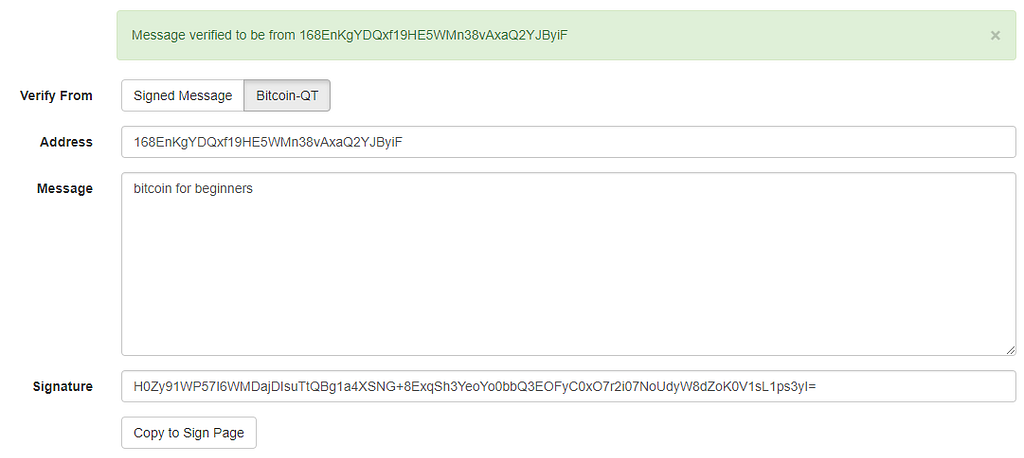 (https://reinproject.org/static/bitcoin-signature-tool/index.html)
What does it mean to “sweep” a private key?
Sweeping means to move all the bitcoins associated with a private key to a new address of your choice. Most wallets offer a sweep feature where you input a private key and the wallet will move all the bitcoins associated with that private key to your address.
What is a fork?
In software development, a fork occurs when a new, separate project is started by copying the source code of another project. In free and open source software, forks are commonly done by developers who may have different goals than the original software. A fork of bitcoin would create two separate versions of the blockchain, after which they would diverge.
A soft fork of bitcoin means that valid blocks of the new version are also considered valid in the old version. Soft forks result in a temporary divergence of the blockchain. The original chain will accept blocks from both old and upgraded nodes. The newly forked chain will only accept blocks from upgraded nodes. If a majority of hashing power converts to the new chain, then it will overtake the original chain. If not, then the original chain will carry on.
A hard fork of bitcoin means that the older version will not accept new blocks. It results in a permanent divergence of the blockchain into two chains with different consensus rules.
A user activated soft fork (UASF) is a soft fork activated by node enforcement rather than miner signalling. UASFs depend on having a sufficient number of nodes enforcing the new rules. These nodes will not accept blocks from miners not following these new rules.
What is a bitcoin improvement proposal (BIP)?
BIPs are documents used to address and propose new features to the bitcoin network.
What scaling problems does bitcoin face?
Scaling refers to the capability of something to handle a growing amount of work, or its potential to increase to accommodate that growth. bitcoin’s block size limit of 1MB is proving to be inadequate and scaling solutions are being proposed.
The “block size debate” is one of the most contentious issues in the bitcoin community. You can read more about it here:
Recent advances in bitcoin, such as SegWit, have led to the concept of “block weight” being introduced. Read about it here:
What is SegWit (Segregated Witness)?
SegWit is a soft fork that changed the transaction format of bitcoin. SegWit splits transactions into two parts: one part containing the typical data in a transaction and the second part containing the unlocking signature (“witness” data), which is added as a separate data structure to the end of the block. This reduces the transaction size because the witness segment is only counted as a quarter of its actual size. As a result, it is estimated that SegWit implements an effective block size limit of 1.8MB.
SegWit also fixes the transaction malleability problem (read about here: ) which was a longstanding problem. This opens the possibilities of other second layer solutions such as Lighting Network, which would have been difficult to implement without a transaction malleability fix.
What are on-chain and off-chain transactions?
An on-chain transaction is a transfer of value that occurs directly on the blockchain. It is included in the bockchain and viewable by anyone.
An off-chain transaction is a transfer of value that occurs outside of the blockchain. Let’s say that you and a friend wanted to transact in bitcoin. You guys create a system where you record your payments to each other over the course of a month, and then the difference is paid. After 1 month, your friend owes you $80 and you owe your friend $70. The net transfer of value is $10, so your friend would send you $10 using an on-chain transaction. In this way, only one transaction fee is paid for what were technically multiple transactions.
bitcoin exchanges also operate using off-chain transactions. For example, when you buy 0.5 BTC on an exchange, it is not immediately sent to your wallet. The exchange simply records the fact that your account has 0.5 BTC worth of “credit”. If you then withdraw that 0.5 BTC, the exchange first checks that your account has 0.5 BTC worth of credit, and then they send you 0.5 BTC on-chain. Similarly, when you do online banking, you are not actually transferring physical cash; you are simply moving numbers around in a database.
What is a second layer?
A second layer refers to a network that works in conjunction with and expands the functionality of the bitcoin network (the first layer). Second layers have been suggested as a solution to bitcoin’s scaling problems and to provide additional functionality to the network. One of the most popular proposals is the Lighting Network.
What is the Lighting Network?
The Lightning Network is a second layer payment-channel technology. It aims to help bitcoin scale by moving the vast majority of transactions off-chain in a trustless and decentralized manner using smart contracts. Users can open payment channels between each other and send as many off-chain transactions as they want. When the channel is closed, an on-chain transaction is made to settle any net transfer of value between users. Unidirectional channels are also possible, allowing users to pay other people without requiring their cooperation to create a channel.
Read about LN here:
How do I acquire bitcoins?
-buy them from an exchange, locally from other people, from a bitcoin ATM
-accept bitcoins as payments for goods or services
-mining (difficult to do)
Where can I spend bitcoins?
There are many sites which list places that accept bitcoins. There are also some major retailers that accept bitcoin as payment. More and more content creators, especially in software, are accepting bitcoins as donations. Of course, you can also transact using bitcoins with anyone you know.
Are there physical bitcoins?
Technically, there is no such thing as a physical bitcoin. However, you can buy a physical coin which has a private key embedded in it. These physical coins are usually bought as collectibles.
Did someone really spend 10,000 bitcoins on 2 pizzas?
Yes, on May 22 2010, someone paid for 2 pizzas with 10,000 bitcoins, only worth a few dozen dollars at the time but now worth dozens of millions. Although your eyes may bulge at such a decision in hindsight, that transaction was crucial in establishing bitcoin as a legitimate currency. May 22 is now known as “bitcoin Pizza Day”, celebrated by eating pizza to commemorate what is believed to be the first real-world transaction involving bitcoin.

bitcoin is trading inside a symmetrical triangle on its 4-hour time frame and seems to have its sights set on the top. Price just recently bounced off support around $7000 and is hovering around the mid-triangle area of interest around $8000-8500.
A move past this level could lead to a test of the actual resistance at $9000 or even a break higher. However, the 100 SMA is below the longer-term 200 SMA to signal that the path of least resistance is to the downside. This means that there’s a chance the drop could resume and another test of support could ensue.
Then again, the gap between the moving averages is narrowing to signal weakening bearish pressure. If an upward crossover materializes, more buyers could join and sustain the climb, possibly even past the triangle resistance.
Note that the chart pattern spans $6000 to $13,000 so an upside break could lead to a rally of the same height. For now, though, stochastic is turning lower to show that sellers are taking over while buyers take a break. RSI is also on the move down to signal that bearish pressure is present.

bitcoin price has ticked higher towards the end of the previous week as profit-taking leading up to the tax filing deadline is almost over. Traders are now anticipating a strong rally after the deadline passes as investors reopen their positions.
After all, big hedge funds are reportedly gearing up to place bets on the industry so other market players might rush to join in. The second quarter of the year has also historically proven to be bullish for the cryptocurrency so traders would likely take advantage of this pattern.
Geopolitical risk is still in play but this seems to be weighing on the dollar instead of boosting its safe-haven appeal. Over the weekend, the US military launched strikes in key areas of Syria so traders might be on edge for retaliation.
The post appeared first on .