
July 21, 2026

Capitalizations Index – B ∞/21M

Investors Turn Bullish as Cryptocurrency Market adds $12 Billion 24 Hours

Investors turn bullish as cryptocurrency market adds $12 billion 24 hours

Investors Turn Bullish as Cryptocurrency Market adds $12 Billion 24 Hours


Bitcoin price
Advertisement

Open Positions at CCN: Full Time and Part Time Journalists Wanted.

Over the past 24 hours, the cryptocurrency market added $12 billion, as major cryptocurrencies including bitcoin, Ethereum, Ripple, and bitcoin Cash experienced a short-term corrective rally.

Breathing Room, But Not Entirely Optimistic

The bitcoin price rebounded from $6,300 to $6,700, breaking a descending trendline since May 3, when BTC achieved $10,000. While it is too early to conclude that BTC has entered into a mid-term rally given that it is still likely for BTC to fall below the $6,000 mark in the short-term, the cryptocurrency market has gained a breathing room from the recent major correction that began in early May.
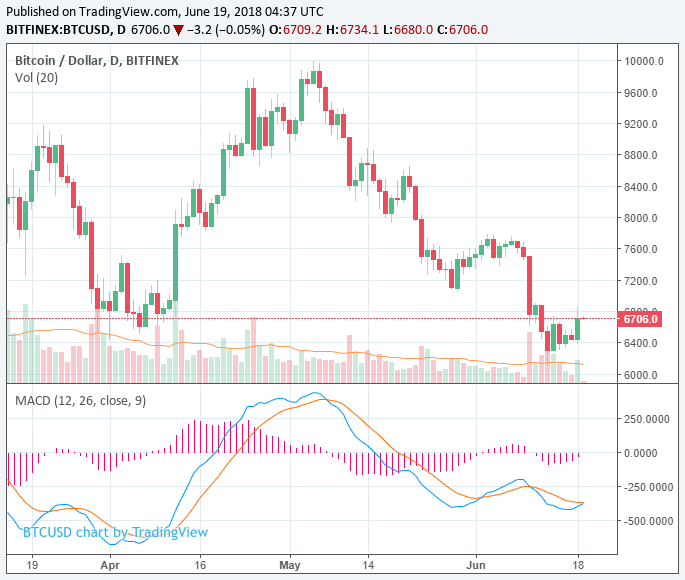
Investors turn bullish as cryptocurrency market adds $12 billion 24 hours

On yesterday’s report, CCN noted that if BTC falls below the $6,300 mark, it could initiate another downward trend, potentially to the higher end of the $5,000 region. CCN also emphasized that if BTC rebounds to $6,600 in a period of 24 hours, there exists a possibility that BTC stops a potential move to the $5,000 region.

So far, BTC has been able to remain relatively stable in the mid-$6,000 zone, with stable volume and moving averages demonstrating some momentum for the dominant cryptocurrency. But, if BTC falls back down to the $6,400 region in the upcoming days, it is likely that BTC will continue its downward trajectory.

Investors have become more optimistic and bullish on the market, due to the abrupt surge in the volume and price of BTC within a small 2-hour period. If investors want to see BTC remain above the $7,000 mark in the short-term, it will have to reverse the bearish sentiment by restoring the volume and continuing the current upwards trend of BTC.

As of now, based on the movement of BTC in the past 24 hours, it cannot be concluded that BTC restored its bullish sentiment and is ready to move to the upside. If BTC does sustain its momentum and volume in the next two to three days and remain above the $6,800 mark, a move towards $7,000 can be a possibility.

Custodian Solution in the Works

This week, Coinbase, the world’s most widely utilized cryptocurrency exchange, wallet, and brokerage, revealed that it is preparing to bring third party institutional custody to the cryptocurrency market and digital assets.

Kyle Samani, a managing partner at Multicoin Capital, which partnered with Coinbase to bring its institutional products to the public market, said:

“There are a lot of investors where custodianship was the final barrier. Over the next year, the market will come to recognize that custodianship is a solved problem. This will unlock a big wave of capital.”

Several prominent investors and hedge fund managers including Ari Paul from Blocktower previously echoed a similar sentiment and noted that the lack of custodian solutions have forced institutional investors to sit on the sidelines.

Currently, there are no institutional investors in the cryptocurrency market and the sector is mainly driven by retail or individual investors. That soon could change however, with companies like Coinbase, JPMorgan, and Goldman Sachs working on institutional-level suite of products.

Featured image from Shutterstock.

Follow us on Telegram.
Advertisement

Published at Tue, 19 Jun 2018 05:42:02 +0000

bitcoin Analysis

Previous Article

Investors Turn Bullish as Cryptocurrency Market adds $12 Billion 24 Hours

Next Article

Authentic Supreme Prodigy Tee, White, Size Medium, Bitcoin

You might be interested in …

How the Blockchain Could Become an Image Dataset Repository for AR/VR

How the Blockchain Could Become an Image Repository for AR/VR

Lampix, an augmented reality (AR) startup, is building the world’s first blockchain-based “image mining” network. The company has embarked on the ambitious mission of developing one of the largest image databases.

The database, which will be available for all to use, intends to be the backbone of AR and machine-learning training. It seeks to suppress startups and developers’ dependency on proprietary image datasets owned by tech giants.

“Existing databases are controlled by the company who built them: Google, for example, has made such a database. However, there are two problems with this approach: Google controls this database and can, at any moment, forbid their competitors from using it, remove access to it, etc. Second, this database includes only the data Google thinks is needed,” George Popescu, CEO and co-founder of Lampix, told bitcoin Magazine.

Instead, Lampix is electing to offer a database where “no single company, and not Lampix neither, will control who has access to the data, and what data should go in the database.”

“No centralized control. This is why we are working on the blockchain,” he said.

Leveraging blockchain technology, Lampix is building a network that rewards users with Lampix tokens, called PIX, to take pictures, describe them and assemble open-source, curated image datasets. Miners can use any device that has a camera with the sufficient resolution, including the company’s Lampix device, to submit datasets.

Datasets submitted will consist of an image and description. To make sure the image and description match, voters will either upvote or downvote a dataset and will be compensated with PIX tokens if their vote aligns with the consensus.

Third-party developers will be able to access these datasets to train their own computer vision applications by paying a small fee using PIX.

Lampix is planning to include a hash of each picture on the blockchain once it is approved and added to the database. This will increase security and address two main concerns: ensuring that a picture hasn’t been tampered with and ensuring that a user is using a full dataset, meaning that no picture has been removed or added.

“Developers will be able to tap into this database for their own product, such as Google Glass, Holo Lens or our Lampix product and create applications,” he said. “This is exciting, as for any application, a lot of data is necessary to make it accurate and work properly.”

Lampix plans to create a total of 1.1 billion PIX tokens. It will sell 50 percent of its tokens in a crowd sale over a period of three days. At launch, one PIX will cost $0.12. The company aims to raise roughly $50 million.

Popescu said the team is currently working with exchanges to list the PIX tokens in as many platforms as possible. “We expect it will be listed on Gatecoin, Bittrex, Kraken, Yunbi and a few more quickly,” he said.

New York-based Lampix builds and sells hardware devices and software that bring augmented reality to any flat surface, turning these surfaces into interactive displays. Using machine learning and computer vision, Lampix recognizes objects and projects context-relevant buttons and menus for different actions.

The company serves the likes of Bloomberg and PwC, as well as large retail chains. It claims it has a pipeline of about 200 famous companies inquiring about its Lampix device.

The database will allow Lampix to improve its technology and make it more accurate as computer vision and machine learning need a lot of images for training and testing.

“Our plan is simple: to map the world inside. Not the room, but actual objects on desks, tables, the surfaces themselves. Or even objects on the floor, on the kitchen counter, on your bathroom counter,” he said. “Google Maps changed the world, but they only have access outside. Imagine what will happen if we map the interior world.”

Much of the business world’s interest in blockchain has been centered on financial and banking services. Yet, possible applications of the technology go well beyond financial services.

“There is a lot of opportunity with user content which is not being explored very much. Many people focus on blockchain in finance,” Popescu said. “However, I think that sourcing user content, and using the technology to manage license and access, is a huge opportunity. AR/VR is just a small piece of this.”

The post How the Blockchain Could Become an Image Dataset Repository for AR/VR appeared first on Bitcoin Magazine.