Interview mit Dr. Jens Zimmermann – Wirtschaftsforum der SPD Teil 1
BTC-ECHO
Interview mit Dr. Jens Zimmermann – Wirtschaftsforum der SPD Teil 1
Am Rande der Arbeitssitzung zum Thema Kryptowährungen des SPD-Wirtschaftsforums hatten wir die Möglichkeit, mit zwei Vertretern der Sozialdemokraten zum Themenfeld Blockchain und Kryptowährungen zu sprechen. Im ersten Teil dieses Interview-Zweiteilers stellen wir dem SPD-Bundestagsabgeordneten Dr. Jens Zimmermann unsere Fragen. Dr. Jens Zimmermann ist sowohl ordentliches Mitglied im Finanzausschuss als auch digitalpolitischer Sprecher der SPD-Bundestagsfraktion, was…
Litecoin Price Analysis: Eyeing $250?
So, there hasn’t been too much of a development since the last time that we covered (LTC). Overall, as expected, there was a big price rise leading into the launch, but as stated – that run needed some time to cool off and that’s why the author originally advocated staying at bay for this coin.
Let’s take a closer look at that chart though:
Currently, the EMA-50 serves as the support for the price here and the 1-day price movement has been affirming this with consistent bumps against the price.
LTC-USD 1-day = Bull Pennant
This is just a brief reminder/study on what a is.
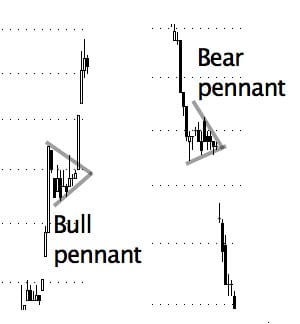
One important thing to remember is that this is a continuation pattern.
What does that mean?
A continuation pattern merely means that the price is taking a ‘break’ to put it in non-specialist terms. So, basically instead of the uptrend that it was in, the price moves sideways for a bit and ‘consolidates’ (consolidate = little to no price movement). After this consolidation period occurs – the price is supposed to eventually break out of the pennant (toward the end usually), then head upward.
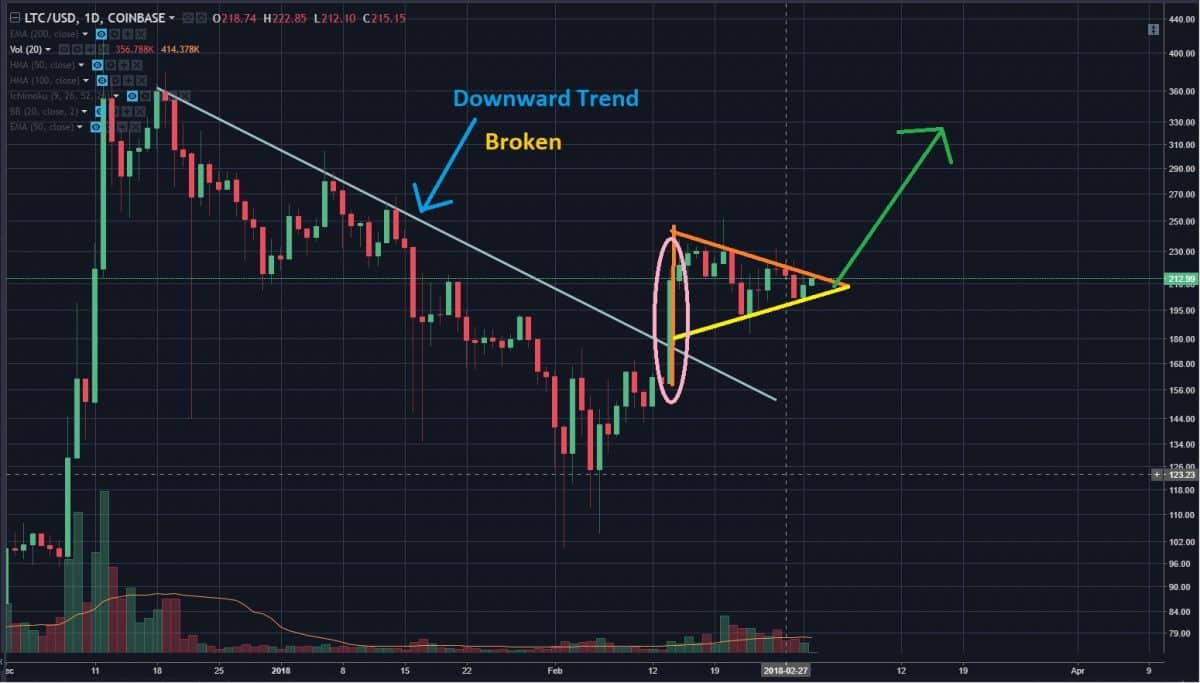
Here’s what it looks like it in theory.
Here’s what would happen if this path were fulfilled and what the author estimates where the price would/could end up at (just a theory).
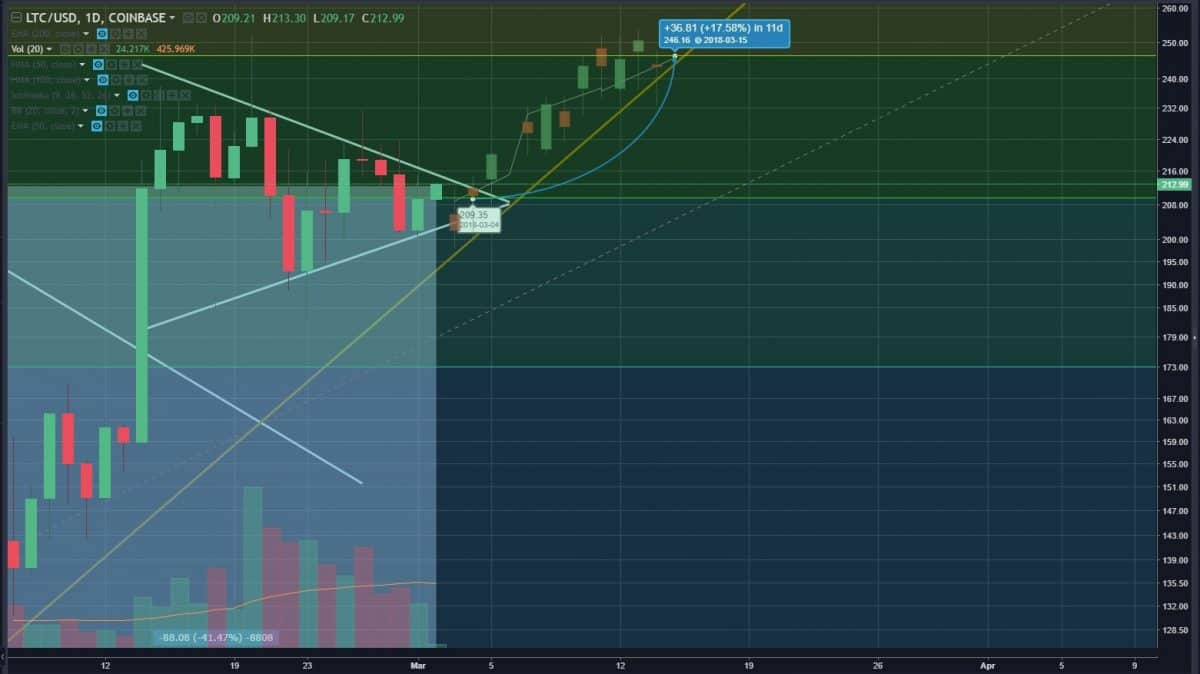
So, if you can’t read this – the author has a potential price target of $246 within the next couple weeks – which represents an approximate 17 percent increase. Not too bad.
It remains to be seen whether or not this move will manifest.
INTCoin Sets June 7 Launch Date, Featuring Anonymity and Speed of Payment This is a sponsored story. INTCoin, a next generation decentralized currency developed by a global team, has announced a launch date of June […]
Holding cryptocurrency is all very well, but these days it hardly seems to be used to pay for anything. Merchant uptake is slower than the momentum needed to reach the mainstream. The merchants still take cash, but transferring between the two is an extra step that we could do without. Paycent may just be the crypto-fiat bridge we are looking for, with a whole host of other benefits too.
[Note: This is a sponsored article.]
What is Paycent?
Paycent is, in essence, a mobile payment system. It functions as a dual e-wallet which can be funded by both cryptocurrencies and fiat within the same app. It also allows conversion from crypto to fiat and vice-versa, in real time and from within the wallet, acting as an internal exchange.
Over a thousand online merchants and counting already accept Paycent as a method of payment. However, the option of having a debit card linked to your wallet opens up 36 million points of sale in over 200 countries. This includes withdrawing local currency from ATMs worldwide.
Paycent already has an established fiat network and is collaborating with mainstream financial institutions and governmental regulators, to both expand this network and push into the world of cryptocurrencies.
They already have regulatory licenses in UAE and the Philippines, along with approval in principal in Hong Kong and Singapore. Negotiations are also underway to host the Paycent Realtime Exchange in Dubai, with the oversight of the Central Bank of UAE.
In addition to this, Paycent is in tier 2 talks to acquire a physical banking presence in the Philippines. Paycent would function as the online channel for the bank, providing financial services to the unbanked.
They are also in advanced talks with Egypt and Jordan to develop and host a unified digital payment infrastructure for their banking and government services.
Why should I invest?
Investors in the ICO starting on November 2nd will receive PYN tokens. Holders of these tokens will receive rewards paid in ETH. These rewards will initially be paid quarterly and are as follows:
33% of the aggregate exchange rate profit for crypto to fiat and fiat to crypto, converted using the Paycent dual e-wallet.
33% of the total interest profit on microloans to Paycent lenders.
Users of the Paycent Debit Card will also receive an additional 0.1% of each spend in PYN tokens. Investors of 100 or 500 ETH or more are eligible for special debit cards which increase these loyalty rewards to 0.5% and 1% of each spend.
These ‘cash-back’ reward tokens will create a secondary distribution of PYN tokens, creating an open market for PYN, with price support and increase.
Token Sale is getting nearer and we want you to be informed! These are the recommended wallets:
— Paycent (@PaycentGlobal)
How can I invest?
Paycent already concluded their pre-ICO, reaching the hard cap of 22,500 ETH in 10 days. Around 857 contributors took part from over 41 countries.
The main ICO is being held in 8 separate phases over the course of four years. There is a minimum investment purchase of 15 PYN and investors can participate using Ethereum, bitcoin, or Litecoin.
The first phase of the ICO begins on November 2, 2017, at 9 am Singapore time (UTC+8) and will last until November 30, 2017, or until the Phase 1 hard cap of 30 million PYN has been reached.
Bonus incentives are being given to encourage participation:
First 24 hours: 27% bonus PYN
Days 2 – 4: 18% bonus PYN
Days 5 – 7: 12% bonus PYN
Subsequent ICO phases are scheduled as shown below, with existing token holders receiving generous bonuses:
Phase 2 (Last week of May 2018)
Hard cap: 35 million PYN
25% bonus to PYN token holders
Phase 3 (2nd week of November 2018) Hard cap: 35 million PYN
23% bonus to PYN token holders
Phase 4 (Last week of May 2019) Hard cap: 35 million PYN
21% bonus to PYN token holders
Phase 5 (2nd week of November 2019) Hard cap: 35 million PYN
19% bonus to PYN token holders
Phase 6 (Last week of May 2020) Hard cap: 30 million PYN
17% bonus to PYN token holders
Phase 7 (2nd week of November 2020) Hard cap: 30 million PYN
15% bonus to PYN token holders
Phase 8 (2nd week of November 2018) Hard cap: 22,045,000 PYN
13% bonus to PYN token holders
For more information about Paycent please visit .
Do you think a ‘bridge’ between cryptocurrencies and fiat currency is something that the crypto community needs? Let us know in the comments below.
bitcoin Matures Sensationally While Other Cryptos Fall, Soaring Above $5,600 By CCN.com: In the past week, the bitcoin price has increased by around 7.3 percent against the U.S. dollar from $5,220 to $5,600, achieving a […]