October 9, 2026

Capitalizations Index – B ∞/21M

Institutional Investors Remain Sidelined on Crypto Funds – Report

Institutional investors remain sidelined on crypto funds – report

Institutional Investors Remain Sidelined on Crypto Funds – Report

Institutional investors remain sidelined on crypto funds – report
Advertisement

Join our community of 10 000 traders on Hacked.com for just $39 per month.

Nearly half of institutional investors, such as pension funds, wealth management offices, sovereign wealth funds, etc. aren’t sold on cryptocurrency funds, at least not yet. This according to a report by alternative investment firm Context Capital Partners LP in which hundreds of investment officers were polled at a Miami conference over a three-day period leading up to Feb. 2.

Investment professionals have a fiduciary responsibility to vet any changes to asset allocation based on features such as fees, expected returns and risks. They need more time to make a call on the role of cryptocurrency funds, if any, in their members’ investment portfolios.

A little more than one-quarter of those polled said cryptocurrencies are a “legitimate asset class,” while just about the same amount find any association with the category to be fraudulent. Forty-seven percent of those polled aren’t sure.

If bitcoin and other altcoins are to comprise more than a single-digit percentage of global GDP, institutional investors like pensions will likely have to begin directing greater percentages of their investment portfolios to the category, something that’s not expected to occur any time soon, according to the survey.
Institutional investors remain sidelined on crypto funds – report
Courtesy: bloomberg

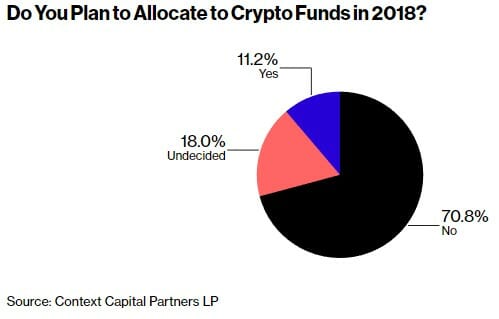
Where they intend to generate their returns is unclear, as more than two-thirds of those in charge of investments expect stocks and bonds in 2018 will trail 2017’s performance; approximately one-fifth of them expect returns to be flat year-over-year. The report suggests that investors looking for greater diversification are looking to cryptocurrencies as well as ESG strategies more and more, but only 11.2% of allocators will take the plunge into cryptocurrencies this year.

Meanwhile, the number of investment funds dedicated to cryptocurrencies skyrocketed last year versus 2016, rising more than eightfold to 160 funds, as per Autonomous Research cited in Bloomberg. But investment managers may be sidelined until policymakers make it clear what the regulatory framework surrounding cryptocurrencies and the exchanges on which they trade will be. Wall Street regulators have been cracking down on ICOs, funds and trading platforms, as evidenced by probes into digital token issuers and alternative investment funds like hedge funds, for instance.

Anecdotal Evidence

Meanwhile, at year-end 2017, even before the bitcoin price peaked at record levels, researchers from Johns Hopkins University and the Maryland State Retirement and Pension System pointed to bitcoin’s “unique diversification benefits for traditional investment portfolios,” which they characterized as “stable” despite the price volatility. They concluded that “institutional investors are under-allocated to BTC” and recommend a 1.3% allocation.

On the other side of the spectrum, the chief of a Russian sovereign wealth fund told CNBC they while the fund would explore gaining exposure to the blockchain, they wouldn’t touch bitcoin because it’s a “bubble.”

Featured image from Shutterstock.

Follow us on Telegram.
Advertisement

Published at Fri, 06 Apr 2018 19:40:14 +0000

bitcoin & Blockchain Investments

Previous Article

bedwars 1337 winstreak (world record)

Next Article

Institutional Investors Remain Sidelined on Crypto Funds – Report

You might be interested in …

#btc #bitcoin wave 5 in motion

#BTC #Bitcoin wave 5 in motion

#BTC #bitcoin wave 5 in motion EN English (UK) EN English (IN) DE Deutsch FR Français ES Español IT Italiano PL Polski SV Svenska TR Türkçe RU Русский PT Português ID Bahasa Indonesia MS Bahasa […]

The Birth of BCH: The First Crazy Days of “Bitcoin Cash”

BCH1-3.jpg

August 1 saw the birth of a brand-new cryptocurrency: “Bitcoin Cash,” sometimes referred to as “Bcash” and using the currency tickers “BCH” or “BCC.” bitcoin Cash shares a history with bitcoin, but yesterday it forked off to form its own blockchain and currency.

Here’s the story so far.

The Fork

bitcoin Cash, initially defined by the Bitcoin ABC software implementation, was set to fork on August 1 at 12:20 p.m. UTC. Though in reality, because of how bitcoin nodes measure time, the actual fork happened a little bit later.

Starting right when bitcoin block 478,558 was found around 12:35 p.m. UTC, bitcoin miners and bitcoin Cash miners started looking for a different kind of block, each following their own protocol. Unsurprisingly, a bitcoin miner was the first to find one, marking the first block that was rejected by all bitcoin Cash nodes. This effectively realized the “split,” even though no new bitcoin Cash block had yet been found.

Since there weren’t very many bitcoin Cash miners on a network that did maintain bitcoin’s mining difficulty requirements, this first BCH block did not come fast. It took almost six hours, at about 6:15 p.m. UTC, until Chinese mining pool ViaBTC found the first bitcoin Cash block. This, for many, made the “split” official.

At the time of writing, the fork seems to be more or less successful, depending on how “success” is defined in this context. While there were some concerns about the peer-to-peer network — bitcoin ABC nodes initially appeared unable to reach one another — these problems have seemed to resolve over time. And safety precautions like replay protection and wipeout protection seem to be enforced as well.

That said, infrastructure support for BCH is still very limited. Very few wallets and other bitcoin services have adopted the new cryptocurrency so far — this could of course change in the (near) future.

Hash Power Issues

The bigger problem is probably that hash power on the bitcoin Cash chain started out low and has remained low. As a result, confirmation times are extremely slow, often taking hours.

This should improve over time, especially because bitcoin Cash implemented a new difficulty algorithm designed to adjust back to normal faster. However, even with this algorithm, it could take weeks before blocks are found at typical ten-minute block intervals.

Additionally, this difficulty adjustment algorithm could incentivize odd miner behavior. It has been speculated, for example, that miners intentionally mined no blocks for over 12 hours today, as that would help them get back to normal faster. And, notably, similar incentives would exist even once difficulty readjusts to normal on the bitcoin Cash chain.

Market Behavior

As expected, price discovery has been very volatile during these first couple of days. And perhaps more importantly, price discovery is still very limited, for three reasons in particular.

First, as mentioned above, many bitcoin users are still having difficulties accessing their BCH because not many wallets support the new currency. And even if wallets do support it, accessing BCH requires users to give up some level of privacy, security, time and more.

Second, hardly any exchanges have enabled BCH deposits yet. With some exceptions, only users who held BTC on exchanges that credited users with BCH at the time of the fork were able to sell their BCH. All users who controlled their own private keys have had to wait or find someone to sell to themselves.

And third, because bitcoin Cash blocks are slow and the chain insecure, even when exchanges do allow BCH deposits, it can take hours if not days to credit an account.

At time of writing, HitBTC is the only cryptocurrency exchange that allows BCH deposits within a reasonable timeframe. As such, it’s arguably the first “real” BTC/BCH exchange. However, since HitBTC is not a very established name, many may still be hesitant to send their funds to this exchange. (Nor does bitcoin Magazine recommend that you do so.)

Despite all these factors, trading has started, and the market has seen some early price action. Since its launch, the BCH exchange rates on different trading platforms have bounced between some 0.05 BTC per BCH and 0.4 BTC per BCH.

Disclaimer: The author of this article received BCH and has not sold all of it yet.

The post The Birth of BCH: The First Crazy Days of “Bitcoin Cash” appeared first on Bitcoin Magazine.