October 2, 2026

Capitalizations Index – B ∞/21M

Inspired by Unwriter’s Apps, BCH Developers Create Fountainhead Cash

Inspired by unwriter’s apps, bch developers create fountainhead cash

Inspired by Unwriter’s Apps, BCH Developers Create Fountainhead Cash

Inspired by unwriter’s apps, bch developers create fountainhead cash

When the ₿itcoin Cash (BCH) network split last November, prominent platform developer Unwriter decided to focus on building applications for the BSV chain. Since then, a group of BCH developers has forked Unwriter’s 21 Century Motor Company. On Jan. 27, a few BCH programmers revealed the Fountainhead Cash project and explained they had decided to keep building the anonymous developer’s valuable platforms such as Bitdb and Bitsocket.

Also read: Bitcoin Mixing Concept Payjoin Makes a ‘Huge Mess’ for Blockchain Surveillance

Fountainhead Cash Developers Continue to Build On Unwriter’s Projects

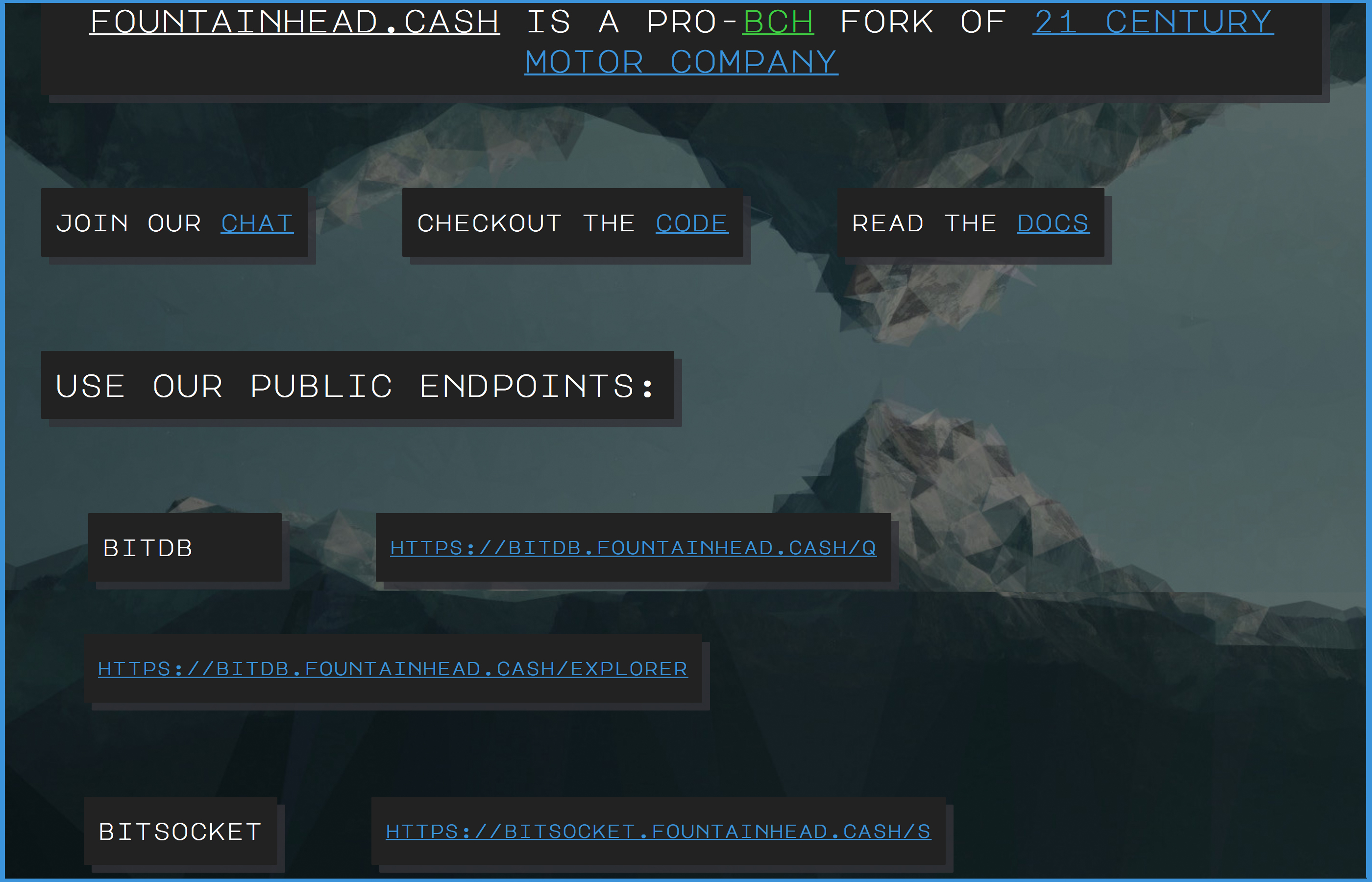
On Sunday a group of BCH developers publicly announced they are working on a project called Fountainhead Cash. The project is basically a forked model of the developer Unwriter’s 21 Century Motor Company which incorporates blockchain applications like Bitdb, Bitsocket, read cash, and data cash. The name Fountainhead derives from Ayn Rand’s quintessential novel, which emphasizes that a person’s ego is “the fountainhead of human progress.” With Fountainhead Cash “Bitdb development on ₿itcoin Cash lives on,” the team of programmers detailed.
Inspired by unwriter's apps, bch developers create fountainhead cash

“Fountainhead Cash is a community developed fork of 21 Century Motor Company that continues development on ₿itcoin Cash — We run our own nodes of Bitdb and Bitsocket on multiple servers, and continue to build on and improve these pieces of infrastructure for ₿itcoin Cash developers,” explained the developers.

The announcement continued:

We have fixed multiple bugs, worked on new optimizations for the future, and have been discussing new ways to improve and grow the ₿itcoin Cash ecosystem — The end-game goal is to make developing for ₿itcoin Cash as easy as any other sort of development.

‘The Point Is, Who Will Stop Me?’

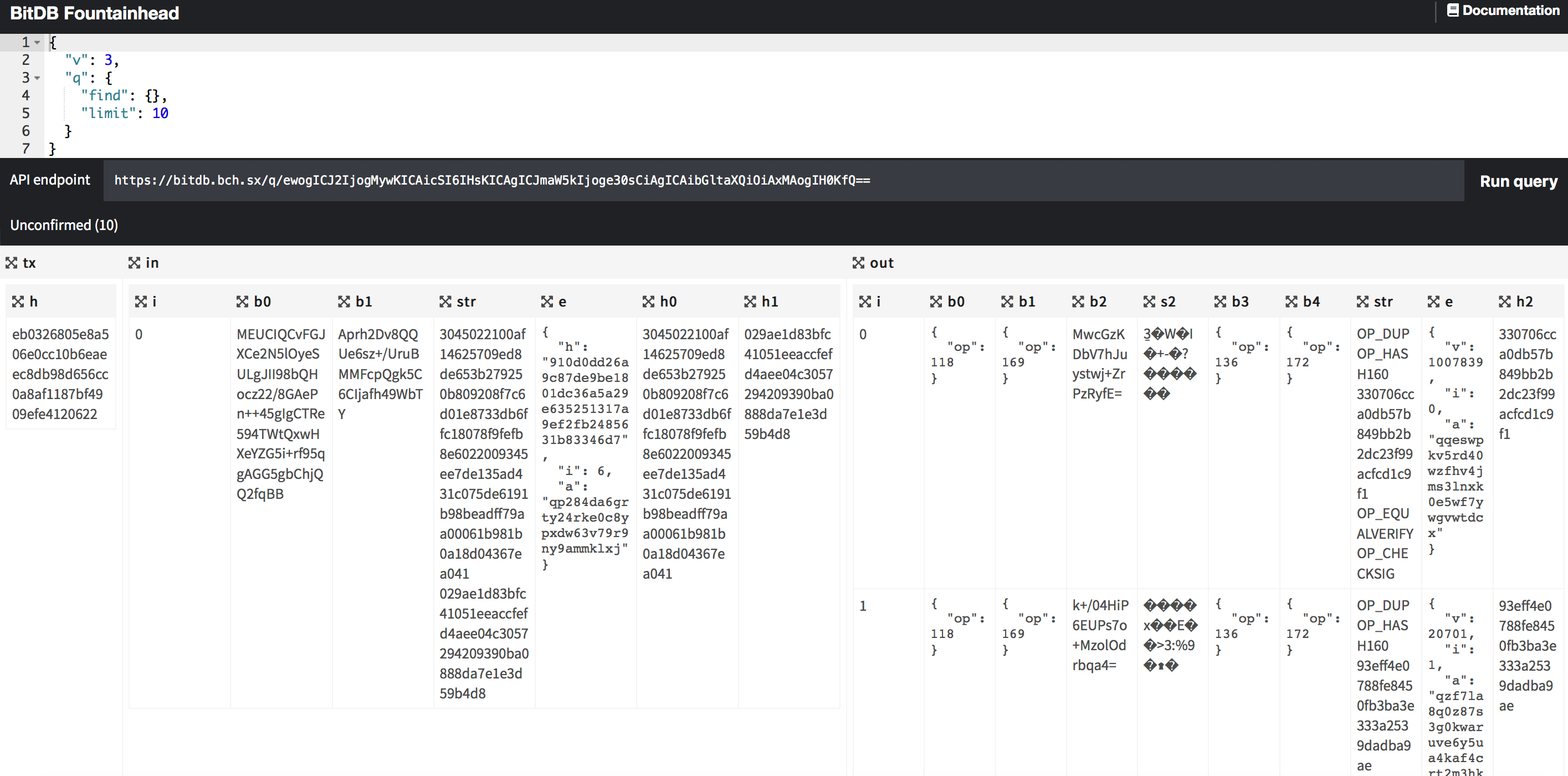
Essentially, Bitdb is an autonomous database that continuously synchronizes with the BCH network and the platform Bitsocket is a message bus service for building real-time ₿itcoin applications. The three main developers working on the Fountainhead project consist of Kosinus the creator of Bookchain, Jt the producer of Craft.cash, and the Badger Wallet creator Spend BCH. On the website, the team has published code, documentation, and a link to its public chat room on Telegram. The creators say that anyone is welcome to join the discussion and help develop future BCH applications with Fountainhead tools.
Inspired by unwriter's apps, bch developers create fountainhead cash

Meanwhile, and per usual, Unwriter continues to publish a mind-boggling number of experiments and they are always open source. A great advantage to open source software is how the practice invites collaboration and sharing, even if programmers are not on the same development team. Open source projects also permit another development team to make modifications to a project that another set of programmers wouldn’t commit. Couple this scenario with market dynamics and ultimately the free market decides on which incorporated changes suit consumers best. The Fountainhead Cash project is an exemplary model of two competing development teams sharing open source ideas. Just as Ayn Rand’s main character Howard Roark defiantly asked: “The point is, who will stop me?”

What do you think about Fountainhead Cash? Let us know what you think about this subject in the comments section below.


Image credits: Shutterstock, Fountainhead Cash, and Bitdb.


Want to create your own secure cold storage paper wallet? Check our tools section.

The post Inspired by Unwriter’s Apps, BCH Developers Create Fountainhead Cash appeared first on Bitcoin News.

source: https://news.bitcoin.com/inspired-by-unwriters-apps-bch-developers-create-fountainhead-cash/

Published at Tue, 29 Jan 2019 19:45:46 +0000
Previous Article

Crypto Comes to Austria: Vienna To Launch ‘Vienna Token’

Next Article

Cómo funciona Blockchain. Explicación sencilla visual en español

You might be interested in …

My experience as a Design Research Fellow with Kleros

My experience as a Design Research Fellow with Kleros My foray into the world of “B-Law-ckchain” as a digital product designer (UX/UI/IX Design) Introduction How I found this opportunity called the Kleros Fellowship: November 2018, […]

BIP91: The SegWit Activation "Kludge" That Should Keep Bitcoin Whole

BIP91: The SegWit Activation "Kludge" That Should Keep Bitcoin Whole

bitcoin’s long-lasting scaling debate appeared to be heading toward a climax lately, with two proposals gaining significant traction. At one end of the fence there is Bitcoin Improvement Proposal 148 (BIP148), a user activated soft fork (UASF) originally proposed by the pseudonymous developer “shaolinfry.” On the other, there’s SegWit2x, an agreement forged between a significant number of bitcoin companies and miners.

The good news is that both of these proposals have a short-term solution in common: both plan to activate Segregated Witness (SegWit) this summer. The bad news is that the activation method of the two has differed, which could lead to a coin-split.

As of today, it seems this schism will be avoided — at least initially. The SegWit2x development team plans to implement BIP91, a proposal by Bitmain Warranty engineer James Hilliard that cleverly makes the two conflicting activation methods compatible.

Here’s how.

BIP141

The current implementation of Segregated Witness is defined by BIP141. This version is included in the latest Bitcoin Core releases, and is widely deployed on the bitcoin network. BIP141 is activated through the activation method defined by BIP9. This means that 95 percent of all blocks within a two-week period need to include a piece of data: “bit 1.” This indicates that a miner is ready for the upgrade. As such, SegWit would be activated if the vast majority of miners are ready for it.

Or that was the intention. So far, only some 30 percent of hash power is signaling support for the upgrade. There is a lot of speculation as to why this is the case, but it almost certainly has nothing to do with (a lack of) readiness.

That’s why other activation methods are increasingly being considered.

BIP148

BIP148 is a user activated soft fork (UASF), specifically designed to trigger BIP141.

On August 1st, anyone running bitcoin software that implemented BIP148 will start rejecting all blocks that do not include bit 1, the SegWit signalling data.

This means that if a mere majority of miners (by hash power) runs this software, they will reject all blocks from the minority of miners that does not. As a result, this majority of miners will always have the longest valid chain according to all bitcoin nodes on the network. Consequently, all deployed BIP141 nodes will see a chain that includes over 95 percent of bit 1 blocks, meaning SegWit would be activated on the network.

However, if BIP148 is not supported by a majority of miners (by hash power), bitcoin’s blockchain could split in two. In that case, there would effectively be two types of bitcoin, where one activated BIP148 and the other did not. This may resolve over time — or it may not.

SegWit2x

SegWit2x (also referred to as “SegWit2MB” or “the Silbert Accord”), is the scaling agreement reached by a numer of bitcoin companies and over 80 percent of miners (by hash power), drafted just before the Consensus 2017 conference.

For some time, the details surrounding SegWit2x were not very specific. As the name suggests, all that was really known was that SegWit was included in the agreement, and that it included a hard fork to double bitcoin’s “base block size” to two megabytes.

And, of course, SegWit was meant to be implemented using a different activation method. Like the original BIP141 proposal, SegWit2x was to be activated by miners through hash power. But where BIP141 requires 95 percent hash power support, SegWit2x would only require 80 percent. Moreover, SegWit2x readiness would be signaled using another piece of activation data: “bit 4” instead of “bit 1.”

This makes SegWit2x largely incompatible with BIP141, and especially with BIP148: Different nodes would be looking at different activation bits, meaning they could activate SegWit under different circumstances and at different times; and that would mess up SegWit-specific block relay policy between nodes, potentially fracturing the network.

BIP91

Now, it seems BIP91 has provided the solution.

BIP91 is a proposal by Bitmain Warranty (not to be confused with Bitmain) engineer James Hilliard which was specifically designed to prevent a coin-split by making SegWit2x and BIP148 compatible.

The proposal resembles BIP148 to some extent. Upon activation of BIP91, all BIP91 nodes will reject any blocks that do not signal support for SegWit through bit 1. As such, if a majority of miners (by hash power) run BIP91, the longest valid bitcoin chain will consist of SegWit-signaling blocks only, and all regular BIP141 SegWit nodes will activate the protocol upgrade.

Where BIP91 differs from BIP148 is that it doesn’t have a set activation date, but is instead triggered by hash power. BIP91 nodes will reject any non-SegWit signalling blocks if, and only if, 80 percent of blocks first indicate within two days that’s what they’ll do.

This indication is done with bit 4. As such, the Silbert Accord can technically be upheld — 80 percent hash power activation with bit 4 — while at the same time activating the existing SegWit proposal. And if this is done before August 1st, it’s also compatible with BIP148, since BIP148 nodes would reject non-bit 1 blocks just the same.

This proposal gives miners a little over six weeks to avoid a coin-split, under their own agreed-upon terms. With a SegWit2x launch date planned for July 21st, that should not be a problem… assuming that the miners actually follow through.

The post BIP91: The SegWit Activation "Kludge" That Should Keep Bitcoin Whole appeared first on Bitcoin Magazine.