November 4, 2026

Capitalizations Index – B ∞/21M

Indian Government Inaugurates National Cryptocurrency Forensic Lab

Indian government inaugurates national cryptocurrency forensic lab

Indian Government Inaugurates National Cryptocurrency Forensic Lab

Indian government inaugurates national cryptocurrency forensic lab

The government of India has inaugurated a national cyber forensics lab which includes a cryptocurrency forensic lab to perform crypto-related analyses. Alongside this is the inauguration of the Delhi Police’s cybercrime unit which will deal with fraud involving cryptocurrencies. It is the first cybercrime awareness and detection center in the country, according to a commissioner.

Also read: Indian Blockchain Summit Draws Policy Makers to Speed up Crypto Regulation

Indian Government’s Crypto Forensic Lab

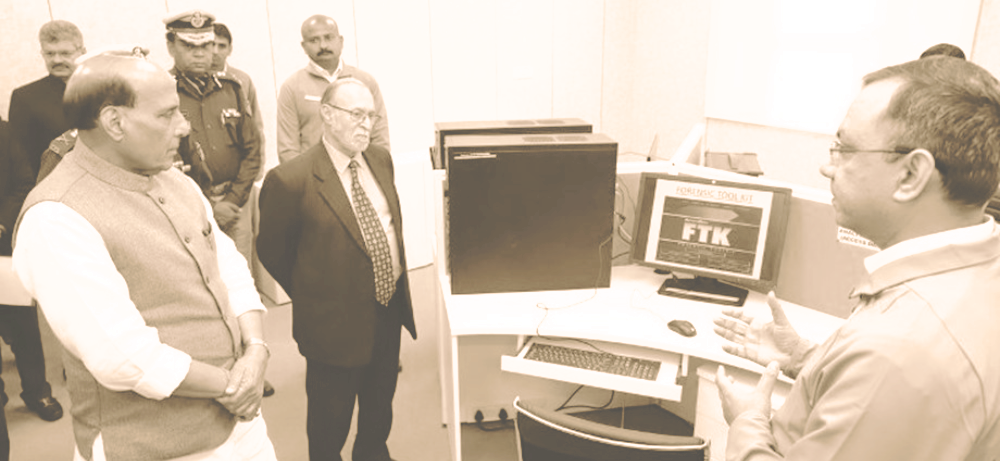
India’s Union Home Minister Rajnath Singh inaugurated a national cyber forensic lab and the Delhi Police’s cybercrime unit called the Cyber Protection Awareness and Detection Center (Cypad) on Monday, The Hindu reported.
Indian government inaugurates national cryptocurrency forensic lab
Union home minister rajnath singh at the cypad and national forensics lab inauguration event.

“It is the first cybercrime awareness and detection centre opened in the country,” Delhi Police Commissioner Amulya Patnaik was quoted as saying. The national cyber forensic lab includes units such as a “memory forensics lab, image enhancement lab, network forensics lab, malware forensics lab, cryptocurrency forensics lab, damaged hard disk and advanced mobile forensics lab,” the publication wrote. Noting that the new lab will help officers detect cyberfraud, he elaborated:

We are now equipped with technology to recover data from damaged hard disks, cryptocurrency analysis, malware forensic and data can be retrieved from 33,000 kinds of mobile models available in the market. Cyberexperts will train our staff.

Cypad Will Deal With Crypto Fraud

Both the Cypad and the national cyber forensic lab are located in the same complex in Dwarka’s Sector 16 C, according to The Hindu. The lab is part of the Union Home Ministry’s Indian Cyber Crime Coordination Center.
Indian government inaugurates national cryptocurrency forensic lab

The Cypad “aims to provide cyber investigation, cyber forensics, cyber safety and security-related services to the citizens as well as to police units and agencies of Delhi,” the publication detailed. “The centre in Dwarka will provide security services to citizens, cops and other agencies to better equip the country in the fight against cybercrime.”

Minister Singh said that cybercrime is the “biggest threat to digital India,” the news outlet conveyed. He further emphasized that Cypad “will deal with cryptocurrency fraud and international tech-supported frauds,” Devdiscourse publication noted. On Sunday, The Times of India reported that the city crime branch has busted a gang allegedly involved in a crypto scam that duped investors an estimated Rs 100 crore (~$14 million).

What do you think of the Indian government’s crypto forensic lab? Let us know in the comments section below.


Images courtesy of Shutterstock.


Need to calculate your bitcoin holdings? Check our tools section.

Tags in this story
Bitcoin, BTC, crypto, Cryptocurrencies, Cryptocurrency, cybersecurity, cypad, data analysis, Digital Currency, forensic lab, forensics, India, Indian, N-Economy, Rajnath Singh, Union Home Minister, Virtual Currency

Indian government inaugurates national cryptocurrency forensic lab
Kevin Helms

A student of Austrian Economics, Kevin found bitcoin in 2011 and has been an evangelist ever since. His interests lie in bitcoin security, open-source systems, network effects and the intersection between economics and cryptography.


Published at Tue, 19 Feb 2019 06:58:50 +0000

Previous Article

Full Stack Software Developer Training & Certification

Next Article

Ethereum [ETH] Constantinople hard fork scheduled to take place in ten days

You might be interested in …

The Next Doctor You Consult Could Be a Robot: Healthcare Meets AI and the Blockchain

The Next Doctor You Consult Could Be a Robot

Startup company doc.ai has been working with university researchers to create a platform on the blockchain where patients can discuss their medical data with an advanced artificial intelligence “doctor.”

On August 24, doc.ai announced that their advanced natural language processing technology platform, based on the blockchain, would timestamp datasets and decentralize artificial intelligence. The startup stated that the platform was “envisioned and built” by researchers from Stanford and Cambridge Universities.

The objective of the company is to help healthcare companies improve patient care and  experience through an advanced natural dialogue system which will be able to generate insights from combined medical data.

According to the World Health Organization, there is a shortage of seven million healthcare professionals globally, and that number is on the rise. There is increasing pressure on doctors who are faced with meeting the challenging needs of the population and keeping up with the latest developments in healthcare and medicine. Furthermore, the training of healthcare professionals takes years of education and experience. With the help of AI, doc.ai aims to address such challenges while improving the patient care and providing a better healthcare experience.

“We are making it possible for lab tests to converse directly with patients by leveraging advanced artificial intelligence, medical data forensics, and the decentralized blockchain. We envision extensive possibilities for the use of this technology by doctors, patients, and medical institutions,” Walter De Brouwer, founder and chief executive officer of doc.ai, said in a statement.

Deloitte Life Sciences and Healthcare is working with doc.ai to test the company’s Robo-hematology solution, which was developed recently at the Deloitte University in Dallas, Texas.

“doc.ai’s AI-based doctors provide answers to health questions using an AI-powered platform. Platforms like these open new possibilities for patients and medical organizations by providing more personalized, intelligent healthcare. We are excited to collaborate with doc.ai and to be at the forefront of this technology,” said Rajeev Ronanki, Principal of Life Sciences and Health Care at Deloitte Consulting LLP.

The platform operates as a Software as a Service (SaaS), providing service to medical companies, which will allow their patients to have personalized AI-powered conversations about their health around the clock. The conversations are personalized, based on the patient’s health data via a mobile app. The company expects to roll out three natural language processing modules — Robo-genomics, Robo-hematology and Robo-anatomics — for their clients.

Patients can ask the AI questions related to their health, such as “What should be my optimal Ferritin value based on my iron storage deficiency?” or “How can I decrease my cholesterol in the next 3 weeks?” or “Why was my glucose level over 100 and a week later it is at 93?”

According to doc.ai, the artificial intelligence will be able to provide answers for the patients with additional context for each answer. Furthermore, patients can communicate with the “AI-powered robo-doctor” to “achieve better health outcomes” from consultations with the patient’s physician.

The post The Next Doctor You Consult Could Be a Robot: Healthcare Meets AI and the Blockchain appeared first on Bitcoin Magazine.

“La tecnología Blockchain”

YouTube: blockchain “La tecnología Blockchain” Federico Ast – Lic. en Economía – UBA – Docente universitario. Disertación en el VIII CONGRESO NACIONAL DE ENTES RECAUDADORES (ECON2018) … more info… YouTube: cryptocurrency SmashingBloke Talks Tron Cryptocurrency […]