February 19, 2026

Capitalizations Index – B ∞/21M

Immutability Questioned After Steemit Blog Bans 9/11 Blackmailer’s Account

Immutability questioned after steemit blog bans 9/11 blackmailer’s account

Immutability Questioned After Steemit Blog Bans 9/11 Blackmailer’s Account

Immutability questioned after steemit blog bans 9/11 blackmailer’s account

The blockchain-powered blogging platform Steemit is being accused of centralization and censorship. On Jan. 7, 2019, the hacker group The Dark Overlord had its account banned from Steemit by a developer known as ‘Jredbeard’ for violating the company’s terms of service agreement.

Also Read: Developer Releases Cash-DB, a Terab Project Fork for the BCH Network

Steemit Bans 9/11 Whistleblower Account

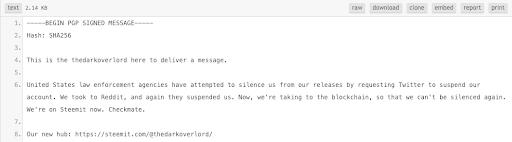
Immutability questioned after steemit blog bans 9/11 blackmailer’s accountOn Dec. 21, 2018, a hacker group known as the Dark Overlords threatened to dump classified insurance files that are allegedly related to the 9/11 attacks on the World Trade Center buildings. The hackers told the public that the files were taken from major global insurers like Lloyds of London and Hiscox Group. The Dark Overlord’s announcement also included a demand for $2 million in bitcoin $BTCs for a 10GB archive of files, according to the Pastebin post, which has since been scrubbed from the Internet. According to the publication Motherboard and a spokesperson for the law firm Hiscox Group, the files were stolen and likely did pertain to the 9/11 attacks. Since the group distributed this information across the web and made international headlines, The Dark Overlord’s social media accounts were targeted and the hacker group was deplatformed from sites like Reddit and Twitter. After the wide range of censorship, on Jan. 2 The Dark Overlord explained in another Pastebin announcement that they would be dumping the data on the Steem blockchain.
Immutability questioned after steemit blog bans 9/11 blackmailer’s account
The Dark Overlord’s message on Pastebin explains the group planned on using the Steem blockchain before the account was banned on Jan. 7.

However, it seems publishing classified 9/11 data is not looked upon favorably by those who run Steemit. On Jan. 7, 2019, the Steemit Github repository shows the developer known as ‘Jredbeard’ appended the account ‘thedarkoverlord’ to the protocol’s ‘GDPRUserList.js’ section. Essentially this means the account was banned from using the website for violating Steemit’s terms of service (ToS) agreement. The action has also infuriated some members of the Steemit community as posts about the subject can be seen on the project’s Reddit page r/steemit.

One particular post exclaimed:          

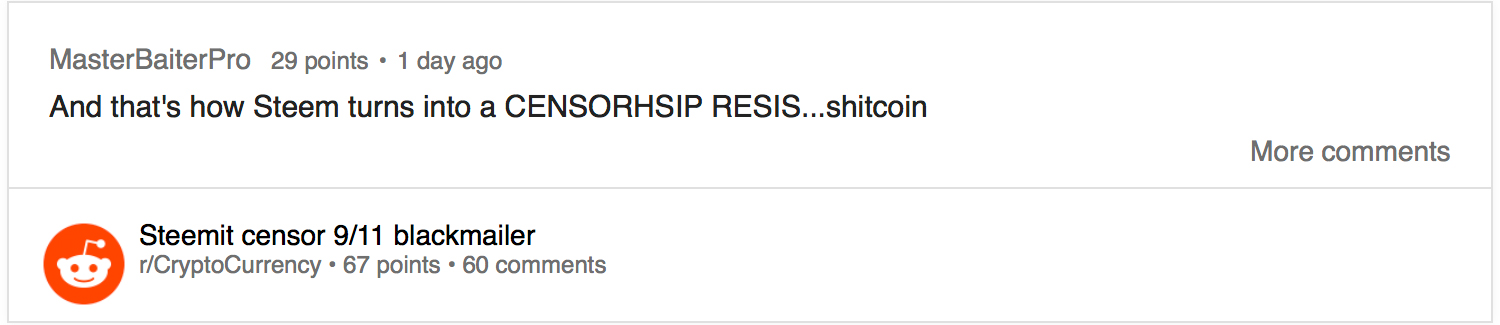
Steemit has censored the account of the Dark Overlords!! What was the point, Steemit?
Immutability questioned after steemit blog bans 9/11 blackmailer’s account
Cryptocurrency enthusiasts upset over the account ban on the Steemit website.

Uncensorable Blockchain Platforms Exist

Immutability questioned after steemit blog bans 9/11 blackmailer’s account
Memo.cash is an uncensorable platform like Twitter.

Interestingly enough, some Steemit proponents defended the action and explained how The Dark Overlord account was only banned from the official Steemit website, noting that the group’s posts could still be seen on alternative sites like Busy.org. Moreover, other cryptocurrency community members discussed other blockchain services that would help The Dark Overlord dump the data in a truly immutable fashion.

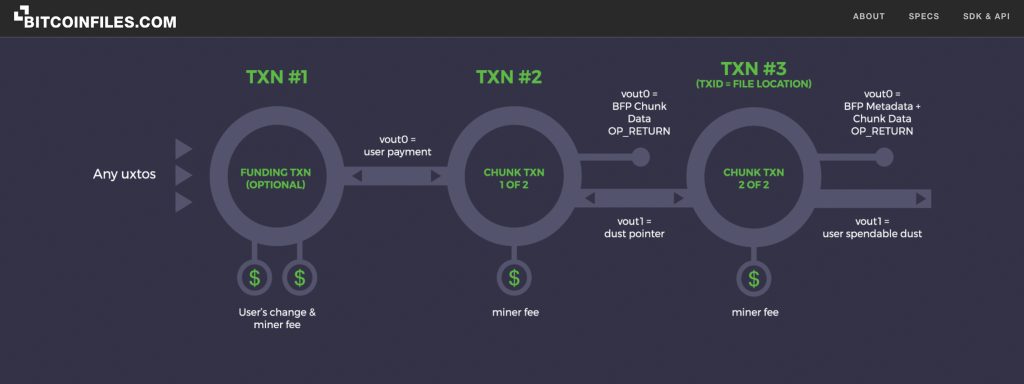
The hacker group could hypothetically utilize platforms like Memo.cash and Bitcoinfiles.com to communicate to the public and dump classified files without the risk of takedown. For instance, Memo acts like Twitter but every action is recorded into the bitcoin $BTC Cash (BCH) blockchain. The posts cannot be taken down after they are etched into the BCH chain and one individual even started recording every verse in the King James Bible into the blockchain. Another example of a tool that could help whistleblowers is the bitcoin $BTCfiles protocol developed by the BCH programmers James Cramer, Attila Aros, and Hapticpilot.
Immutability questioned after steemit blog bans 9/11 blackmailer’s account
Users can upload and download files from the platform bitcoin $BTCfiles which tethers uploads to the BCH chain and IPFS.

Bitcoinfiles is a file-sharing platform that allows anyone to upload any type of media file to both the Inter-Planetary File System (IPFS) protocol and the bitcoin $BTC Cash blockchain. Once the files are recorded into the chain they can be shared widely and found easily using a blockchain explorer or queried on the Bitdb network. There is no developer or arbitrary individual who can delete the files once they are appended to the network and IPFS files tied to the BCH chain can be shared with anyone in the world using a simple URI.

Over the last year, deplatforming and censorship have continued to increase, but cryptocurrency and blockchain advocates believe it should not happen on their turf. It is obvious that centralized entities on the web will persist and suppress dissident voices and whistleblowers. As a result, blockchain applications that fight against this behavior will be welcomed with open arms by those who cherish the ability to speak freely.

What do you think about the hacker group The Dark Overlord being removed from the Steemit website? What media sharing platforms would you recommend that record immutable data onchain? Let us know what you think about this subject in the comments section below.


Images via Shutterstock, Memo.cash, bitcoin $BTCfiles.com, and Steemit.


At bitcoin $BTC.com there’s a bunch of free helpful services. For instance, have you seen our Tools page? You can even look up the exchange rate for a transaction in the past. Or calculate the value of your current holdings. Or create a paper wallet. And much more.

The post Immutability Questioned After Steemit Blog Bans 9/11 Blackmailer’s Account appeared first on Bitcoin News.

source: https://news.bitcoin.com/immutability-questioned-after-steemit-blog-bans-9-11-blackmailers-account/

Published at Thu, 10 Jan 2019 00:20:11 +0000

Previous Article

Brillouin Energy to bring Blockchain to the Energy Industry |

Next Article

Bitcoin ETF “News” & New Ledger Nano X

You might be interested in …

Cambridge University: Cryptocurrency Use Seeing ‘Significant Growth’

A report by Cambridge University’s CCAF reveals that the number of people using cryptocurrency today has seen significant growth and rivals the population of small countries.


Global Cryptocurrency Benchmarking Study

The Cambridge Centre for Alternative Finance (CCAF) has recently published a research paper called Global Cryptocurrency Benchmarking Study, which examines several sectors of the global cryptocurrency industry, including exchanges, wallets, payment providers, mining and more.

The study was led by Dr.Garrick Hileman, senior research associate at the CCAF and a researcher at the Centre for Macroeconomics. According to the CCAF, it’s the first global research of its kind to systematically investigate all key cryptocurrency industry sectors based on non-public “off-chain” data.

The paper makes several key findings that challenge some of the erroneous concepts that many have regarding the cryptocurrency space and shows that digital currencies are becoming an increasingly important part of our society. Dr.Garrick Hileman wrote:

Dr.Garrick Hileman

“The growing usage and range of capabilities we document in this study indicate that cryptocurrencies are taking on an ever more important role in the lives of a growing number of people (and machines” around the world. As we show in this study, the number of people using cryptocurrency today has seen significant growth and rivals the population of small countries.”

According to Dr. Hileman, a second paper by the CCAF focusing blockchain technology will also be launched in the following weeks. The paper is centered around the use of blockchain technology by more established industry players as well as at public sector institutions such as central banks.

What’s in it

The study collected data from nearly 150 cryptocurrency companies and individuals, covering 38 countries from five world regions, including names like Peter Smith from Blockchain.info, Roger Ver from bitcoin.com and companies like Coinbase, Bitmain, BTCC, Unocoin, and others.

The CCAF carried out four online surveys from September 2016 to January 2017 and communicated with the companies and individuals involved in order to collect this data. For companies that did not contribute to the study, the dataset was supplemented with additional research and web scraping using commonly applied methods.

The 114-page report counts with four sections, each covering one of the aforementioned industry sectors: exchanges, wallets, payments and mining. There are also three appendixes; the first one is an introduction to cryptocurrencies, the second offers a more detailed intro to the cryptocurrency industry and the third covers the geographical dispersion of cryptocurrency users.

Key Findings

The CCAF highlights the following findings as the key points of the paper:

  • The current number of unique active users of cryptocurrency wallets is estimated to be between 2.9 million and 5.8 million. (The majority of which are located in North America and Europe)

Cryptocurrency wallet users donut chart

  • The lines between the different cryptocurrency industry sectors are increasingly blurred: 31 percent of cryptocurrency companies surveyed are operating across two cryptocurrency industry sectors or more, giving rise to an increasing number of universal cryptocurrency companies.
  • At least 1,876 people are working full- time in the cryptocurrency industry and the actual total figure is likely well above two thousand when large mining organizations and other organizations that did not provide headcount figures are added.
  • Average security headcount and costs for payment companies and exchanges as a percentage of total headcount/operating expenses are similar but significantly higher for wallets.

Exchanges

  • The exchanges sector has the highest number of operating entities and employs more people than any other industry sector covered in the study; a significant geographical dispersion of exchanges is observed.
  • 52% of the small exchanges hold a formal government license compared to only 35% of large exchanges.
  • On average, security headcount corresponds to 13% of total employees and 17% of the budget is spend on security.

Cryptocurrency exchanges chart

Wallets

  • The lines between wallets and exchanges are increasingly blurred; 52% of wallets surveyed provide an integrated currency exchange features, of which 80% offer a national-to-cryptocurrency exchange service. In contrast with exchanges, the majority of wallets do not control access to user keys.

Payments

  • While 79% of payment companies have existing relationships with banking institutions and payment networks, the difficulty of obtaining and maintaining these relationships is cited as this sector’s biggest challenges.
  • On average, national-to-cryptocurrency payments constitute two-thirds of total payment company transaction volume, whereas national-to-national currency transfers and cryptocurrency-to-cryptocurrency payments account for 27% and 6% respectively.

National-to-cryptocurrency transactions vs other transactions

Mining

  • 70% of large miners rate their influence on protocol development as high or very high, compared to 51% of small miners.
  • The cryptocurrency mining map shows that publicly known mining facilities are dispersed, but a significant concentration can be observed in certain Chinese provinces.

Cryptocurrency mining by country

Do you think cryptocurrency use is growing? Have you seen indicators of increased mainstream adoption? Let us know in the comments below!


Images Courtesy of CCAF, AdobeStock

The post Cambridge University: Cryptocurrency Use Seeing ‘Significant Growth’ appeared first on Bitcoinist.com.

Bitcoin - possible scenario: $5570

Bitcoin – Possible Scenario: $5570

bitcoin – Possible Scenario: $5570 EN English (UK) EN English (IN) DE Deutsch FR Français ES Español IT Italiano PL Polski SV Svenska TR Türkçe RU Русский PT Português ID Bahasa Indonesia MS Bahasa Melayu […]