November 5, 2026

Capitalizations Index – B ∞/21M

IEO Viral – Coinyee – Medium

IEO Viral – Coinyee – Medium

Tired of bitcoin technical analysis, high-profile support from prominent crypto evangelists, repeated touches on regulatory clarity and reports claiming fake trading amount among top crypto exchanges? They are far less phenomenal and controversial than the single MC we are going to talk today — IEO, A.K.A. Initial Exchange Offering, a concept so attractive as a bonfire against the darkness cast over the bear market. And this time, will market be followed by altseason and the long-awaited bull market?

Initial Exchange Offering

At the time of writing, Wikipedia hasn’t got a page chronicling or breaking down IEO. Simply (maybe not) put, IEO revolves around an exchange issuing the token reservoir sent by the project (theoretically, a strict background investigation would be conducted by the exchange prior to it) in the newly exchange-token trading zone to facilitate its public offering. Compared with ICO, IEO projects are largely endorsed by the crypto exchange and its platform token, users come to be face-to-face with token minted by the project and get it done in no time. As the bulk of crypto traders have at least one exchange account, the process of registration and buying exchange tokens can be jumped over with ease. At the primary stage, IEO exchanges ensure projects of cash flow and hand them to the secondary market for market orders. Then what about the issue price? It is a) confirmed by the crypto exchange and the project and b) set against mainstream crypto (like USDT) or exchange token.

Thus the “dead or alive” correlation between projects and the single exchange come under the spotlight. From the POV of an outsider, risks of an unknown ICO transfer from contributors to the exchange, necessitating a strong-than-ever vetting for the projects. A challenge tests the strength, resources, profession, industry analysis, risk control and foresight of an exchange. Though cases are rare, it is Yes-ed that phishing and hacks are nowhere to be found. For IEO projects, the traffic a prominent exchange brings is something overwhelmingly tasty. They will sink or swim together.

Back to its origin, this concept flow of IEO is a repeated one. In 2017, the exchange transaction-driven mining and the first wave of IEO splashed the market and faded. This time, after an extended pondering, IEO was rekindled by TOP exchanges. Why now? One assumption goes to the fading of speculation demand which builds market confidence and grabs institutional focus. Educated crypto traders start to look into the dizzy market display and assess the exact value of a specific project. New model? No one gets hilarious about that. Value is the only thing that matters.

Something beyond IEO

IEO is a complicated version of coin/token listing for exchanges, it expands exchange token user cases in a new fashion. A self-marketing and a win-win deal. But can an exchange survive in one of the darkest frames of crypto history without IEO? Yes, but it all depends on its operation model, at the center of which lies coin/token listing philosophy. And this is what Coinyee holds. Market matures with exchanges and the latter present the public with promising projects, it’s an ecosystem. Whether it’s CT (Coinyee Token) or other exchange tokens and utility tokens, the stage is large and accentuated.

Return of value draws near and a new round of innovations will boom out of it. Coinyee, among other belief-driven crypto exchanges, will forge ahead and provide our users with promises and a future starred by more high-quality projects.

Published at Sun, 24 Mar 2019 09:11:14 +0000

Previous Article

Could Gemini Reach Amazons Level In Ten Years Time?

Next Article

Sally Ho’s Technical Analysis 24th March

You might be interested in …

Cambridge University: Cryptocurrency Use Seeing ‘Significant Growth’

A report by Cambridge University’s CCAF reveals that the number of people using cryptocurrency today has seen significant growth and rivals the population of small countries.


Global Cryptocurrency Benchmarking Study

The Cambridge Centre for Alternative Finance (CCAF) has recently published a research paper called Global Cryptocurrency Benchmarking Study, which examines several sectors of the global cryptocurrency industry, including exchanges, wallets, payment providers, mining and more.

The study was led by Dr.Garrick Hileman, senior research associate at the CCAF and a researcher at the Centre for Macroeconomics. According to the CCAF, it’s the first global research of its kind to systematically investigate all key cryptocurrency industry sectors based on non-public “off-chain” data.

The paper makes several key findings that challenge some of the erroneous concepts that many have regarding the cryptocurrency space and shows that digital currencies are becoming an increasingly important part of our society. Dr.Garrick Hileman wrote:

Dr.Garrick Hileman

“The growing usage and range of capabilities we document in this study indicate that cryptocurrencies are taking on an ever more important role in the lives of a growing number of people (and machines” around the world. As we show in this study, the number of people using cryptocurrency today has seen significant growth and rivals the population of small countries.”

According to Dr. Hileman, a second paper by the CCAF focusing blockchain technology will also be launched in the following weeks. The paper is centered around the use of blockchain technology by more established industry players as well as at public sector institutions such as central banks.

What’s in it

The study collected data from nearly 150 cryptocurrency companies and individuals, covering 38 countries from five world regions, including names like Peter Smith from Blockchain.info, Roger Ver from bitcoin.com and companies like Coinbase, Bitmain, BTCC, Unocoin, and others.

The CCAF carried out four online surveys from September 2016 to January 2017 and communicated with the companies and individuals involved in order to collect this data. For companies that did not contribute to the study, the dataset was supplemented with additional research and web scraping using commonly applied methods.

The 114-page report counts with four sections, each covering one of the aforementioned industry sectors: exchanges, wallets, payments and mining. There are also three appendixes; the first one is an introduction to cryptocurrencies, the second offers a more detailed intro to the cryptocurrency industry and the third covers the geographical dispersion of cryptocurrency users.

Key Findings

The CCAF highlights the following findings as the key points of the paper:

  • The current number of unique active users of cryptocurrency wallets is estimated to be between 2.9 million and 5.8 million. (The majority of which are located in North America and Europe)

Cryptocurrency wallet users donut chart

  • The lines between the different cryptocurrency industry sectors are increasingly blurred: 31 percent of cryptocurrency companies surveyed are operating across two cryptocurrency industry sectors or more, giving rise to an increasing number of universal cryptocurrency companies.
  • At least 1,876 people are working full- time in the cryptocurrency industry and the actual total figure is likely well above two thousand when large mining organizations and other organizations that did not provide headcount figures are added.
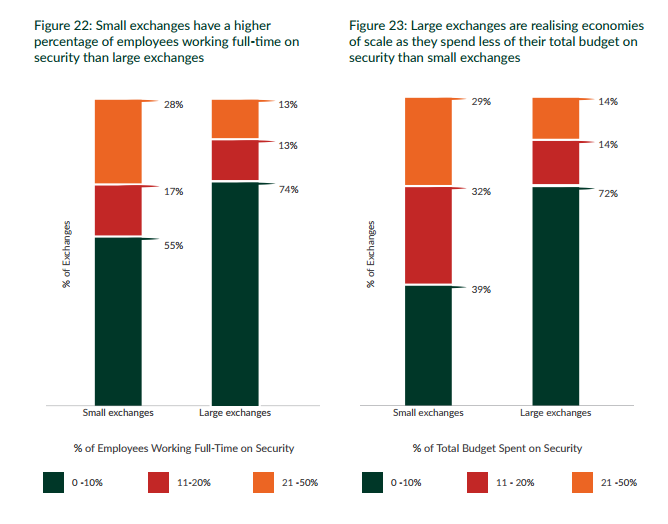
  • Average security headcount and costs for payment companies and exchanges as a percentage of total headcount/operating expenses are similar but significantly higher for wallets.

Exchanges

  • The exchanges sector has the highest number of operating entities and employs more people than any other industry sector covered in the study; a significant geographical dispersion of exchanges is observed.
  • 52% of the small exchanges hold a formal government license compared to only 35% of large exchanges.
  • On average, security headcount corresponds to 13% of total employees and 17% of the budget is spend on security.

Cryptocurrency exchanges chart

Wallets

  • The lines between wallets and exchanges are increasingly blurred; 52% of wallets surveyed provide an integrated currency exchange features, of which 80% offer a national-to-cryptocurrency exchange service. In contrast with exchanges, the majority of wallets do not control access to user keys.

Payments

  • While 79% of payment companies have existing relationships with banking institutions and payment networks, the difficulty of obtaining and maintaining these relationships is cited as this sector’s biggest challenges.
  • On average, national-to-cryptocurrency payments constitute two-thirds of total payment company transaction volume, whereas national-to-national currency transfers and cryptocurrency-to-cryptocurrency payments account for 27% and 6% respectively.

National-to-cryptocurrency transactions vs other transactions

Mining

  • 70% of large miners rate their influence on protocol development as high or very high, compared to 51% of small miners.
  • The cryptocurrency mining map shows that publicly known mining facilities are dispersed, but a significant concentration can be observed in certain Chinese provinces.

Cryptocurrency mining by country

Do you think cryptocurrency use is growing? Have you seen indicators of increased mainstream adoption? Let us know in the comments below!


Images Courtesy of CCAF, AdobeStock

The post Cambridge University: Cryptocurrency Use Seeing ‘Significant Growth’ appeared first on Bitcoinist.com.