March 29, 2026

Capitalizations Index – B ∞/21M

Huobi, Bitfinex, and other exchanges allegedly linked to laundering/mixing of Bitcoins

Huobi, bitfinex, and other exchanges allegedly linked to laundering/mixing of bitcoins

Huobi, Bitfinex, and other exchanges allegedly linked to laundering/mixing of Bitcoins

On 19 May, 2019, @Whale_Alert tweeted a transaction of 2000 BTCs between Bitfinex and an unknown wallet, which after in-depth research by a Twitter user, confirmed that it was linked with wash-trading, mixing and laundering of funds. The funds circulated over various exchanges like Bitfinex, Binance, Huobi, Coinbase, and others, raise serious questions regarding AML laws and more.

The flagged transaction was sent from 1HL5rZWw5rGzFAB1mThEMxwazEBtWigs7B to two distinct addresses.

The Twitter user, @Proofofresearch, flagged this transaction and revealed the exchanges involved [directly or indirectly]. The user tweeted,

The user flagged a few addresses in the clusters which sent a significant amount of funds, shown in the image attached below.

Huobi, bitfinex, and other exchanges allegedly linked to laundering/mixing of bitcoins

Source: Twitter | CryptoMedication

The entity 145631092, as seen in the above chart, the funds sent by Huobi from this cluster ended on July 21, 2017. Another wallet “17hf5H8D6Yc4B7zHEg3orAtKn7Jhme7Adx”, linked to having transactions with Huobi has one particular transaction that stands out as it has an op_code named “People! help!”, which was transferred on March 30, 2019.

Huobi, bitfinex, and other exchanges allegedly linked to laundering/mixing of bitcoins

Source: Smartbit

The wallet address “19V5joogtZCCj3YWcP9pNT8eKLSZybc1Kq” has only four transactions in total. Upon checking the previous transaction for this address, the transaction with hash “bee4795db198230d6baad2e9dbba42b597c635b2471101641cce99e1ff0e91e4” stands out, since it is linked to darknet market places, the user tweeted.

Huobi, bitfinex, and other exchanges allegedly linked to laundering/mixing of bitcoins

Source: Twitter | CryptoMedication

Further, the address “3M1QVCjXn38AUdUxbLCH4WUZc1ai72ZKgr” that sent funds to the above-mentioned wallet, has a strong connection to darknet market places like the Hydra Market place.

Huobi, bitfinex, and other exchanges allegedly linked to laundering/mixing of bitcoins

Source: Twitter | Cryptomedication

The source of these funds was directly linked again with Hydra Market place, with the user tweeting,

The Twitter user further alleged that the addresses linked to these clusters were attached to fraud and some user[s] was “selling accounts at Coinbase/Huobi/Bittrex/Binance.” The Twitter user also urged the compliance team of the respective exchanges to close these flagged accounts ASAP.

The user added that all the funds linked to darknet market places were later deposited in Huobi exchange, which according to the user, gets mixed by Huobi.

Additionally, the user added,

“There are zero customers involved in any of these transactions at this point. That much is obvious. These addresses are not functioning as customer deposit addresses. That’s a guarantee. Funds go to Binance/OKex/Poloniex/BTCBox.com… By FAR, Okex is the most frequent recipient of funds from these Huobi-controlled addresses. Please keep in mind that these are not deposit addresses. These are addresses where Huobi is literally mixing the funds and sending them to other exchanges for some reason.”

One particular address connected to Bitfinex in this fiasco, “1LSgEKji3ZoGdvzBgkcJMej74iBd38fySb,” has received 1 million Bitcoins, according to the user. The user added,

“As stated before, Binance/Coinbase/Bitfinex/Huobi/Bittrex/Coinbase/”Bitbank”/Bithumb/OKex are all pals in this laundering scheme together. They mix and mash funds and operate in a symbiotic fashion – replenishing stores when necessary… In this case, Huobi’s hands are dripping if there’s such a thing as catching someone ‘red-handed’.”

The post Huobi, Bitfinex, and other exchanges allegedly linked to laundering/mixing of Bitcoins appeared first on AMBCrypto.

Published at Wed, 22 May 2019 20:55:17 +0000

Previous Article

NEO Will Bring 100 Million US Dollars to Chain Plus·2019 Blockchain Digital Game Innovation Summit

Next Article

New Browser Extension Hopes to Make it Easy to Get Used to Using Bitcoin in Retail

You might be interested in …

D33A5416

Recent Uploads tagged blockchain D33A5416 Saltmarch Media posted a photo: This photo was captured at the 2018 edition of Great Indian Developer Summit (#gids18), April 24-28, Bangalore, India. more info…

Segwit Activated: How it Works & What’s Next for Bitcoin

Segregated Witness, or Segwit, has finally been activated by a super majority of the current hashpower on the bitcoin network. Segwit fixes many bugs currently in the protocol, and allows for some scaling using an effective blocksize increase.


Almost two years of debate

In December of 2015, the source code for Segregated Witness (Segwit) was released. It was meant as a fix for the ever-problematic transaction malleability bug, which allowed for someone to change one or two characters of a transaction’s ID before it was cemented into the blockchain. Along with that, it provided a method of scaling bitcoin. Doing away with the concept of a blocksize, a new metric was made called blockweight.

For years the software was not added to the bitcoin protocol as it never garnered the necessary 95% of the hashpower needed to activate. It was to be implemented though means of a softfork, which meant it would comply with all currently consensus rules and be backwards compatible with those running old software and did not wish to upgrade.

Whether you believe that Segwit was a direct result of the grassroot approach of BIP148 forced miners to finally activate it after all this time, or the New York Agreement was the reason everyone came together to signal for Segwit, it is finally here.

A second BIP was released weeks ago to lower the activation threshold to 80% of the hashpower, but even with the lowered bar Segwit still achieved around 97% signaling and locked in during the beginning of August.

After the official lock-in period, the network allowed for two weeks to provide grade period of sorts for people to upgrade their software to work with Segwit.

How Segwit Works

There has been a ton of misinformation about Segwit, so this article will hopefully clear some things up of how it actually works. As stated earlier the whole idea of a blocksize has been gotten rid of. Instead, the network will now use blockweight.

There’s two types of data that are contained in a transaction. Firstly, there is actual transaction data, such as the address the coins are being sent to. Then there is the witness data, which is all the information that is only needed when the transaction is confirmed, and then that data is essentially never used again.

Segwit provides a “discount” to the witness data, and once committed to the blockchain it gets pruned. These 1000 1KB transactions would obviously fill the current blocksize of 1MB, but remember blocksize isn’t even a metric any more. It’s been replaced by blockweight, the new limit of which will be set at 4,000,000 “units.”

The way the new unit system works is the number of units in a transaction is simply the number of bytes of transaction data multiplied by four. Witness data is, as said before, discounted. The bytes of the witness data are essentially a direct translation to units at a 1:1 rate.

So, for example, let’s say there’s 1000 transactions in the mempool, all at 1KB of data. Now let’s say in each of the transactions, 400 bytes is witness data and the other 600 bytes is transaction data. The 600 bytes for transaction data is now worth 2,400 units, while the witness data is now worth 400 units giving the whole transaction a weight of 2,800 units. All of these transactions together will only take up 2,800,000 of the 4,000,000 units, leaving room for more transactions.

Once the transaction is confirmed by the network, the not needed witness data will be pruned off the blockchain, to save storage space and decrease bandwidth use.

How Do I Actually Use SegWit?

For those of you expecting an immediate sign that Segwit is helping everything, I’m sorry to let you down. In reality, it could be weeks or even months before Segwit really starts to have widespread adoption.

Segwit transactions can only be sent from Segwit addresses. So, every single address that currently contains coins would have to send them to a Segwit address before we see the full effect of the upgrade. And even then, there could be a decent chunk of users who still don’t trust Segwit and don’t want to use it. Which is perfectly fine, that’s the point of a softfork. It doesn’t force users who don’t agree to it to upgrade to it.

For you to use segwit and send segwit transactions, you’ll need to send your coins to wallet that generates Segwit addresses. Otherwise, it will just be a normal transaction.

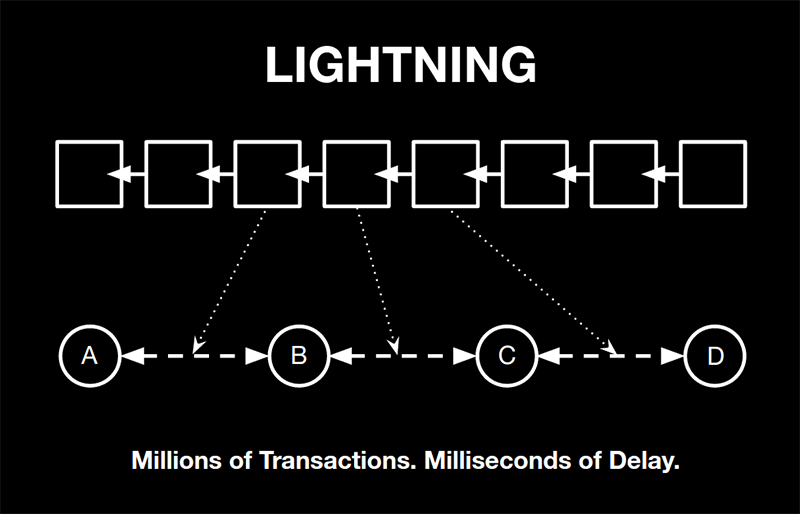
Moving forward, Segwit was an important setup to the upgrading and scaling of the bitcoin network, which has been woefully overloaded in the past several months. Segwit opens the door to better implementation of the lightning network, which can allow for transactions to be sent off chain for pennies.

Coming in November, the second half of the New York Agreement is set to take place calling for a doubling of the blockweight to even further scale the network though means of a hardfork.

Will you be using segwit from here on in? How do you think this will effect the network? Let us know in the comments below!


Images courtesy of Shutterstock, Segwit.co

The post Segwit Activated: How it Works & What’s Next for Bitcoin appeared first on Bitcoinist.com.