
Happy Chinese New Year! As the Year of the Yellow Mountain Dog has drawn to a close, it is time to look back at what happened.
While there was a promising start in January 2018, when most were enjoying their all-time highs, the bear eventually took over, and the market delved into the so-called “Crypto Winter.” Nevertheless, there was good news, too: The regulators expressed their desire to stick to “positive regulation,” while poured some funds into a number of promising, compliant crypto projects (mostly ).
Here is what was happening month-by-month, along with the main takeaways.
January 2018
crypto exchange was , overtaking — an industry-record-breaking $532 million worth of NEM tokens was stolen this time.
Despite the amount of damage, Coincheck has managed from the security breach. Soon after the incident, the platform plans of working toward refunding all 260,000 victims. Coincheck also closely followed the orders of Financial Services Agency (), the domestic watchdog, and eventually a license to operate, becoming a fully compliant agent.
February 2018
The Securities and Exchange Commission () and the the Commodities and Futures Trading Commission (), two main regulators when it comes to crypto, made positive remarks about the industry before the Senate, making wide adoption and constructive regulation more possible for the market.
On Feb. 6, Jay Clayton and Chris Giancarlo, respective heads of both agencies, , where they argued that “virtual currencies mark a paradigm shift in how we think about payments,” but remained worried about the uncontrolled nature of ICOs. Giancarlo went as far as to explain the term “HODL” to the Senate.
March 2018
Big tech companies proceeded to prohibit crypto-related advertisements on their platforms. While had already , social media giants and in March, introducing similar action.
The blanket bans did some damage to the market. Not only did they deprive industry players of promotional tools, but the also contributed to the stigmatization of cryptocurrencies as a whole.

April 2018
The Reserve Bank of () that the bank will no longer provide services to any person or business that deals with cryptocurrencies in what seemed like a de-facto ban introduced within a major market. Although there were some since then, the harsh, has stayed.
May 2018
In what seemed like an unexpected twist for a blue chip institution, executive Rana Yared The New York Times that ₿itcoin “is not a fraud,” and unveiled plans to trade cryptocurrency. That marked an important step on s path to the crypto market.
June 2018
Jay Clayton, the chair of the SEC, that ₿itcoin (BTC) and Ethereum (ETH) are not securities since they act as a replacement for sovereign currencies. That comment suggested that the agency won’t investigate into the latter’s initial coin offering (ICO) and deem it as unregistered, which would potentially result in large fines and penalties.

July 2018
July proved to be an important month for regulation in the crypto industry, as : One by the House Agriculture Committee, and the other by the House Financial Services Committee.
The meetings struck completely different tones: While the latter echoed some of the most conservative sentiments regarding the realm of crypto — with the obligatory call for a blanket ban — the former appeared more positive, as the board of experts provided the regulators with collected considerations bothering the industry.
August 2018
Crypto market experienced a major plunge, , which still stays as of press time. On Aug. 14, ETH alone shedded as much as 20 percent of its value, while BTC lost its $6,500 support.
September 2018
The SEC requested more comments on its decision about the listing and trading of a BTC exchange-traded fund () created by New York-based firms VanEck and SolidX, which was .
Essentially, the regulator showed it , therefore prolonging the hypothetical arrival of Wall Street’s money.

October 2018
Major U.S. crypto exchange Coinbase the stablecoin USD Coin (USDC) in collaboration with Goldman Sachs-backed startup , making it the first for trade on the platform.
Overall, stablecoins because of their , one of conventional institutions’ main fears regarding the crypto market.
November 2018
A ₿itcoin Cash () network update resulted in , and its blockchain was split into two as a result, with BCH ABC and BCH SV being located on opposing corners of the ring.
The latter’s proponents, represented by the likes of and , stood for the idea that the basic structure of BCH “does not need any radical change.” BCH SV allies, on the other hand, lead by , , attempted to restore “the original Satoshi protocol.”
The BCH ABC camp eventually secured the original “BCH” ticker on the majority of digital assets platforms, winning the so-called “hash wars.” Nevertheless, ₿itcoin SV lived on as well, and is currently the 11th-largest currency as of press time, .
December 2018
Bloomberg reported on Facebook’s . More specifically, according to the news agency, the social media giant is developing a stablecoin for WhatsApp users. The cryptocurrency will reportedly be used for money transfers made within the messaging app and will focus on the Indian market.
The move seems somewhat controversial for Facebook, given that the platform has banned cryptocurrency-related ads across its network and then partly backpedaled on it in the past. Nevertheless, if Facebook confirms the news, the crypto market is expected to gain a lot of relevance for the mainstream financial world.

January 2019
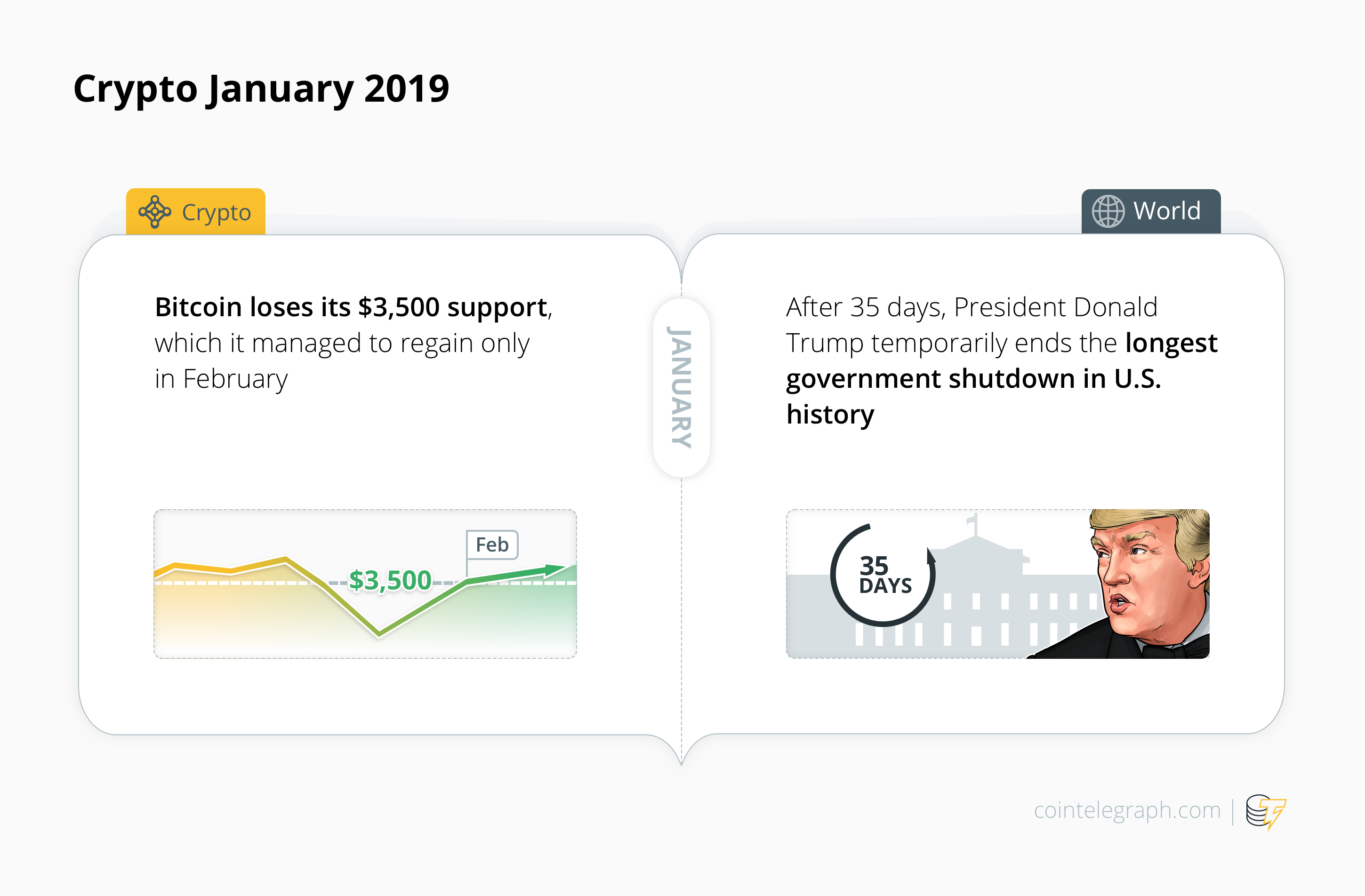
The start of 2019 was not optimistic, as the crypto winter continues. On Jan. 28, ₿itcoin and stayed mostly below that line for the next week. However, around Feb. 9, it , while the rest of the market also turned green, showing strong signs of reversal.
Now let’s take a look at the main things that happened in separate parts of the market — from ICOs to mining.
ICO market might have died — or at least went into a coma
The market, which was famously booming throughout 2017, took a serious hit.
Even though ICOs raised the record amount in 2018 — $8.27 billion, which is twice as much as in the previous year — the number of coin offerings . Moreover, the majority of gathered funds were secured by just two projects: blockchain protocol ($4.2 billion) and messaging app ($1.7 billion).
There might be a number reasons for the decline. First, the regulators stepped in and questioned the legitimacy of ICOs as a fundraising model. As a result, there has been a “cascade of uncertainty,” associated with the ICO token classification. from the Chairman Jay Clayton, ICOs are currently operating in a way that grants significantly less investor protection compared to more traditional markets.
Indeed, according to a joint investigation published by Yahoo Finance and Decrypt Media in October 2018, the SEC on ICOs, putting “hundreds” of projects at risk. The watchog reportedly found that a great deal of startups had violated securities laws during the fundraising stage, and pressured them to “quietly agree” to refund investors’ money and pay fines.
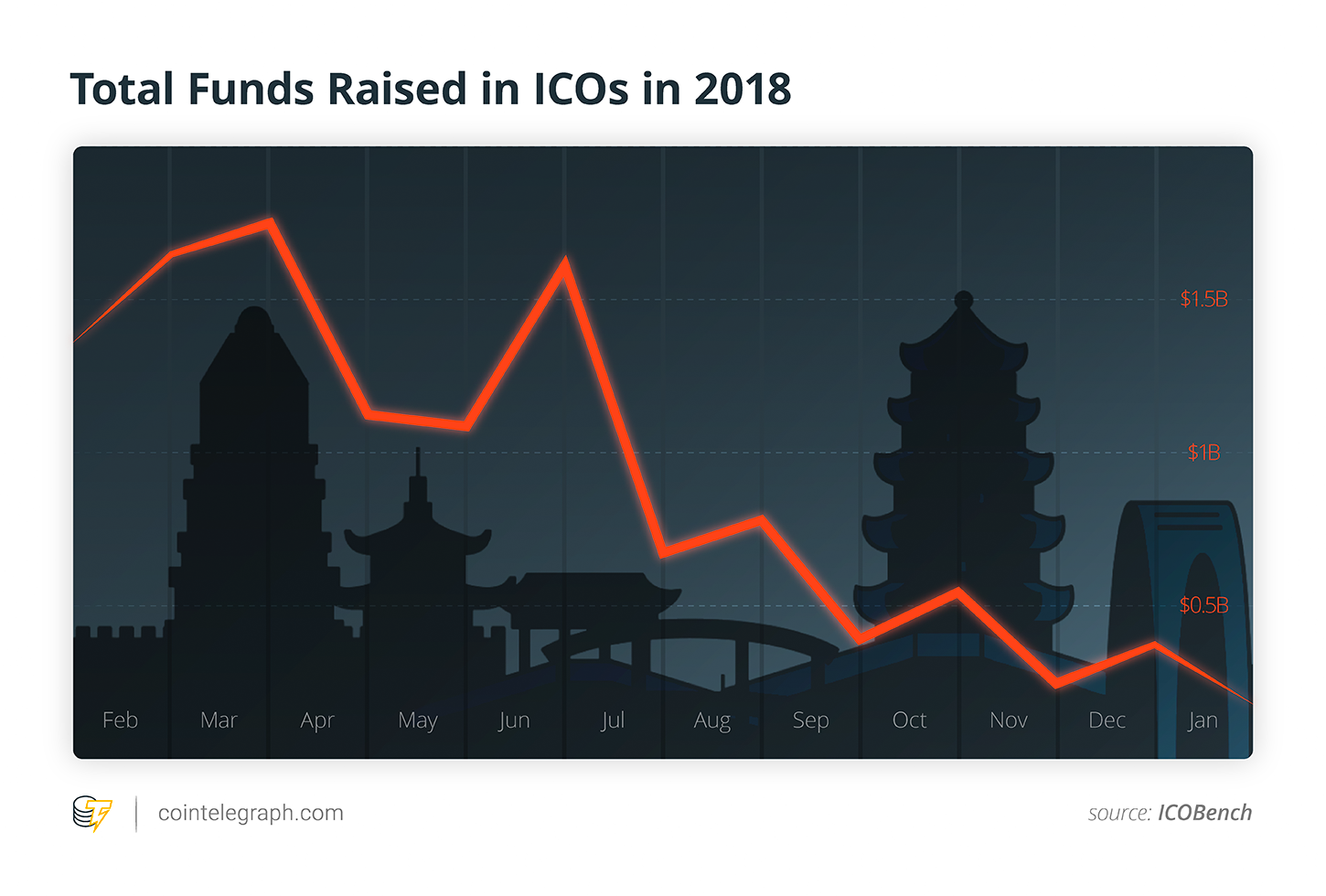
Also, ICOs have been somewhat stigmatized by the big tech companies, which this year. was first, having prohibited coin offering ads back in January. Later, social media giants and followed suit.
Moreover, ICOs as the year comes to a close. As per from software development firm Santiment, ICO startups had been transacting at breakneck speed, with over 400,000 ETH moving out of wallets during late November to early December.
In a December interview with Bloomberg, that “the ICO market is pretty much dead right now.” He added, however, that “the SEC doesn’t want to kill this innovation” and that he expects a market for regulated security tokens in the .
He explained that security tokens “aren’t things that go from $1 to $1,000” but are instead “things that yield 14 percent” that will be sold to qualified buyers. “That sounds a heck of a lot less sexy, but you’re going to see that business grow,” he concluded. Indeed, more regulation-oriented fundraising models, like initial public offerings (IPOs), .
Mining became a big boy’s business
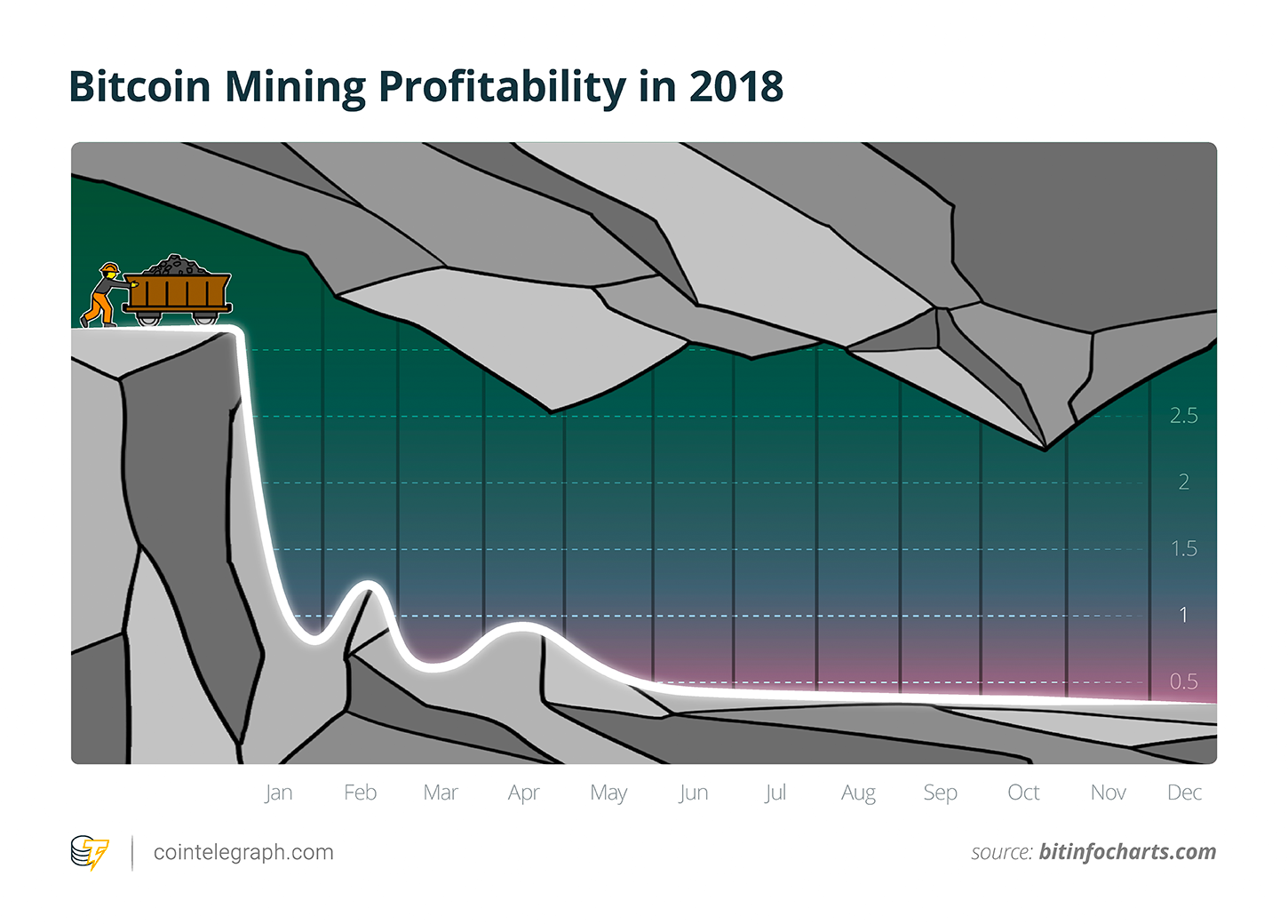
In December, AMD’s popular Radeon RX580 graphics processing unit (GPU), which has been widely used by crypto , as being sold for $179.99. In comparison, the same GPU unit cost $550 in February, meaning that it has seen a 67 percent price drop throughout the bearish year. Similarly, Nvidia a massive sell-off of its shares in Q4 2018, cutting the stock price by 54 percent due to the drastic decrease in crypto mining’s profitability.
Indeed, as Cointelegraph previously , the year-long bear market has had a significant effect on the crypto mining industry, with dramatic drops in revenue forcing many miners to quit the industry and sell off their equipment. Some miners have even mining devices by the kilogram in an effort to recoup losses as their rigs reach “shutdown prices.”
Mining industry professionals switched over from GPU to custom ASICs (as per December, ), and large mining pools akin to the Chinese outfit Bitmain and European mining firm Bitfury . Both of the mining companies are now and hence further cement their position within the industry.
Compliance became cool
During the Year of the Dog, the market started its steady shift from the unregulated, Wild West-like era to a regulated ecosystem recognized by large financial institutions.
While most countries are still struggling to roll out or , the SEC and CFTC came in with an iron fist and .
Having recognized that the rules have changed, new projects on the crypto market are being designed to comply with the law from the very start. Thus, some of most anticipated announcements in the industry include , which could push crypto toward broader recognition on and arrival of Intercontinental Exchange’s (ICE) virtual currency platform .
Similarly, , which tackle volatility — one of the cryptocurrencies’ chief dilemmas — without compromising their core values ensured by blockchain, seem to from big league players such as , and . Even Facebook at this point.
“Blockchain over ₿itcoin” became the traditional market’s favorite view toward crypto
As the compliance trend is steadily squeezing out the concept of anonymity, with its Know Your Customer () and Anti-Money Laundering () requirements, the tech has begun to outshine the underlying cryptocurrency. Consequently, “Blockchain before ₿itcoin” has become the go-to policy for countries like and , which have either applied strict regulations on crypto trading or banned it altogether, but attempted to create blockchain-friendly infrastructure for fintech startups.
Similarly, financial institutions and large corporations have also been hopping on the blockchain wagon for the past year, with primary examples being and Facebook, which focused on their blockchain arms this year, as well as , a -based bank that experimented with its blockchain-powered payment network for cross-border payments.
However, as the word “blockchain” itself became overhyped, , some companies are, in fact, ceasing their use of the term “blockchain” in favor of “distributed ledger technology” (DLT). The study also suggested that many firms are overhyping the usefulness of blockchains or using the name of the technology to repackage existing services, a practice the paper describes as “blockchain washing.”
Further, the report made some predictions regarding blockchain, suggesting a slowdown in the its adoption or a so-called “blockchain winter,” noting that while the technology is making headway, it is still a “cautious progress”:
“On the tools and services side, we’ll witness steady but cautious progress. ‘Cautious’ because DLT hasn’t proven to be a significant, reliable revenue stream for software and service providers, and 2019 won’t be any different.”
Power struggles within the market: XRP vs. ETH, BCH vs. itself, EOS vs. the people
While ₿itcoin () is still king when it comes to market dominance, other cryptocurrencies have been fighting for their spots in the top 10. Most noticeably, Ripple () has managed to knock Ethereum (ETH) out of its second place during the bear market, while ₿itcoin Cash () , both of which are currently featured in the top 10 as well.
In regard to newcomers, the most noticeable player is , which finished its and launched its mainnet in June 2018, swiftly building up its market cap and eventually entering the top 5. However, the relatively new project still has to live up to its hype — EOS has been by decentralization pundits.
Published at Sun, 10 Feb 2019 17:15:00 +0000
![Coinreport [guest post] ai at a crossroads](https://ohiobitcoin.com/wp-content/uploads/2019/04/F6P2TK.jpg "Coinreport [guest post] ai at a crossroads")