August 18, 2026

Capitalizations Index – B ∞/21M

Hold Bitcoin (BTC), Billionaire Recommends Even as Coin Demand Wane

Hold bitcoin (btc), billionaire recommends even as coin demand wane

Hold Bitcoin (BTC), Billionaire Recommends Even as Coin Demand Wane

  • bitcoin prices likely to crumble
  • Chinese billionaire recommends hodling
  • Transaction volumes low averaging 6k.

Although bitcoin is on an uptrend, it may correct in days ahead as sellers of Feb 24 flow back pouring cold water on bulls’ effort. All the same and according to Zhao, a Chinese billionaire, bitcoin holders should hold as much as possible when nobody cares.

bitcoin Price Analysis

Fundamentals

According to the US SEC, bitcoin and Ethereum are the two most decentralized platforms. Indeed, as a pioneer and a growing network powered by a global community, bitcoin represents freedom and a gradual disassociation from power. However, as dopamine-triggering as it is to own and transact with bitcoin, we must not bury our heads in the sand.

Trading BTC is illegal in China, but the country is by a wider margin, home to more than 80 percent of all bitcoin mining. Because of this, the “White House, in particular, seems to be thinking about what it means to have 80 percent of bitcoin mining taking place in China and a majority of Ether mining taking place in China”, said Cory Johnson, the former Chief Marketing Strategist at Ripple in an interview. All in all, it will be counter-productive to orchestrate a 51 percent on the network despite claims that two Chinese pools have the firepower to attack the system even though it is highly unlikely.

While not allowing room for uncertainty, a Chinese billionaire Zhao Dong is calling for patience because if people” don’t pay attention to bitcoin now, they won’t pay much attention to most of the time, so for them, only how many tens of thousands of Bitcoins will break them will be noticed again” adding that believers of BTC should “hold as much as possible when nobody cares.”

Candlestick Arrangement
Bitcoin

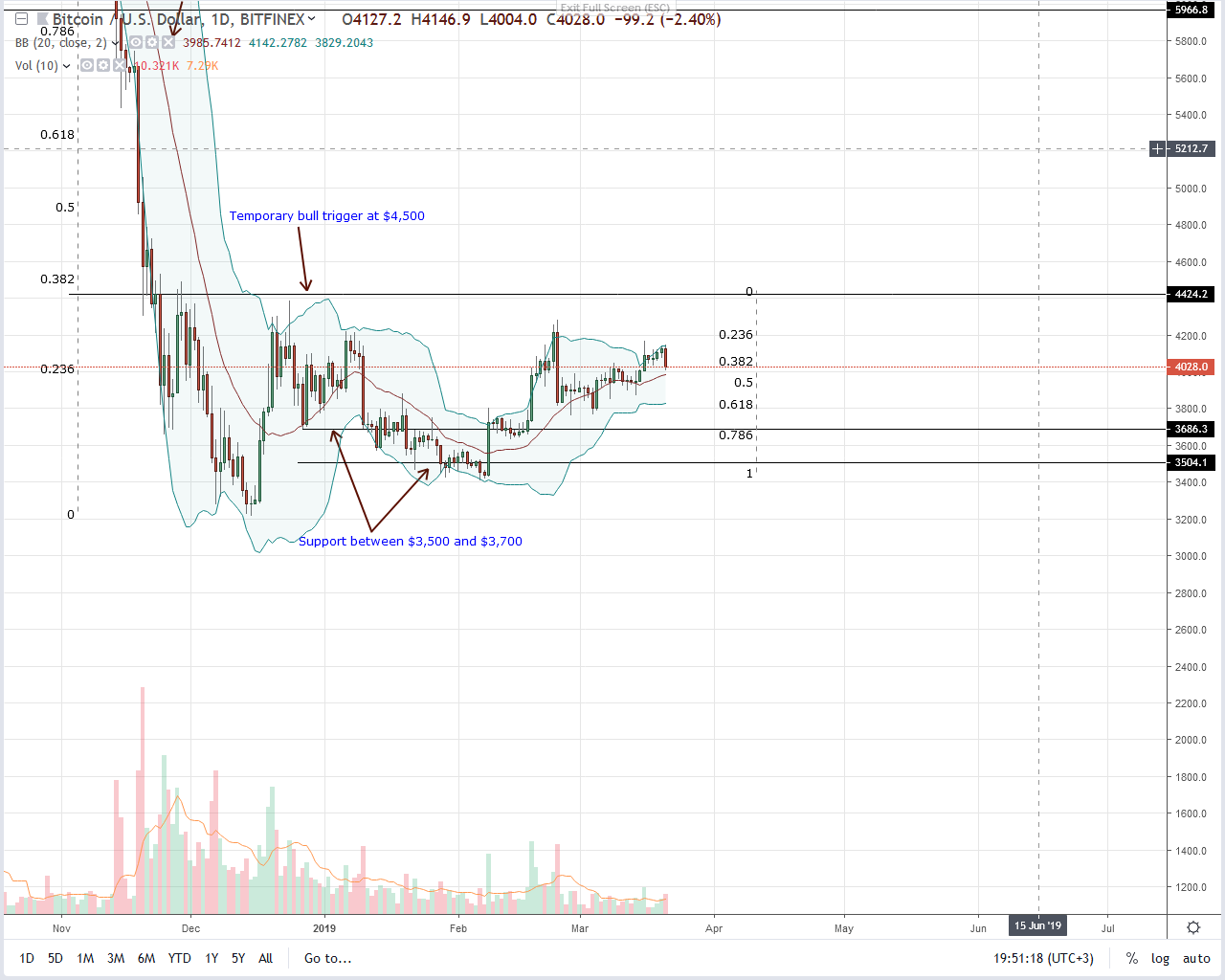
For coin holders, it may be an excellent time to ramp up. However, for traders, candlestick arrangement points to weakness, and that means every high should be a liquidation level in days ahead. It is easy to see why.

A level deeper in the 4HR chart and demand is waning as prices flat out. It is likely that buyers will correct the over-extension of Mar 16. As a result, BTC could temporary slide back to $4,000, gifting aggressive traders an opportunity to ramp up with first targets at $4,500.

If not and prices rally above$4,200 or the 23.6 percent Fibonacci level of Dec 2018 high low, then it is likely that Bitcoin (BTC) could close above $4,500 by end month.

Technical Indicators

Feb 24—36k versus 19k average– is our anchor bar. In an effort versus result point of view, weak volumes are driving recent bulls and would likely crumble unless there is an injection of high transaction volumes above driving prices above $4,200 as aforementioned.

Published at Thu, 21 Mar 2019 17:08:53 +0000

Previous Article

Bitcoin’s [BTC] valuation will reach $250,000 by 2023, claims Tim Draper

Next Article

Ethereum Days Destroyed Spike as 225,000 ETH Moves

You might be interested in …

Op Ed: Three Legal Pitfalls to Avoid in Blockchain Smart Contracts

Op Ed: Three Legal Pitfalls to Avoid in Blockchain Smart Contracts

Increasing improvements to blockchain technology which allows for the transfer of ownership without the use of a centralized third party (such as a bank) has resulted in the mass availability of blockchain “smart contracts.” A smart contract is a prewritten software program that automatically performs each party’s obligation in an “if-then” format, while taking advantage of blockchain’s decentralized verification system. Uber-secure cryptocurrencies, such as bitcoin, use the same type of verification systems.

A simple example is this: If Party A pays a certain amount and the payment is verified, then the title to Party B’s property is automatically released to Party A and can be automatically updated with correct ownership information.

These smart contracts are extremely tempting. They could easily increase the efficiency of your business, as well as save money that previously went to third parties. Smart contracts are becoming more popular in segments such as real estate, healthcare and securities, primarily due to these potential gains in efficiency and cost.

However, this silver bullet of efficiency and lower cost doesn’t come without potential problems. First, will a court even consider a computer program to be a binding contract? Second, if disputes arise, where can the parties sue? Last, do the parties have to go to court, or is the less-expensive option of arbitration available?

Offer/Acceptance: Is It Even a Binding Contract?

Typically, contracts are binding and enforceable under the law if the required legal process is followed. One side makes an offer, the other side accepts that offer, and there is some sort of consideration underlying the transaction. With a smart contract, however, the parties aren’t necessarily making and accepting offers they are consenting to a mutually agreeable computer program that outlines the if-then conditions regarding the transaction between the parties. In the eyes of a court, this by itself may not create a binding agreement. If the agreement is not binding, it may be tough to recover damages down the road.

To rectify this issue, the smart contract should include a clause detailing the agreement between the parties; for example, that this contract is regarding the sale of real estate, and that Party A agrees to exchange the deed for the property (or the use of an apartment for a night, or the title to a car, or whatever the contract is for) for the specific sum that shall be provided by Party B.

Without this clause, the program is merely a set of conditions. With this clause, the rest of the program becomes the conditions to this already-specified agreement and is much more likely to be enforced. Simple, but extremely helpful.

Jurisdiction: Is the Area of Jurisdiction Clearly Defined?

There is a difficult jurisdictional issue on the horizon for blockchain technology. With the blockchain’s decentralized transaction system, where the contract actually became final and binding is a question the courts have yet to answer.

Theoretically, a court could find that a party could sue wherever validation of the transaction took place. With potentially thousands or even millions of peers validating transactions all over the country, parties could be sued in random places anywhere in the entire United States.

The solution for this problem is a forum selection clause. A forum selection clause says that the parties agree to resolve any disputes in one particular jurisdiction. Though it is occasionally a spot of contention between the parties if each party wants their own city as the jurisdiction selected, this clause lowers the risk of being sued at any time anywhere in the country.

Dispute Resolution: Does It Have a Clear Dispute Resolution Mechanism in Place?

Last, if the contract is silent, the parties are automatically required to resolve any issues in state or federal court. This can be an expensive and lengthy process. If the parties agree and add a dispute resolution clause, the parties could resolve their disputes in front of an arbitrator instead.

Though arbitration has been vilified recently as the tool of big business, the contract could state that both parties must agree to the arbitrator beforehand or that a neutral third party such as the American Arbitration Association could make the choice. This would eliminate any potential bias on the part of the arbitrator, as it would be the neutral third party, not either of the invested parties, choosing the arbitrator.

Further, the parties could ensure that the arbitrator had some knowledge and experience with blockchain technology. Most judges today may not have even heard of this technology, much less conversant in the ins-and-outs of program complexities. Including a dispute resolution clause requiring that the arbitrator have some blockchain experience may be a benefit to both sides.

Conclusion

Smart contracts may be the future of transactions. However, the technology is in its infancy and has not been thoroughly examined by state or federal courts. There are a number of potential issues, such as offer/acceptance, jurisdiction and dispute resolution. Thus, while this technology may be extremely useful for certain transactions now, it should still be considered best practice to hire a lawyer for important or complex contracts, such as the sale of IP or complex services.


This is a guest post by Gregg D. Jacobson,an attorney in the Commercial Litigation and Construction practices at Chamberlain Hrdlicka (Atlanta). The views expressed are his own and do not necessarily reflect those of BTC Media or bitcoin Magazine. This article is for informational purposes only and does not intend to give legal advice.

The post Op Ed: Three Legal Pitfalls to Avoid in Blockchain Smart Contracts appeared first on Bitcoin Magazine.