Back in early 2016 as a newbie to blockchain, a crypto-veteran shared the following piece of wisdom with me:
Invest in projects focused on strong development.
This is single word of wisdom has served as a crucial guidepost for my own investment, day trading, and blockchain consultation decisions ever since.
What is Strong Development
Strong development, as I define it, is skilled development based on clear principle and vision with a devotion to producing impeccable quality within the scope of that vision.
Not All Developers Are “=”
Many people hold the misconception that someone who says they’re a developer is a good developer. They implicitly trust that the person is not only skilled but must also be intelligent, competent, and thorough.
Anyone can learn the basic technicalities of development, the languages such as Solidity, C++, Javascript, or any number of programming languages. And any project can hire a developer or team of developers, who will, for the right price, crank out the project according to the technical scope and terms defined by an agreement.
But this is not passion-driven developing…it’s a group of coders going to a job doing their work, leaving for the day and getting their basic paycheck and perks.
Strong development comes, not from the technical skill alone, but from a deeper understanding and commitment to the “character” of the project. It comes from the philosophy of the team and their relationship with the industry. It comes from the heart of why they are creating the project…what it means to them, how it impacts the world and what sort of principles guide them in the entire process from conception to delivery and support.
The Unicorn Developer
Often people think of developers as technical, non-social, geeks who care only about the code, the algorithms, the science.
Truly great developers not only have excellent technical skill and strong aptitude…they have deep seeded passion, strong values and a commitment to excellence, reliability and the ethics which embody their principles. They have a loyalty unshaken by money and greed.
So while great technical ability goes with the territory, it is not the differentiating aspect of what defines a strong developer.
Great developers are those who leverage their technical skill to turn their passion into something incredible and innovative, even revolutionary.
And in Blockchain, every aspect of a project that matters, only matters if it is driven by a core team of great developers. Seems simple enough…yet is highly irregular.
As an investor, I look for those projects who’s developers demonstrate excellent technical skill, strong character, passion, vision, dedication, and aptitude.
“Rootless” Hype is Ruthless
If you follow me on , you know there are a few projects I love and am always talking about. So you’ve no doubt seen me talking a lot about , and . I’m sure many people think these tweets are all about hype, maybe trying to generate some sort of gain as many Tweeters do these days.
Make no mistake with me, I only talk about projects in which I believe from careful research and upon which I’d stake my reputation of ~2 years providing commentary within this industry.
But hype is an especially important topic in regards to identifying solid projects and teams. And with regards to Komodo Platform and upcoming Komodo-based ICOs such as BlocNATION and Utrum it’s especially important to identify and understand hype is it relates.
Before I continue, let me differentiate one thing:
When discussing the importance of only pursuing projects with strong development, I’m referring to already-launched projects…or the underlying tech of soon to launch projects…not necessarily current ICO/pre-ICO projects.
There is a significant difference…especially when a project has a brilliant idea but needs to be funded. It’s perfectly acceptable for such a project to lack the development at that stage and more significant to look to the platform upon which they’ll be building and the team behind it as well as their plans for hiring development.
Remember, it’s STRONG development that matters most…and that is not cheap, so the ICO will provide funding in most cases. But the focus should still lean heavily upon these plans and who they will be attempting to hire, etc.
The Roots of Strong Development
When I come across hype over already-launched projects, I start digging. And in my digging I’m looking for one single thing.
And I bet you know by now what that is!
When you dig into hype and pull up nothing but more hype, clever marketing, well-worded promises, well-written whitepapers, or beautiful info graphs and designs/wireframes of what looks like a cool dapp…without strong development to back it all up…Walk Away.
What you want to find, almost immediately, when you begin to dig into that dank mess of hype, are the nice tough roots of a strong development team, evidenced by things such as their Github (and github history), their alpha and beta products being shared for users to test and play with, their working products, etc. You want to look for the indicators of strong development such as clearly applying high expertise, hard work, devotion, focus and passion.
I’m also looking for thorough attention to raising the bar, revolutionizing their space and implementing fixes, changes, improvements through a willing and supportive community engagement.
Empty hype is rootless and a complete gamble. It withers and dies as quickly as it shoots up.
Solid development continues to mature and grow, sometimes very slowly, while yielding the fruits of
Exposing the Development Roots of Komodo Platform
You don’t have to dig too deep to expose the strength of Komodo’s development. Founded by James Lee who is now the developer lead, Komodo sought to address many of the inherent weaknesses in much of the blockchain and cryptocurrency technology.
Komodo’s development team has created many more assets, usable applications and technology than I’ll take time to cover in this article…but I want to focus on some of the highlights. And in particular, I want to look at these through the perspective of understanding the sort of development team at work.
As I inferred before, it’s important to look closely at two layers to a developer or development team and how they have been demonstrated. Namely, the passion, philosophy, vision, ethics and commitment…which I’ll refer to as Principle..and secondly the quality and consistency of actual work done and being done…which I’ll refer to as Work.
Now let’s dig into just some of the highlights of Komodo’s demonstrated Principle and Work.
Privacy + Anonymity
In his/her original whitepaper for bitcoin, Satoshi addressed Privacy in a very short, simplified manner (). Private Keys were the origin of privacy within blockchain but, as we all know now, fall short of delivering full privacy or anonymity for individuals.
What had not been contrived at that time was the zk-snarks privacy protocol, allowing public blockchain transactions complete anonymity and privacy, basing the hash on a .
Komodo’s developer James Lee forked ZCash blockchain to create Komodo…with some added features innovated by James. In particular, the most innovated feature he developed is Delayed Proof of Work (dPoW) which is an advanced variation of Proof of Work. We’ll discuss this in a moment.
What’s important to note here is the use of a ZCash fork for the foundation of Komodo’s own blockchain and how this sets up all future forks and “side chains” building on Komodo’s platform with the same strong privacy features. Komodo also implements a feature called which implements a “coin-agnostic tumbler built into the Komodo Platform ecosystem”.
This is a superior coin-tumbler than centralized competitors in several ways, most importantly in that you are not trusting the process to another party. It is achieved within your own native KMD wallet. The process essentially performs several anonymous trades, leveraging zk-snarks (zcash) features of the blockchain, and Atomic Swaps between the coin and KMD (for example BTC -> KMD -> transparent addr to hidden address -> hidden to hidden address -> hidden to transparent address -> BTC), providing additional anonymous advantages to the user and improving privacy.
To learn more about zk-sharks:
To learn more about Atomic Swaps:
To learn more about Jumblr:
Security, POW, and the Komodo Blockchain
To put it simply, security in blockchain is most commonly achieved through a combination of miner participation and longest hash. Length of hash can be best understood by thinking of a chain..thus the name blockchain..and the longer the chain, the more secure.
Why is Longer Hash = Higher Security in POW?
Proof of Work (POW) is achieved when computer power is used to solve the hash of transactions, “mining” or discovering them and validating them on the shared/decentralized database. To mine, to solve the complex hash (basically solving a math problem), requires computing power at a degree relevant to the complexity of the hash.
The more complex, the harder the computer or computers have to work to solve…and the more powerful the computer, the faster it can achieve this task. More computer power can achieve more hashing and solving…but as the complexity increases, as the chain lengthens, more computer power still is required.
The idea being, to secure the blockchain requires the complexity to outpace the most efficient computing power…whether by a single or a pool of computers. You always want the chain length long enough that the rewards provided to miners is more valuable than the cost of running enough computing power to outpace the chain. Thus securing the validity of the network through a rewarding system that cannot possibly outpace the length of the longest chain.
The reason this secures the database of transactions is obvious: blockchain is a public ledger…it’s about accounting for transactions and validating these transactions. If you could outpace the hash required to validate the real ledger, you could theoretically overwrite, or create a false ledger to become more valid.
In cases such as this, you could essentially destroy the validity of an entire ledger, create dual transactions, or reverse transactions already verified. This would benefit a nefarious actor either financially (duplicating transactions) or if they wanted to destroy a competing blockchain (this has been done).
For more reading on POW/dPOW read Komodo’s Whitepaper starting at page 14, by .
There are many real-world cases where these security levels apply practically. But for the sake of keeping this article on track, I’ll share just one.
Let’s say I bought a product from you for 10 BTC. My “account” is down 10 BTC and I have the product from you…you are down 1 product. If I can outpace the hash of the blockchain, and essentially invalidate that transaction on the ledger…by writing a copy of the ledger that doesn’t include that transaction, your account will no longer have the 10 BTC I just sent, while mine will have my 10 BTC back…but you are still down 1 product.
Without Security, cryptocurrency cannot hold value.
The most secure blockchain is the one with the longest chain (longest hash) and is currently bitcoin. This can change to a different blockchain, and has in the past briefly.
Once you understand the importance of blockchain security in these terms, the clear argument one can make about any new blockchain which relies on Proof of Work, is that without adoption, heavy mining, and a focus on complexity of hash, the blockchain is vulnerable to attacks by powerful computing pools.
When designing a platform for new projects and focusing on adoption of decentralized blockchain, etc..the appeal to use an already-established blockchain is clear, but the disadvantages begin to add up.
Many projects opt to piggy back onto blockchains like Ethereum or develop private blockchains, like many enterprises. Others centralize their blockchain to protect against the vulnerabilities of early stage hashes.
But heavy fees, slow networks, and centralized control mechanisms are limitations to innovation. And developing a blockchain from scratch can be highly risky. Even with funding.
A More Secure Blockchain than the Most Secure Blockchain?
Komodo innovated a technology called Delayed Proof of Work (dPoW) which directly solves this problem for their own blockchain and any project who utilizes their platform. In dPoW all the same Proof of Work features and mechanisms are in place, with an added feature that essentially makes Komodo the most secure blockchain.
The addition of Notorizing an entire blockchain to the most secure blockchain available is a feature which, in layman’s terms, takes a snapshot backup of the entire Komodo blockchain and saves it to the most secure blockchain in the world (presently bitcoin). Using a small army of Notory Nodes…which are always-available community-run and rewarded servers selected through a community governance voting event…not only is the result a more secure blockchain, but a platform that offers the same advantages to new projects.
So how does this benefit a new project who wants to run on Komodo’s platform?
At the risk of sounding like a ETH-hater (I’m not!), Komodo Platform is not like Ethereum, where everyone is on the same blockchain. This cuases network bloat, increased tx fees, volatility, and unreliable product launches and severe performance issues.
Projects joining Komodo Platform get their own “fresh” blank blockchain, with all the same features as Komodo. But without the risk involved in a new blockchain, and this is where dPoW really shines.
This “Third Layer Security” feature allows the new project the ability to notorize their fresh blockchain to the Komodo blockchain. In other words, the new project with a would-be vulnerable blockchain, can immediately begin creating snapshot backups to the Komodo blockchain…which is snapshot backed up to bitcoin.
To take down a Komodo-based project one would have to take down three layers, the project, Komodo and bitcoin. New projects essentially “inherit” the security of bitcoin.
Freedom (+Control) & True Decentralization
One of the most important catalysts for inviting innovation, creativity and smart development projects to any platform is empowering through freedom and self-governance/control. As Blockchain is evolving we are seeing more and more the importance of this philosophy and the work of developers implementing mechanisms which promote freedom and self control.
What Komodo has developed on a platform level, is a solution which gives projects total control and freedom over their own code, their own blockchain, their own network…while benefiting from all the advantages of the Komodo Platform network.
While other projects enforce fixed rules and guidelines for everything from token creation, to token features, to smart contracts and code, to blockchain and gas prices, speed and performance limitations and more…Komodo works with projects to create independent, self-defined and governed projects with independent gas prices, etc., while maintaining the interdependence on Komodo’s most advantageous, non-intrusive and complementary features (such as dPOW).
This brings up an important observation regarding decentralization. Komodo’s approach to coding follows the strong belief in supporting and promoting decentralization, while empowering new projects with the support they need to create and grow unencumbered in a threat-free environment.
This freedom of allowing full independence with the advantages of interdependence, keeps any central point of control from interfering with a project…but allows the project to benefit from an already-established decentralized network.
Atomic Swaps
You’ve probably heard a lot about Atomic Swaps lately. , so I won’t go into this too heavily here.
In short, this is the ability to swap any token for any other token directly, from your wallet, without any intermediary or exchange. For example, you can swap your BTC for LTC, directly and wallet-to-wallet…at the current or agreed upon price with another anonymous individual.
Atomic Swapping was first made easily accessible by Komodo, who’s development team innovated into a user-friendly activity and continues to perfect through their app …a local wallet/DEX you can install and use directly from your computer.
DEX
is essentially a wallet you control that has features built in which resemble an exchange. It allows you to allocate any of your tokens to be available for trade with other users of the app, in which case an Atomic Swap is performed directly from your wallet with the other users wallet…for the tokens you both are wanting to swap at the prices/exchange rates for which you list your tokens.
Often referred to as a “Decentralized Exchange”, thus the shorthand DEX, BarterDEX is very unique from other “DEX” apps available. Most specifically in that it’s actually a wallet with Atomic Swap capabilities and Exchange-like features built in.
To learn more about BarterDEX, .
Agama Wallet w/ Jumblr Built-in
As mentioned previously, one of the major features Komodo Platform offers is zk-snarks privacy, paired with Jumblr…which is all available through their wallet. As with any cryptocurrency, the primary way users interact with the network is through the wallet. , available on Desktop and Android devices.
Agama has the option to use Native or Lite mode. In Native mode, your wallet iterates the blockchain and stays synced. You are truly decentralized in this mode, your Agama wallet maintaining a synchronized version of the blockchain on your computer.
In Lite mode you are leveraging the SPV server, essentially the blockchain doesn’t download to your computer and you can still have and access your own unique wallet on the Komodo blockchain.
Agama also includes Jumblr, the coin tumbler discussed previously. Within the wallet you can generate both transparent addresses (public and trackable) or z-addresses (private and anonymous). This is part of the zk-snarks features built into the Komodo Blockchain, providing users with the ability to have completely private transactions of their cryptocurrency…something you cannot natively achieve with bitcoin or Ethereum.
Github Activity
The last “root” I want to touch on is the Github activity of the Komodo development team. In case you’re unfamiliar, Github is the open code repository for new code, updates, patches, iterations and all open source code pertaining to Komodo’s blockchain, daemon (what Nodes run), and wallets.
Projects within Blockchain use Github to keep their software updated, available, transparent, organized and for collaboration. It’s also where investors and other interested parties can go to see the history of activity within a projects Github.
Komodo Platform has been the in the past 12 months according to a report on . What this essentially means is that Komodo’s development team is the most active on Github within the Crypto category.
With a little more digging you’ll find these are real-life, usable and tangible updates that reflect a constantly improving, evolving and very innovative team of developers and a project that is rapidly growing and improving the Blockchain landscape.
Just Some of the Roots
Again, the previous are only some of the “roots” to be discovered when you dig just a little beneath the surface.
There is so much positive activity, visionary development and innovation being achieved by this project, it’s beginning to get some of the visibility it’s deserved for the past few years. Komodo began with an intent focus and devotion to top-tier development and with the addition of some strong marketing and communications team members, they are stepping into the light.
Personally, I really respect the approach they’ve taken over the years and believe strongly in the philosophy for which they stand.
Who’s the King of the (Blockchain) Jungle?
In the case of Blockchain, Code is King.
Development is what provides a project with roots. While marketing is important, it’s strong, healthy development that yields a strong project and following. When paired with strong marketing and messaging, you have a killer project thriving with exciting solutions, engaging a flourishing community, and leading innovation within the industry.
This is exactly what Komodo Platform is doing.
When people ask me “what’s the next big thing like Ethereum?” although I may personally believe Komodo is the easy answer, my answer is usually more disappointing because I don’t give a quick pick list. My answer is the guidepost I introduced at the beginning of this article….“focus on development”…an answer anyone can find through careful consideration and a couple simple questions:
Is the development team the #1 priority of the project?
Is the development team driven by the vision and principles of the project?
If you can identify resounding positive clarity to these questions, you may have a “winner” on your hands.
In the world of Blockchain, a world defined by code, where the best code wins, any project not putting their emphasis on strong development is not setting themselves up for success.
This is why I am passionate about projects such as Komodo Platform. The founder, a developer who wanted to do things better and chose to innovate, has set the tone and the project keeps getting better, continues to revolutionize the industry and is quickly becoming a major leader within the Blockchain space.
It’s projects such as Komodo Platform that inspire and remind me what’s truly important in Blockchain, they stand out from the chaos and demonstrate through vision, passionate and methodical hard work, world-class development, and innovation the true strength of not only their development but of their entire team.
Learn more about Komodo Platform at
Follow Komodo Platform’s official Twitter at

OLXA has just been listed on the Cryptocurrency Live Prices Platform “CoinLib”.
CoinLib.io is a new platform that offers live and historic cryptocurrency prices, charts, cryptocoin rankings and customizable portfolios. The site’s features include price alerts and news plus several progressive features — a way to track all of your cryptos in one place.
CoinLib has shown its faith in being one of OLXA Partners by showing uptodate live prices for the OLXA Coin/Token Even during the Initial Coin Offering ICO of OLXA. That was an easy task for CoinLib because OLXA is listed already on ForkDelta and OctaEx Exchanges during the ico beside the current voting for listing OLXA on Mercatox, Dontoshi and Next Exchange.
OLXA ICO Contributors are controlling the price of OLXA Tokens on the exchanges during the ICO and as we can see the Live Price of OLXA Token on CoinLib at hitting $0.069 During the ICO
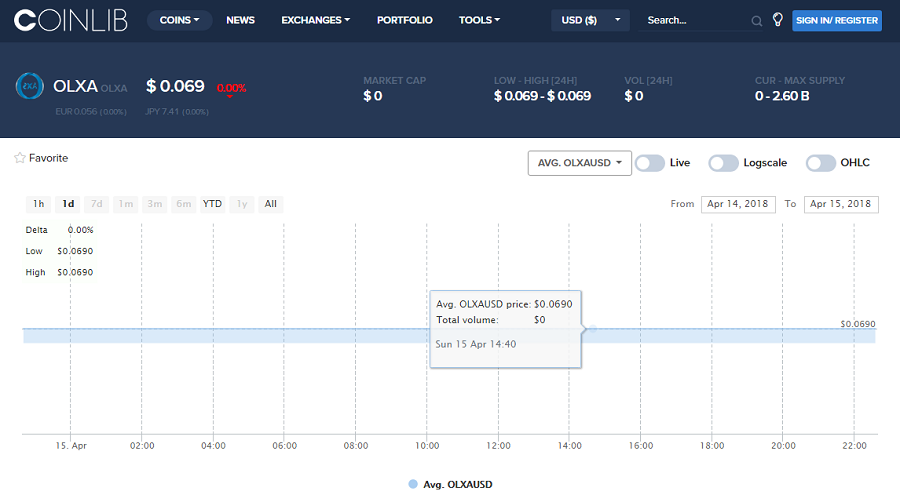
Taking into consideration that OLXA ICO is still Live at triggered at price $0.012 with special bonuses.
Why OLXA is proud of being listed on CoinLib ?
CoinLib has shown its powerful widgets and tracking tools that easily tracks each cryptocurrency price from the exchanges as well as showing the live prices to the blockchain community in a very professional way with history storage and data analysis.

These amazing features on CoinLib made OLXA proud to provide its community the live analysis for OLXA Token on CoinLib.
OLXA is starting the manufacturing process of its technology products once achieving the softcap of the OLXA Initial Coin Offering ICO, Feel free to .
With OLXA — The Sky is the Limit!
OLXA is proud of having more partners and we welcome all partnership requests through our e-mail at partners@olxacoin.com
OLXA reveals a clear desire to embrace the cryptocurrency market with stability and credibility as a fundamental element of its growth and user focus strategies.
Thank you for being one of our global supporters,
Keep tuned for more news
Follow on Social Media:
Telegram:
Facebook:
Twitter:
Hi everyone! Earlier this week I had a brief escape to a city in the clouds…

(Canary Wharf in London, if you’re wondering)
…and came home to find half the trees being cut down on the street my apartment looks out over. Why? Apparently they’re “not safe” and the powers-that-be are worried that, in a rough storm, they might fall over. I’m not sure what’s more disconcerting: that they’re preparing for “rough storms”, or that beloved trees that have been struggling to grow for 40 years are not even being given a chance to show their sturdiness. Safety is important. But so are trees. And Madrid is poorer for their loss.

— x —
This Rachel Rose O’Leary highlights a fundamental tenet of capitalism: it is naturally monopolistic.
Apparently crypto communities are up in arms over the arrival of ASIC (Application-Specific Integrated Circuit) chips, which give their owners an advantage in mining certain cryptocurrencies. Developers and users of ethereum, zcash and monero fear that the advantage that the new chips can give miners of these cryptocurrencies will upset the delicate balance in their decentralized ecosystems.
And they’re right, it’s likely that the result will be increased centralisation, as those with money (to spend on the chips) end up producing a greater number of tokens and thus making more money, which means they can buy more chips, and so on.
This freedom — to spend money on making more money — is capitalism’s centralizing force. And while factories and transportation networks have certain physical barriers that could slow the centralisation down, the digital world moves faster. Network effects are realised in a shorter time frame.
Yet this is antithetical to the crypto spirit of decentralized finance. Hence the existential conflict. To stop it from happening, strict rules will be needed. But rules decided by whom? Invariably, those that make the rules end up controlling the system. Not exactly decentralised.
It’s not often we get to watch capitalism at work in a petri dish. And the accelerant of networks and social media will make this expected plot twist particularly edifying to watch.
— x —
The reveal that several projects an ICO on codebases incubated within the Hyperledger consortium is further evidence of the spread of non-ethereum ICOs…
The Sovrin Foundation, creator of the Hyperledger Indy codebase for digital identity management, is planning a crypto token launch this summer.
And PokitDok, a healthcare API platform exploring blockchains, is looking into launching an ERC20-based token on top of Sawtooth, another Hyperledger codebase. ERC20 is a template designed to simplify the issuance of digital tokens on ethereum — this is the first I’ve heard of it potentially being used on other blockchains.
While that in itself is fascinating, taking this forward, I’m intrigued as to what it could do for interconnectivity…
— x —

by Christian Nagel, via
— x —
JP Koning sets out of what a digital central bank currency could look like…
“Like banknotes, these digital tokens are anonymous and untraceable. To make use of them, people don’t have to register for an account. Rather, the tokens are held independently on one’s device, sort of like how paper money is held in one’s wallet without requiring any sort of registration with the issuing central bank.”
… why it wouldn’t destabilize the system…
“…imagine a world with digital currency. In the event of a panic, customer redemption requests will be instantaneously granted by the bank facing the run. But that same speed also works in favor of the bank, since a request to the central bank for a top-up of digital currency could be filled in just a few seconds.”
… and why it probably wouldn’t work.
“…what if there just aren’t that many people who care about online privacy? Countries like Sweden, where banknote usage is plummeting, give credence to this concern while surveys of cash users in the eurozone show that anonymity is not terribly important to them.”
— x —
I’m far from a cryptocurrency maximalist, and am more interested in what blockchain’s can’t do than what they can, so it would be fair to think that I’m enjoying the growing chorus debunking the hype of both.
To some extent, yes, but I am now getting increasingly irritated by a new kind of hype: articles that decry blockchain’s futility and crypto’s lack of fundamentals, without understanding either. There are many smart realists out there (you’ll see me retweeting their stuff in approval). But as the hype cycle moves into the trough of disillusionment, others are jumping on the negative bandwagon without having the credentials or depth of knowledge to present arguments that hold up to either fact-checking or logical scrutiny. I’m not naming names because they don’t deserve the publicity — and that, more than reasoned debate, seems to be more what they’re interested in.
— x —

Dramatic interior shots by Spanish artist Lino Lago — via