
February 25, 2026

Capitalizations Index – B ∞/21M

‘Gravity’s a B*tch’: BitMEX CEO Mocks Crypto Firms for Failure of ‘Poo Poo’ ICOs

‘gravity’s a b*tch’: bitmex ceo mocks crypto firms for failure of ‘poo poo’ icos

‘Gravity’s a B*tch’: BitMEX CEO Mocks Crypto Firms for Failure of ‘Poo Poo’ ICOs


Arthur hayes bitmex crypto exchange
Arthur Hayes is the CEO of crypto exchange BitMEX. | Source: Featured Image from Distributed/YouTube

The research team at BitMEX exchange has released a report in collaboration with TokenAnalyst which reveals that various ICO teams in 2018 gifted themselves a grand total of $24.2 billion worth of crypto tokens.

The abstract of the piece is quick to state that “in reality liquidity was too low for this value to be realized,” adding that the true value has fallen by now to $5 billion due to the crypto bear market, and $1.5 billion worth of transfers from team address clusters have gone through.

Arthur Hayes, the CEO of BitMEX, mocked crypto startups for reaping the fruits of creating “poo poo” tokens through ICOs. “Gravity is a b*tch,” he said.

Follow The Money

The research is based on data for 108 tokens which, at the all-time high (ATH), were worth $80 billion in total, representing a $70 billion “loss” from the peak value, although again, it would have been impossible to sell for that much due to liquidity issues. The BitMEX research team acknowledges this in the piece but considers it a useful guideline because some trading did, in fact, occur at the ATH for these projects.

Of the $24 billion issued to ICO teams by themselves, 54% of the value was lost due to the price of the currency crashing. The teams currently hold an illiquid $5 billion in crypto tokens they issued to themselves and may have realized up to $1.5 billion in gains on top of that.

The researchers emphasize the caveat that the valuations for these holdings, while accurate in terms of the current trading price of each currency, may be overblown in the sense that the liquidity is not there to support selling the holdings at once or even at all. The data was gathered from studying smart contract information on the Ethereum blockchain.

The data is therefore a probabilistic estimate and is likely to be inaccurate at individual project level. However, the primary motivation for this report was to produce macro data about the team holdings of ICO tokens on Ethereum. Although this analysis has produced results which are far from perfect, we believe one can draw reasonable macro conclusions from the analysis.

The research then goes on to analyze each token’s value at ICO, post-ICO issuance, transfers away from team cluster, loss in value, and current value.

The End Result
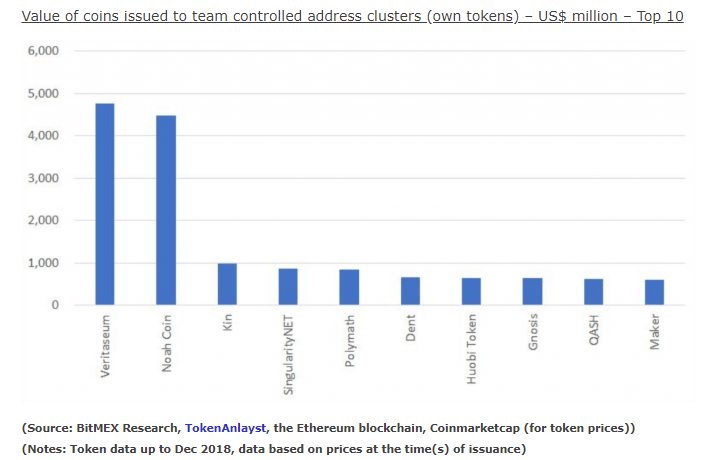
Ico crypto treasury
Source: bitmex

The article concludes that ICO teams may have profited by $13 billion in total from ICOs, with very little effort made or value generated on their part.

Although, as we have repeatedly explained, there are many inaccuracies and assumptions involved in producing the data. Based on our methodology, it appears as if ICO teams have profited by almost US$13 billion from this ICO process. In our view, this money was made incredibly easily, with very little work, accountability or transparency. Therefore ICOs has proven an extremely attractive way for project founders to raise funds. The results for investors of course, have not been as attractive.

Billions were raised in the ICO process which burned countless investors over-eager to get in on the crazy throughout 2017 and much of 2018. While the trend had mostly died down as of Q3 last year, it’s too late to undo the damage done to retail investors’ pockets as well as the reputation of the cryptocurrency movement overall, both of which will need to be rebuilt slowly over time, and one can only hope that in the future, participants on both sides of the market will exercise more restraint when it comes to fundraising projects so as to avoid disaster.

As crypto-twitter novelty account @TheCryptoDemon jokingly put it earlier today:

Featured Image from Distributed/YouTube

Published at Wed, 16 Jan 2019 17:03:26 +0000

Previous Article

Dow Jumps 145 Points as Markets Shrug off Brexit Blunder

Next Article

Crypto Venture UpStake is Redefining the Industry with a Proof-of-Burn Stable Coin

You might be interested in …

Does Regulation Slow Down or Accelerate Adoption?

Recently, many countries and cities have published new laws and legislations to regulate bitcoin. Does this help contribute to mainstream adoption, or is it merely a hindrance to it?


Regulation Slowing Adoption

New York was the first state in the USA to tighten regulation on bitcoin and other virtual currencies, via its BitLicense. This is issued by the New York State Department of Financial Services, and it regulates businesses which work with virtual currency.

The implementation of this law caused some bitcoin companies to cease operations in the state, while some others decided to go through the regulatory process to operate legally. However, to date, only 3 BitLicenses have been granted. Circle, Ripple and Coinbase are the only companies with the right to operate, and they must collect information on New York residents and report it back to the NYSDFS.

Other companies, like BitFinex and Kraken, decided to cease operations in the area and ban New York residents from using their services. They deemed the BitLicense to be too complicated to work with, and simply moving out of the area was the simplest option.

In other countries like China, regulation has been a bit harsher. Major exchanges were forced to introduce fees, freeze withdrawals and disable margin trading to comply with new regulation from the People’s Bank of China. Zhou Xuedong, director of the PBoC’s Business Administration unit, stated:

“There is a significant risk, one is the risk of customer funds security, the second is the risk of money laundering, the third is the risk of leveraged transactions.”

Ways Around Regulation

However, the bitcoin community has developed solutions to avoid regulation. Decentralized, peer-to-peer marketplaces exist, where users can spend and obtain bitcoins without adhering to any official regulation since the platform isn’t run by a third party.

BitSquare is a decentralized bitcoin exchange, where users can buy and sell bitcoins without proving their identity. OpenBazaar employs a similar concept and allows users to set up stores to sell their products.

There are also other platforms that aim to promote decentralisation. For example, Blockonomics.co provides a free, detailed bitcoin invoice services for freelancers and businesses, as an alternative to Coinbase or BitPay. This means that again, users can enjoy the same services without having to go through long verification processes.

Regulation Fueling Adoption

Contrary to popular belief, regulation doesn’t necessarily have to slow down adoption. In some cases, regulation could help bring cryptocurrency technology to the masses; an excellent example of this is Humaniq.

Humaniq is a new platform which aims to bring mobile banking services to those who reside in emerging economies. The platform is powered by blockchain technology, but they aim to be compliant with KYC/AML laws in the countries they will operate in.

However, users no longer have to go through a complicated verification process. Instead, the users’ identity can be verified by simply having them take a photo of themselves or by reading a short piece of text.

Africa mobile

This could mean a significant step forward for blockchain technology. Users would be able to access all of its advantages without too much trouble, which is very important for those who live in emerging economies.

Nonetheless, any person can use Humaniq; their ICO (Initial Coin Offering) begins today, April 6th, which is a great chance to contribute to the project if you haven’t yet already done so.

[Disclaimer: This is a sponsored article. Publication does not constitute an endorsement and should not be considered as investment advice. Bitcoinist is not responsible for any outcome that may result from investing in this ICO.] 

Do you think that cryptocurrency businesses should be regulated? If so, why? Let us know your thoughts below!


Images courtesy of Blockonomics.co, BitSquare, Humaniq, NewsBTC, CoinFox and The Houston Free Thinkers.

The post Does Regulation Slow Down or Accelerate Adoption? appeared first on Bitcoinist.com.

Bitcoin will reach 10,000 in May

bitcoin will reach 10,000 in May Photo by Austin Distel on Unsplash Altcoin season has arrived and BTC is surging In late 2017, bitcoin prices reached around $20,000. In 2019 many analysts are expecting bitcoin’s […]