US Department of Justice formally sanctioned an Iranian company and nine Iranian nationals for broad, worldwide hacking schemes against government outlets, universities, energy concerns, and private companies. Among the over half dozen hackers named was the alleged perpetrator of the Home Box Office (HBO) compromise and subsequent bitcoin ransom. The wildly popular HBO drama, Game of Thrones, was scooped up in 1.5 terabytes of stolen data, and threatened with pre-season leaks unless demands for millions of dollars in cryptocurrency were met.
Also read:
Game of Thrones bitcoin Hacker Named and Shamed in DOJ Iranian Sanctions
By summer of last year, HBO announced it had been . Terabytes of data stolen included closely held unaired episodes of its Emmy-award winning fantasy drama Game of Thrones (GOT). It’s the largest known media hack of its kind, seven times that of the notorious 2014 Sony data compromise. Soon after, partial leaks made their way around, prompting demands towards HBO for upwards of six million dollars in bitcoin or suffer the entire GOT season being distributed online.
In November of 2017, Iranian Behzad Mesri was indicted by US authorities for the GOT affair. Mr. Mesri has been linked directly to the HBO hacks, though his ties to the Iranian government remain loose at best — rumors are he might have been part of the Revolutionary Guard. The indictment accused Mr. Mesri of taking part in the Turk Black Hat Security division of the Iranian military, which had special emphasis on cyber attacking Israel.
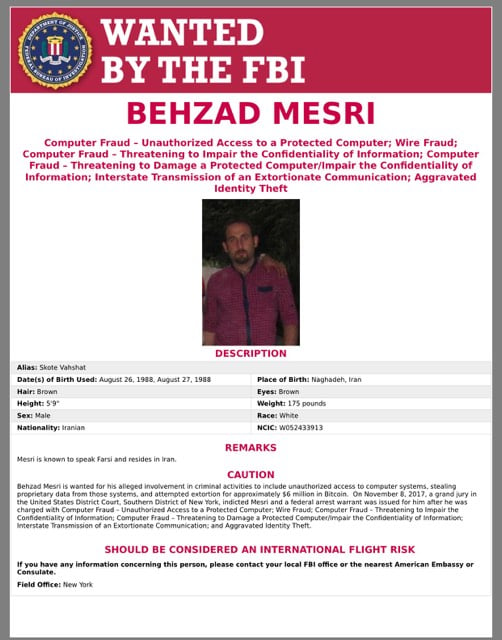
Reports at the time said there was little chance he would be turned over to the US, and so the Department of Justice (DOJ) engaged in a name and shame campaign. Mr. Mesri was given his own ”Wanted”-poster, and the lead agent announced in GOT lingo how “Winter has come for Behzad Mesri. He will never be able to travel outside of Iran without fear of being arrested and brought here to face these charges. The memory of American law enforcement is very long.”
The US alleges he was able to steal episodes of many unaired HBO shows, including coveted GOT scripts. He then began teasing the company with clunky messages such as “Hi to all losers! Yes it’s true! HBO is hacked…Beware of heart attacks,” signing them as Skote Vahshat. His demands reportedly included upping a bitcoin ransom from over five and a half million dollars to more than six, and, for emphasis, he began leaking portions of GOT to other media organizations.
Broader US Policy Toward Iran
For its part, HBO insisted, “It has been widely reported that there was a cyber incident at HBO. The hacker may continue to drop bits and pieces of stolen information in an attempt to generate media attention. That’s a game we’re not going to participate in.” Though seen as largely symbolic without Iran’s legal cooperation, the newly announced sanctions carry real world implications for Mr. Mesri, who remains free from US justice officials. Should he decide to travel he risks arrest and immediate extradition to the United States. If he owns anything in the US, all assets will be frozen or confiscated. 
Mr. Mesri is caught up in the larger US policy toward Iran, while the current American administration is decidedly more hawkish than in previous years. Supposedly, cyber attacks from Iran have been increasing in intensity since 2013, and included university professors and other state agencies.
HBO has not revealed whether it paid the ransom, but they’ve previously said they were going to offer 250,000 USD as a ”sign of good will”.
Do you think HBO paid the ransom? Let us know in the comments!
Images via Pixabay, FBI.
At we do not censor any comment content based on politics or personal opinions. So, please be patient. Your comment will be published.
The post appeared first on .

The introduction of Segwit and the launch of bitcoin cash (BCH) were two attempts at solving the bitcoin’s scaling problem. Both movements took a different approach, with Segwit seeking to reduce transaction size and BCH seeking to increase the block size. A new report compares the transaction volume on each chain, BTC (Segwit) and BCH, since last summer’s hard fork, and the numbers are remarkably close.
Also read:
Segwit and BCH Show There’s More Than One Way to Scale a Blockchain
Blockchain scaling is one part technical, one part ideological. There was a number of reasons that led to the fork of bitcoin core in August to form bitcoin cash, but at its heart it came down to increasing transaction capacity. Segwit sought to compress the amount of data in each transaction, thereby freeing up block space, while bitcoin cash made the size of each block bigger, up to a maximum of 8MB. New data published by Bitmex Research shows how each chain has fared since bitcoin core and bitcoin cash went their separate ways.
The cumulative transaction volume between BCH and Segwit is remarkably close, showing that each scaling solution has found their levels of support. Bitmex Research : “Since the launch of bitcoin Cash, 6.1 million Segwit transactions have taken place, only 20.1% more than the cumulative number of bitcoin Cash transactions…Adjusting for the one-month head start [BCH had], SegWit has 31.5% more cumulative transaction volume than bitcoin Cash, larger than 20.1% but still reasonably close.”
 Total transaction volume for Segwit and BCH is extremely close.
Segwit Had a Slow Start
Segwit adoption was low from the outset, and remained that way for several months, allowing bitcoin cash to get a head start. By late December, the total transaction volume of BCH and Segwit was neck and neck at around 4 million transactions apiece. It is only in the last month, when Coinbase belatedly introduced Segwit, pushing its adoption rate over 30% for the first time, that its total transaction volume has been able to compete with bitcoin cash.
Proponents of each chain have reasons to be content with these figures, and of how the future is shaping up for their preferred scaling solution. As Bitmex Research notes:
Although the data suggests that Segwit transaction have been adopted slightly faster than bitcoin Cash, resulting in more transaction volume, bitcoin Cash advocates could argue that the bitcoin Cash token is more about a philosophy of larger capacity in the long term, rather than the speed of the actual increase in transaction volume in the short term. Therefore bitcoin Cash supporters can still claim that bitcoin Cash will eventually have more transaction volume than bitcoin, once adoption of the coin increases.
bitcoin Core Block Sizes Fall to Their Smallest in Two Years
Last week, the average block size for bitcoin core (BCT) fell to just over 0.5MB, its smallest since January 2016. Around 22% of block space is taken up by Segwit transactions, showing that the scaling technology is still under-utilized. The dramatic reduction in BTC block space owes less to Segwit and more to improved batching coupled with reduced transaction volume. It is no coincidence that the average number of daily BTC transactions is also at its lowest level in two years.
 BTC block sizes are at their lowest in two years.
The average number of daily BTC to BCH transactions for the moment maintains an average ratio of 10:1, which also mirrors each asset’s respective price. However, total transaction fees for sending BTC in the last 24 hours are 200x greater than BCH. Even if the transaction volume on each chain was equal, in other words, BTC would still cost 20x more to send.
Why do you think BTC transaction volume is so low right now? Let us know in the comments section below.
Images courtesy of Shutterstock, Bitmex Research and Blockchain.info.
Need to calculate your bitcoin holdings? Check our section.
The post appeared first on .