For the second week, crisis remains one of the hottest topics in the crypto world. After the CEO of the exchange, 30-year-old Geral Cotten, suddenly died, the exchange has allegedly access to its cold wallets, where as much as 190 million Canadian dollars ($145 million) in digital assets were stored.
The firm has since in the Nova Scotia Supreme Court, which has granted it with a 30-day stay of proceedings under the Companies’ Creditors Arrangement Act (CCAA) — which will end on March 7 — to search for the missing funds.
According to court filings cited by , the company is considering selling its platforms to cover its debts.
While it’s still unclear what will happen once the CCAA order expires, the case itself has raised a lot of questions.
Cotten had exclusive access to the cold wallets
Given that QuadrigaCX was a major crypto exchange in Canada — in fact, in 2015, it the largest in the country — its funds management was surprisingly insecure.
According to the filed by Cotten’s wife, Jennifer Robertson, she learned from Alex Hanin, the chief website architect of QuadrigaCX’s website, and Aaron Mathews, the director of operations at the exchange, that her husband “took sole responsibility for the handling the funds and coins and the banking and accounting side of the business.”
Therefore, Cotten was entirely accountable for the wallets and corresponding keys to $145 million in digital assets. Robertson said in the affidavit:
“Quadriga keeps only a minimal amount of coins on the server [a hot wallet]. The normal procedure was that Gerry would move the majority of the coins to cold storage as a way to protect the coins from hacking or other virtual theft.”
Robertson added that “despite repeated and diligent searches,” she has not been able to find the keys — or access his encrypted laptop, where they could be stored.
As Taylor Monahan, ex-developer of Ethereum () wallet interface MyEtherWallet (MEW) who is now CEO of the MyCrypto project, previously Cointelegraph that the idea of large amounts of digital assets being locked out because they were controlled by one person seems “beyond absurd”:
“The fact that a person controlling millions of customer assets didn’t have any sort of backup in place, gave no one else access, and didn’t leave any information regarding these accounts with anyone is beyond absurd. If this is indeed the truth, any number of outside factors could have resulted in the loss of access to those customer funds, like fire, flood, misplacing the single piece of paper, etc.”
Similarly, Michael Gokturk, CEO of Vancouver-based digital assets platform Einstein Exchange, The Globe and Mail that having entire access to those funds would make Cotten particularly vulnerable to kidnapping or other forms of extortion:
“It’s the equivalent of walking around with millions of dollars in cash on you at all times.”
Will was filed just two weeks prior to Cotten’s death — and it mentioned everything but the keys
Court documents cited by show that Cotten on Nov. 27, just 12 days before his death. As per the will, the QuadrigaCX CEO made his wife the executor of his estate and left her all his assets — which, , added up to $9.6 million.
The list of Cotten’s belongings outlined in the will is rather long: Specifically, it includes several properties in Nova Scotia and in British Columbia, a 2017 Lexus, an airplane, a Jeanneau 51 yacht and two of his pet chihuahuas named Nitro and Gully, along with $100,000 for their care. Moreover, Cotten to Robertson.
In case of Robertson death, in turn, Cotten’s assets would be divided among other family members, CBC . Thus, his plane, Lexus and a property in Kelowna, British Columbia — were left to his brother and his sister-in-law, while “various” Nova Scotia properties and his sailboat would allegedly be bequeathed to his parents.
Nevertheless, the keys to QuadrigaCX’s cold wallets — or any other ways of accessing those funds — aren’t mentioned anywhere in the papers — which might be strange, given that Cotten actually thought about his death and filed related documents.
Expert analysis show no definite signs of ‘cold wallets’
Robertson claim that the funds at QuadrigaCX would normally be held in a cold wallet, reteriated the exchange’s policy that could be traced back to 2014, when , stating that the exchange held the majority of its assets in offline storage.
However, after the news about Cotten’s death and QuadrigaCX application for the CCAA broke, community members began tracing the funds and found out that the notorious cold wallets might not exist at all.
For instance, Taylor Monahan of MyCrypto, , has yet to find any signs of cold wallets. She told Cointelegraph:
“Based on what I’ve seen with their other main Ethereum wallets, I haven’t found any signs of a cold wallet. We can see large amounts of ETH move between their known ‘hot’ wallets. We see large amounts of ETH being moved temporarily to a variety of addresses before quickly being sent onto an exchange. But we don’t see any significant amount of funds being moved to something that resembles ‘cold’ storage.”
Other research, published on cryptocurrency portal Zerononcense Blog, also that QuadrigaCX never had offline storage, per se. The report explicitly states:
“It appears that there are no identifiable cold wallet reserves for QuadrigaCX.”
According to the research, the exchange likely only had cryptocurrency reserves of under $100 million. Further, the report contains alleged evidence that shows that someone had access to the company’s wallets after Cotten died, reportedly making several outgoing transactions since Dec. 9.
Cotten’s death itself raises some questions as well
Robertson her husband’s unexpected death on Jan. 15 — more than a month after he passed away “due to complications with Crohn’s disease.” According to the widow’s statement published via QuadrigaCX’s Facebook page, Cotten perished while travelling in India. The itself is not normally fatal, but might entail life-threatening complications.
Soon after hearing about Cotten’s passing, QuadrigaCX users took to social media , citing a lack of proof.
As per , the CCAA filings included a statement of death issued by J.A. Snow Funeral House in Halifax.
Further, according to , Cotten spent a day at the Fortis Escorts hospital in Jaipur, where he was admitted on Dec. 8, before dying of a “cardiac arrest.” The QuadrigaCX CEO was reportedly accompanied to the hospital by his wife.
As per the report, Cotten was “feeling feverish” and complained of vomiting, watery stools and crampy abdominal pain. Upon admission, he was diagnosed with “septic shock, perforation, peritonitis, intestinal obstruction.” He was reportedly declared dead at 7:26 p.m. on Dec. 9 after several episodes of heart malfunction.
That information is echoed in an alleged death certificate issued by the local municipality, which has since surfaced online. However, among Reddit users, who noted that Cotten’s surname was misspelled as “Cottan.” It also doesn’t specify the exact time of death.
Quadriga continued accepting deposits after it knew it couldn’t access cold wallets — and had past banking problems
Several reports indicate that QuadrigaCX on Dec. 9. The exchange was shut down on Jan. 29, after Robertson, who says she was not involved in the business while her husband was alive, filed an application to hold an emergency meeting, where board directors then . Interestingly, the official announcement maintenance issues as the reason for closure.
Therefore, while Robertson and QuadrigaCX executives knew about Cotten’s death — and therefore acknowledged that they could not access their cold wallets — being on the verge of a liquidity crisis — they continued to accept deposits from customers.
At the time, QuadrigaCX’s traders , with complaints dating back to as early as early 2018, when the Canadian Imperial Bank of Commerce (CIBC) five accounts belonging to Quadriga’s payment processor, Costodian Inc., and its owner, Jose Reyes. Combined, they reportedly contained around $19.6 million.
Patryn’s role in QuadrigaCX — and his (unproven) ties to a convicted money launderer
Cotten the digital assets exchange back in 2013 along with Michael Patryn, of the Vancouver ₿itcoin Co-op, a voluntary association of local cryptocurrency enthusiasts, of which Cotten was a director.
In May 2015, in one of his first public appearances as QuadrigaCX co-founder, Patryn that his company was selling over-the-counter () shares for ₿itcoin.
After that, in March 2016, the British Columbia Securities Commision (BCSC) barred QuadrigaCX from selling securities after (CTO) for not submitting annual audited financial statements for the fiscal year that ended Oct. 31, 2015.
About a week before getting hit with the CTO, Quadriga started to undergo massive layoffs among the company’s executives: First, directors Anthony Milewski and Lovie Horner . Then, soon after the order was issued, Bill Filtness, a director, and Natasha Tsai, the chief financial officer, . It appeared that Patryn and Cotten were the only seniors left in Quadriga.
However, in March 2018, Quadriga’s official Reddit account that Patryn was “an early [sic] who left the company more than two years ago.” Although that , showing that he left the firm in February 2016, Patryn’s resignation from Quadriga was never announced. Nevertheless, , he worked with Cotten “until a fight split them” in 2016.
Further, Reddit users have Patryn to a convicted money launderer named Omar Dhanani. The theory mainly rested on the fact that Dhanani used the name Omar Patryn in a forfeiture case and that a fraudulent company called Midas Gold Exchange .
Quadriga has this accusation, calling it “nonsense.” Patryn has also , saying that alias “Omar Patry” is just a coincidence.
Quadriga transferred $500,000 in BTC to its cold wallets even after they got locked out
On Feb. 12, big four auditing firm Ernst & Young (), which has been appointed by the court as an independent third party to monitor Quadriga’s hearings, its “,” suggesting that the Canadian exchange accidentally transferred nearly $500,000 in BTC to its cold wallets earlier this month.
That seems to complicate the case even further because, at the time, Quadriga clearly knew that it couldn’t access those wallets (which, as mentioned above, have been reported as nonexistent by some third-party analysts in the crypto community). The EY document states:
“On February 6, 2019, Quadriga inadvertently transferred 103 ₿itcoins valued at approximately $468,675 to Quadriga cold wallets which the Company is currently unable to access. The Monitor is working with Management to retrieve this cryptocurrency from the various cold wallets, if possible.”
Ernst & Young also reported that it secured a number of Quadriga electronic devices for further analysis — allegedly owned or used by Cotten — including four laptops, four cell phones and three encrypted USB keys.
QuadrigaCX used a fake address for its office
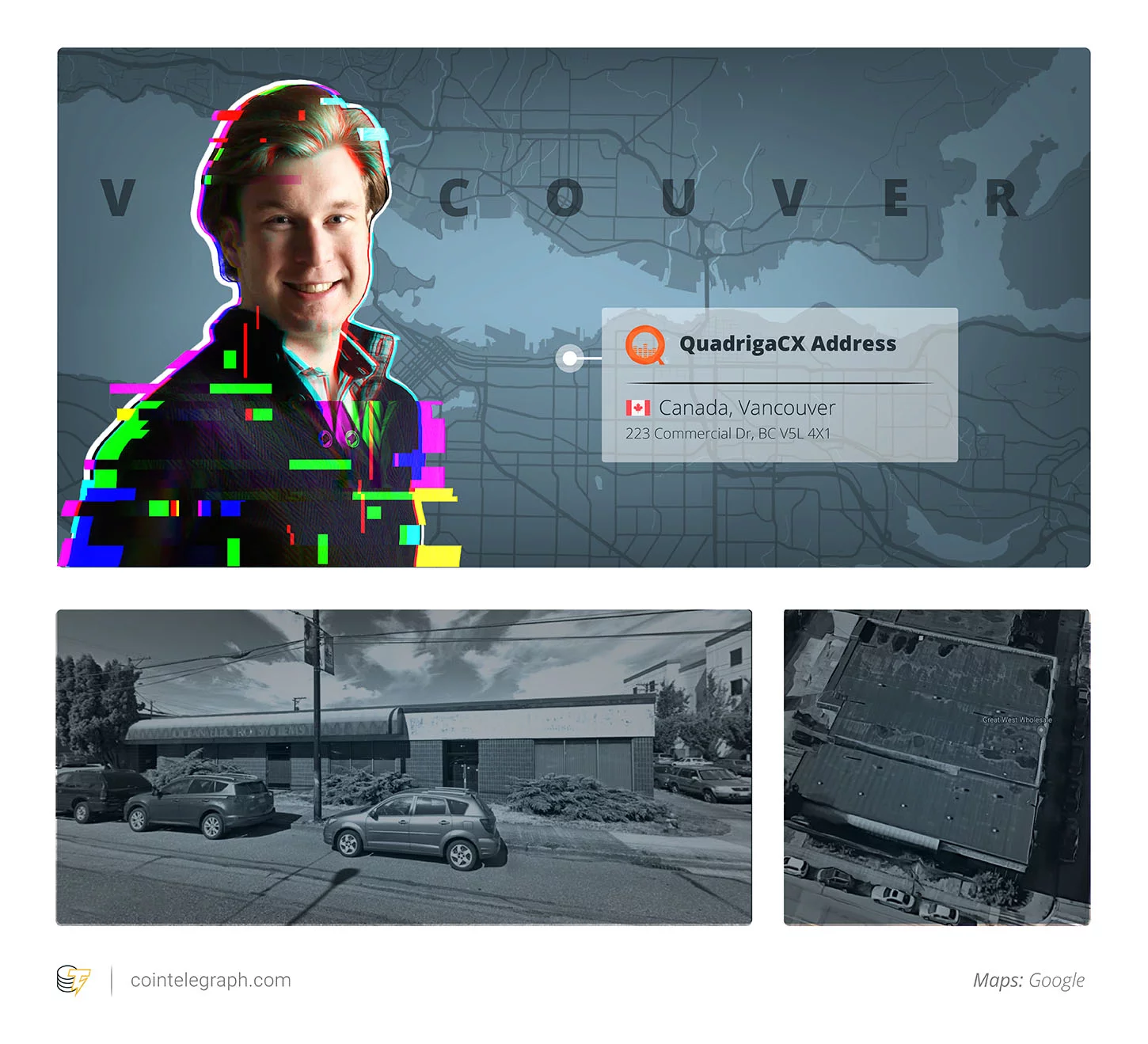
In February 2018, Reddit user u/Psychofig that, after he checked out the address stated on the exchange’s website — 223-2055 Commercial Drive, Vancouver BC — he discovered it was nonexistent. Indeed, for that address shows no sign of Quadriga’s brick-and-mortar presence.
In response to u/Psychofig’s post, the company that they had an office before, but closed it down for the public due to security concerns:
“Its a PO [post office] box, just like our competitors. We could have a physical office where you could visit, but then we would risk being robbed like Canada ₿itcoins.”
Meanwhile, the authorities start looking into the case
At first, regulators seemed hesitant to investigate the case, citing regulatory difficulties. For instance, on Feb. 7, the British Columbia Securities Commission (BCSC) that it does not oversee QuadrigaCX, since the firm has allegedly not shown signs of trading securities or derivatives, or operating as an exchange in general. “As such, BCSC does not regulate it,” BCSC spokesperson Brian Kladko .
However, on Feb. 8, the Ontario Securities Commission (OSC) into the Vancouver-based exchange. Specifically, the agency that, “given the potential harm to Ontario investors, we are looking into this matter and have already been in contact with the monitor.”
Previously, Jesse Powell, the CEO of United States-based crypto exchange , which also operates in Canada, that he finds the story “bizarre and, frankly, unbelievable.” Powell even suggested the Royal Canadian Mounted Police (RCMP) contact his exchange, as it has “thousands of wallet addresses known to belong to @QuadrigaCoinEx [QuadrigaCX]” that Kraken is currently scrutinizing.
Published at Wed, 13 Feb 2019 16:27:00 +0000