November 8, 2026

Capitalizations Index – B ∞/21M

Fortnite Star Ninja Has Millions of Duplicate Followers: Bombshell Study

Fortnite star ninja has millions of duplicate followers: bombshell study

Fortnite Star Ninja Has Millions of Duplicate Followers: Bombshell Study

Fortnite star ninja has millions of duplicate followers: bombshell study

Legendary Fortnite player Richard Tyler “Ninja” Blevins has much to celebrate. In 2018, the gamer and wildly popular Twitch streamer told CNN he earned close to $10 million.

Other reports indicate that Ninja makes more than $500,000 per month in sponsorship and ad revenues stemming from the size of his massive viewer base. But how would Ninja fare if his sponsors knew that his reach was actually millions of fans smaller than they think?

Study: Ninja Has 4 Million Duplicate Followers

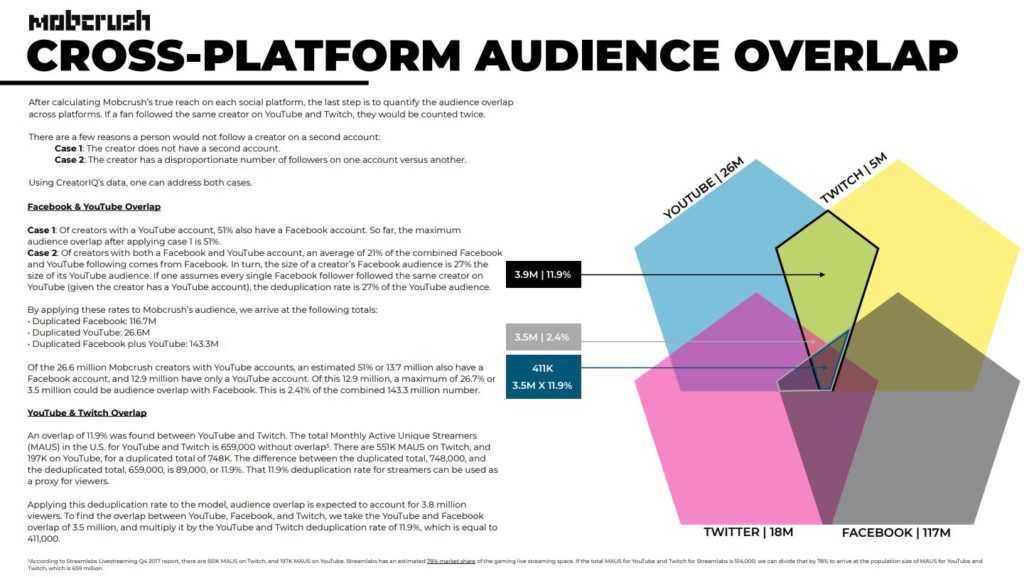
This is how the Mobcrush/CIQ study measured audience overlap on Twitch and other streaming platforms.

Last week, Mobcrush and CreatorIQ (CIQ) – companies that work to enable monetization options for creators – unveiled this blockbuster finding from a case study that measured streaming audiences on Twitch and other platforms.

Taking Ninja’s cumulative ~47 million followers across his various social media accounts, Mobcrush and CIQ applied their cross-platform deduplication method to determine the Fortnite streamer’s true reach.

The study found an audience overlap of more than 4 million followers across Ninja’s social media accounts. | Source: Mobcrush/CIQ

Of Ninja’s 47 million followers on Twitch, Facebook, and YouTube, more than 4 million are the product of audience overlap, meaning that his audience reach is inflated by more than 9%. Breaking it down further, the Mobcrush/CIQ study identified a 2.41% overlap between YouTube and Facebook and an 11.9% overlap between YouTube and Twitch.

Notably, the report does not account for overlap on Twitter and Instagram. Michael Lambie, Head of Product at CreatorIQ told CCN this was because the study focused on “mature live-streaming” platforms.

Impacting Ninja’s Income

If a 9% dip in reach equates to an equivalent 9% decrease in earnings, and we use Ninja’s self-reported figure of $10 million for 2018, we could estimate his anticipated income for 2019 at approximately $9.1 million. | Source: Shutterstock

If Ninja’s sponsors acknowledge an estimated difference of 9% (or more) between his perceived total following and his true reach, could that spell disaster for the influencer’s future income?

If a 9% dip in reach equates to an equivalent 9% decrease in earnings, and we use Ninja’s self-reported figure of $10 million for 2018, we could estimate his anticipated income for 2019 at approximately $9.1 million; however, the formula isn’t that simple.

Ninja Won’t be Hard up for Cash

To determine a more accurate estimate of Ninja’s future income, we would also need to account for the growing number of advertisers who are flocking to influencer marketing. MediaKix estimates that between 2018 and 2019, the global spend on influencer marketing will increase by approximately 30%.

Applied directly to Ninja’s numbers, a 30% increase would put Ninja’s projected 2019 income around $11.83 million for an overall increase of 18.3% compared to 2018.

Consequently, it doesn’t look like he’ll be hard up for sponsorship revenue, even if a few million of his followers don’t really exist.

CCN reached out to Ninja’s PR team, but they did not respond to our request for comment.

How Transparency Could Save Advertisers Over $100 Million Annually

Advertisers are throwing money at media influencers. Perhaps they should be more careful about using audience metrics when calculating paydays. | Source: MediaKix

Defective calculations of influencer reach, coupled with the influx of “fake influencers” – who purchase followers and engagement to embellish the extent of their impact – may cost advertisers up to $100 million annually.

With the influencer marketing industry growing at an astonishing rate, sponsors can expect to see an increase in fraudulent practices that cost advertisers money concurrent with the growth of the industry itself.

Tools like the cross-platform deduplication method help advertisers to weed out fake influencers who strive to take their money and run.

Recently, even Facebook has come under scrutiny for allegedly inflating its user base to increase ad revenue. Without accurate measurement devices in place to differentiate influencers who have legitimate clout – like Ninja – from those who do not, the influencer community as a whole could suffer.

The full Mobcrush and CIQ report is available here.

Ninja Image from Robert Reiners / Getty Images / AFP

Published at Wed, 20 Feb 2019 16:55:58 +0000

Previous Article

Quadriga CX Fiasco Highlights the Need for Crypto Insurance

Next Article

Judge Appoints 2 Law Firms to Represent Quadrigacx Clients

You might be interested in …

Производитель материнских плат ASRock объявил о выпуске видеокарт для майнинга

ForkLog Производитель материнских плат ASRock объявил о выпуске видеокарт для майнинга Тайваньская фирма ASRock разработала линейку видеокарт, «заточенных» под добычу криптовалют. Представитель компании подтвердил, что четыре из представленных в линейке Phantom Gaming Series устройства «предназначены […]

Trustlessness in Action: Particl's Model

Particl Thumb 5

“Trustlessness” is a term often
quoted as a feature of blockchain technology but what does that mean and is absolute
zero trust a myth or really true? Praised as one of the characteristics that
make the blockchain so revolutionary, a trustless system is one where two peers
can enter a virtual hand shake agreement, i.e.  smart contract, without relying on a
trusted third party to facilitate.


Blockchains are good at being
permissionless and having decentralized tasks that are recorded on an auditable
ledger, yet not all blockchains are completely trustless, and achieving full
trustlessness is challenging if not impossible.
Even
an open-source project like bitcoin that is constantly being reviewed can have
trust issues, not from the code but by the developers and reviewers of the
code. So trustlessness is more of a term describing an ideal state on the
blockchain where code is law with the caveat that humans write code and to err
is human.


Before looking at how a fully
trustless blockchain can be implemented by privacy advocates like Particl — an open-source project that is building
a decentralized ecommerce application on the blockchain — let’s look at the
obstacles standing in the way.


I Trust
You, Until I Don’t


We’re conditioned to think of
trust as a good thing. Traditionally, positive human relationships have
required a level of trust.
From an economic perspective, however, trust has significant
downsides.


The greatest drawback is that trust
can be broken. When you engage in a transaction with someone you believe to be
trustworthy, but then they fail to deliver the promised goods or services, you
suffer.
In
addition, trust is not efficient. It has to be cultivated and you have to
invest time in evaluating how much another party can be trusted before you
engage in a trade.


Blockchain technology can be
leveraged to overcome the risks and inefficiencies that are associated with
trust.
With
the right approach, it’s possible to make reliable transactions on the
blockchain without knowing or trusting the person or group you are dealing with.
That is because the blockchain can be used to enforce good behavior.


In Particl’s case, by creating
a simple smart contract, you can ensure that if one party in a transaction
fails to uphold their end of a deal, the blockchain can automatically cancel
the transaction or punish the misbehaving party in another way. In effect, this
feature makes it impossible for a malicious user to profit by taking advantage
of the trust that another user places in them without inflicting harm on
themselves as well.


The
Trustless Challenge


If you buy or sell something
using bitcoin, you don’t automatically gain protection against being cheated: default
bitcoin transactions are non-reversible. The ability of the blockchain to
enable transactions that are both trustless and reliable is difficult because
it needs to be done without the intervention of a third party. In conventional
trading contexts, transactions are typically policed by a central authority that
evaluates claims about broken trust and responds accordingly. For example, if a
seller cheats you on eBay, you can complain to eBay and request a refund. These
authorities also charge fees or percentages of sales revenue whether they are
used or not.


The downside to this approach
is that it compromises privacy. In order to provide this protection against
broken trust, a platform like eBay oversees transactions. It knows what buyers
and sellers are doing.
With a two-person trustless escrow, in contrast, reliable
transactions can be implemented without the oversight of a third party. You
don’t have to lose privacy to gain reliability.


The tricky thing about
achieving true trustlessness on a privacy-focused blockchain is that it doesn’t
happen by default. Although multiple times more efficient than building trust
in public, smart contracts still need to be signed and the exchange of goods or
services still needs to happen. The beauty is that an agreement can be made and
successfully carried out even if one or both parties don’t fully trust each
other.


A Trustless
Solution


Particl leverages bitcoin as
the underlying blockchain protocol, but adds privacy enhancements that make it
possible for users to perform transactions that are trustless, reliable and
private. In an innovative development, PART transactions do not require users
to write smart contracts themselves. Instead, this feature is built into the
platform.


Central to Particl’s approach
to trustless transactions is mutually assured destruction (MAD) escrow. MAD
escrow
is a special type of smart contract that prevents either party from
profiting in the event that one cheats during a transaction.


In addition, because the smart
contract is enforced automatically via the blockchain, Particl developers play
no role in overseeing transactions. Their platform guarantees privacy while
achieving trustlessness at the same time. Two people from anywhere in the world
can enter into a binding agreement that is only finalized when both agree it is
completed.


Blockchain technology’s promise
is that users are no longer bound by the inefficiencies and risks associated
with trust in order to make transactions. Most blockchains, however, do not yet
implement truly trustless transactions. Particl is an exception, as it was developed
with trustlessness at its core from the start. Particl developers aim to “square
the circle” by delivering trustless ecommerce without compromising reliability
or privacy.

The post Trustlessness in Action: Particl's Model appeared first on Bitcoin Magazine.