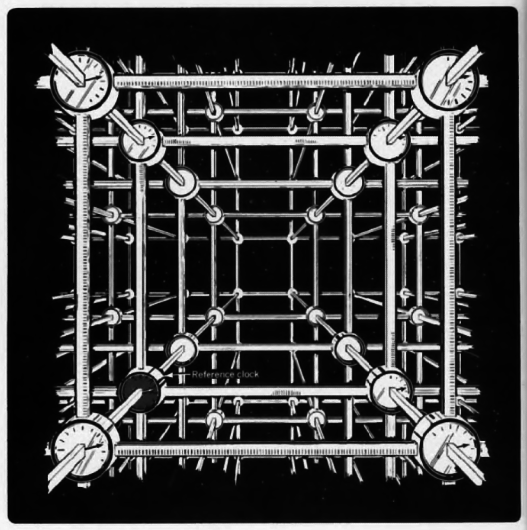
 Lattice of Space and Time. Cartography requires machine like clock procedures to produce space coordinates
The fundamental tenet of the FOAM Proof of Location protocol is time synchronization. Fixed radio beacons called Zone Anchors can discover each other in a permissionless and decentralized fashion. Together the anchors synchronize their clocks and establish a Zone, and in doing so maintain a quorum over space and time.
The goal of this post is to explain the importance of time synchronization in a Proof of Location system by way of a historical examination. As we will see clock coordination and time synchronization has been a key factor in cartography and will continue to be for the FOAM protocol. See our previous post for more context:
General Relativity
In the classical mechanics of , time is defined as absolute and independent with its own unidirectional flow and pace. With the introduction of spacetime, absolute time was admonished. Albert Einstein’s 1905 paper “” introduced the theory of relativity while forever dismantling Newtonian physics. He wrote, “Time can not be absolutely defined and there is an inseparable relation between time and signal velocity”. Under this new theory, the only means to define time is in reference to a definite system of linked, coordinated, and synchronized clocks.
”Time can not be absolutely defined and there is an inseparable relation between time and signal velocity”
Today, distributed clock coordination and in turn time synchronization power our economy and schedule our lives. The history of this development touches on the convergence of Capitalism, Globalization Modernity, Technology, and Philosophy. The Global Positioning System(GPS) of satellites relies on synchronized atomic clocks across ground-based stations in order to offer location services to receivers. However, because the clocks on the satellites are moving through space at varying velocities, relativistic effects on the clocks need to be resolved. With GPS, the theory of relativity has become a proven technology and has augmented all conventional surveying and cartographic tools.
Independent of GPS time, is an international time scale computed by taking the weighted average of more than 300 atomic clocks that are located at more than 60 timing laboratories around the world. Additionally, – the primary time standard by which the world regulates clocks and time — is based on TAI but further accounts for “” which corresponds to the speed that the Earth is rotating. UTC keeps the time synchronized and aligned with the astronomical time of the stars, with corrections defined by the .
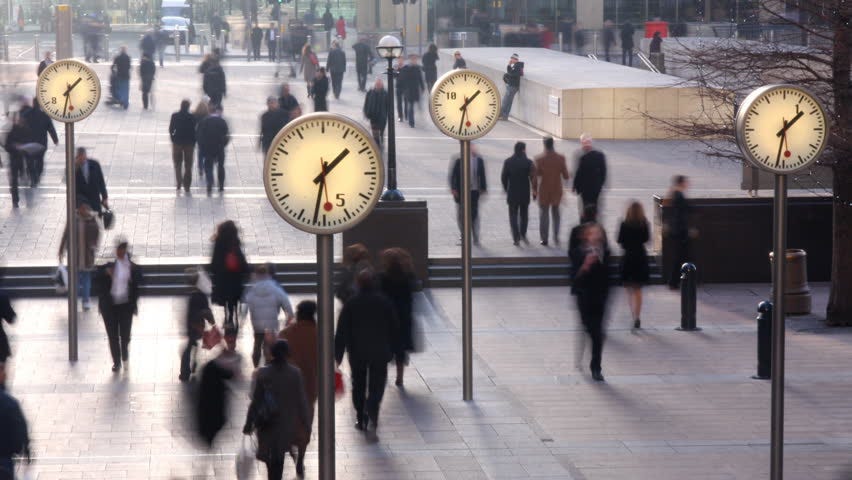 There is no master clock and there is no single source for the time.
Needless to say, Einstein’s breakthrough that coordinated systems requires synchronized clock simultaneity holds true and for how we program our technology today. If the the only way to have a coherent meaning of time is through a frame of reference, today we have many to pick from when considering the current differences in the global time keeping standards.Interestingly enough: “no clock keeps the “official” version of UTC, because TAI and UTC are “paper” time scales that can only be calculated after all of the data from the international contributors are received.” There is no master clock and there is no single source for the time.
Canonical Time
Even before the invention of mechanical clocks in the Middle Ages, there was a single source of time known as . Maintained and administered by Catholic churches, Canonical Time was a physical broadcast from powerful bells, hung on high towers. This form of public time broadcast affected the architecture and design of cities. The Medieval Church was much more than a religious institution.It also maintained Canon Law which in addition to time contained standard weights of elements for fair markets and dispute resolution. The church bell tower became the tallest and most expensive structure in every European settlement.
the simultaneous rise of the mechanical clock and the sandglass in the 14th Century. Both worked separately to redefine the structure and ordering of human relations. The sandglass was used for decentralized portable time and as a means to independently check the public mechanical clocks in the bell tower for fraud.Szabo attributes both the mechanical clock and the sandglass to an economic revolution in time-rate wages over serfdom and standard equal hours that sophisticated institutions and coordination of departments and people could occur. Common time synchronization allowed for the first “fair and fungible measure of sacrifice” and contracts to be fulfilled around time. Szabo writes in the :
“The most valuable property of the bell tower time was not its accuracy, but its fairness. Even if it broadcast the wrong time, it broadcast the same wrong time to everybody.”“The productive synchronization of human relationships funded the bell towers; the bell towers would provide a ready market for public clocks. Thus did in Europe emerge a“virtuous circle” that would advance both its timekeeping technologies and time-dependent institutions beyond those of the other continents.” Clock Tower in Bern, Switzerland where Einstein worked as a Patent OfficerTime for Navigation
To make spatial measurements a coordinate and time system is needed and technological machines have brought maps and clocks closer together than ever. This also applies to navigation systems from the Middle Ages as well, which could not use GPS or any radio assistance for navigational assistance. Instead, local synchronized clocks in the form of sandglasses formed the bases of navigation for early explorers.
A technique known as , also , relies on predicting movement based on direction, duration, and speed. Originally a manual computation, Dead Reckoning was used by aviators during the Cold War. Distance can be calculated from time and speed in order to generate a sequence of vectors. In addition to sandglass time intervals, a magnetic compass was utilized. This method is highly prone to error. It is also difficult to follow Dead Reckoning directions as it is only a means of navigating through space to a destination. In short, localizing oneself on a map was not possible. Dead Reckoning is made up of “temporally constant but spatially variable vectors” that can not be projected onto a Ptolemaic map with lines of latitude and longitude or a Euclidean plane, it only can manifest as a scaleless vector with measurements of time. A Ptolemaic is one that corresponds to the coordinates of the Earth at scale.
 The Vectors of Dead Reckoning Directions can not be Mapped to Coordinates
The difficulty of being able to locate your position on a map was historically known as the Longitude problem. Latitude is easily determined through celestial measurements, however there are no natural elements that can be used to measure longitude. Because of this, getting lost navigating at sea was a real danger to commerce and lives. Following the disastrous loss of the British Fleet in 1707 near the Scilly Isles due to such navigational errors, the British Parliament passed the, which created a panel of experts to oversee rewards for solving the problem of finding longitude at sea.
This spurred a breakthrough by J clockmaker who invented a marine chronometer and solved the problem of longitude at sea. The marine chronometer could mechanically keep a reference time of a specific location and remain accurate over long periods, despite changes in temperature, pressure or humidity. Knowing the difference in time between a fixed location, the Greenwich Meridian and the time of a moving ship can be used to calculate the longitude of the ship using spherical trigonometry. The chronometer served as a portable time standard, for every hour of difference in local to reference time 15ºof longitude could be accounted for.
As the electro-coordinated simultaneity of clocks drove the growth in the early 20th century of industry, railroads, telecommunication, and commerce synchronization, and it also became a symbol of interconnected modernity. Simultaneously, there was a rush to establish time coordination systems over radio waves. Radio time soon took over for the marine chronometer and long distance radio allowed more precise determinations of longitude, not only for ships but modern municipalities in colony countries that needed to synchronize their clocks with London, for example as well as orient their location on the map by obtaining an accurate longitude reading from the radio time.
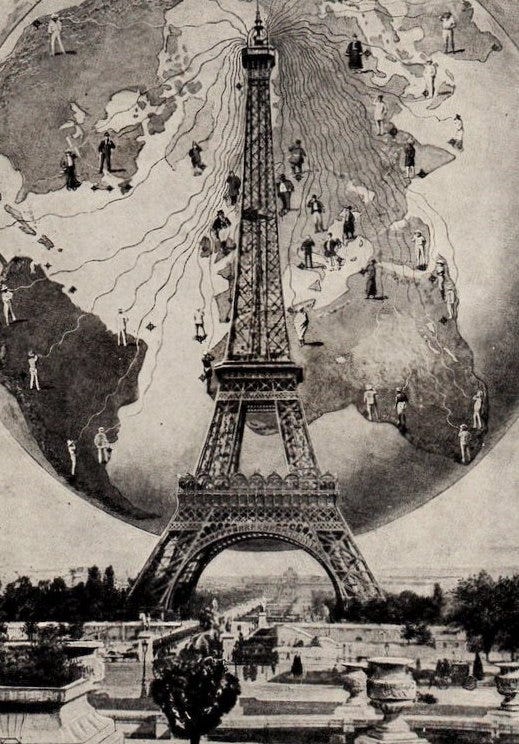 The Eiffel Tower was once a great Radio Time Synchronizer
The Eiffel Tower was slated for demolition in 1909 until its usefulness as a radio tower was discovered. By 1910, the Eiffel Tower had been transformed into a radio tower, becoming the greatest time synchronizer in the world. The tower’s signal could be used to configure longitude anywhere it could be received. The tower would broadcast a signal every 1.01 seconds and receivers would subtract the difference in seconds of local signals before collision to obtain longitude. In 1913 The Paris Observatory, using the Eiffel Tower to broadcast, exchanged signals with the United States Naval Observatory in Arlington, Virginia to securely verify longitude.
The Asynchronous Internet
Today, clock synchronization protocols– some relying on radio broadcast — are used to provide accurate location and time for many systems without fault. However, all of these systems are centralized and are not interactive. It is not possible to produce a verified digital certificate about your location, the radio broadcasted time signals of GPS can only be used to calculate location. Global clocks have been difficult to maintain between nodes on the Internet because the network is asynchronous, a trusted third party would be needed. Szabo writes, .
addressed this problem, but not until the implementation of bitcoin and the blockchain was the consensus problem implemented at scale for the asynchronous network of the Internet.All participants in bitcoin are financially incentivized to maintain a ledger of transactions and order them by their corresponding time-stamp. In such a distributed system there is no global”now” and the clocks of local machines drift apart, eliminating the possibility of relying on machine local timestamps for the ordering of data. As a solution, Satoshi Nakamoto proposed that in the absence of a global clock a Distributed Timestamp Server can be used, and this is essentially what bitcoin implements. As Nakamoto writes:
“Every general in the Byzantine’s general’s problem, just by verifying the difficulty of the proof of work chain can estimate how much parallel CPU power per hour was expended on it, and see that it must have required the majority of the computers to produce that much work in the allotted time… the proof of work chain is how all synchronization, distributed data base, and global view problems you’ve asked about are solved.”
Such an advancement in Distributed Network Security has encouraged a new resurgence in Byzantine Fault Tolerant(BFT) research with projects such as , and . For the first time will be possible over the asynchronous internet with decentralized consensus.
When it comes to repurposing BFT consensus protocols from traditional distributed computing:
body[data-twttr-rendered=”true”] {background-color: transparent;}.twitter-tweet {margin: auto !important;}
3/ The protocols come in three main flavors: Synchronous, Partially Synchronous and Asynchronous consensus. The first two flavors make assumptions about how fast participants in the protocol can exchange messages over the network
—
FOAM is focused on implementing synchronized clocks for Proof of Location as a decentralized, privacy preserving, and interactive alternative to GPS and means of measuring space and time for cartography and map making. The entirety of the FOAM protocol relies on Synchronous, Partially Synchronous and Asynchronous consensus.
Anatomy of a Zone
A Zone Anchor is a device with a radio transmitter, a local clock, and a public key. A node is capable of engaging in a clock-synchronization protocol and requires a connection to a gateway.Four or more Zone Anchors form a Zone, establishing a quorum and maintaining clock-synchronization for a given region. Once synchronized, the Zone can determine the location of a requesting node by using time of arrival measurements for a verifiably triangulated position.
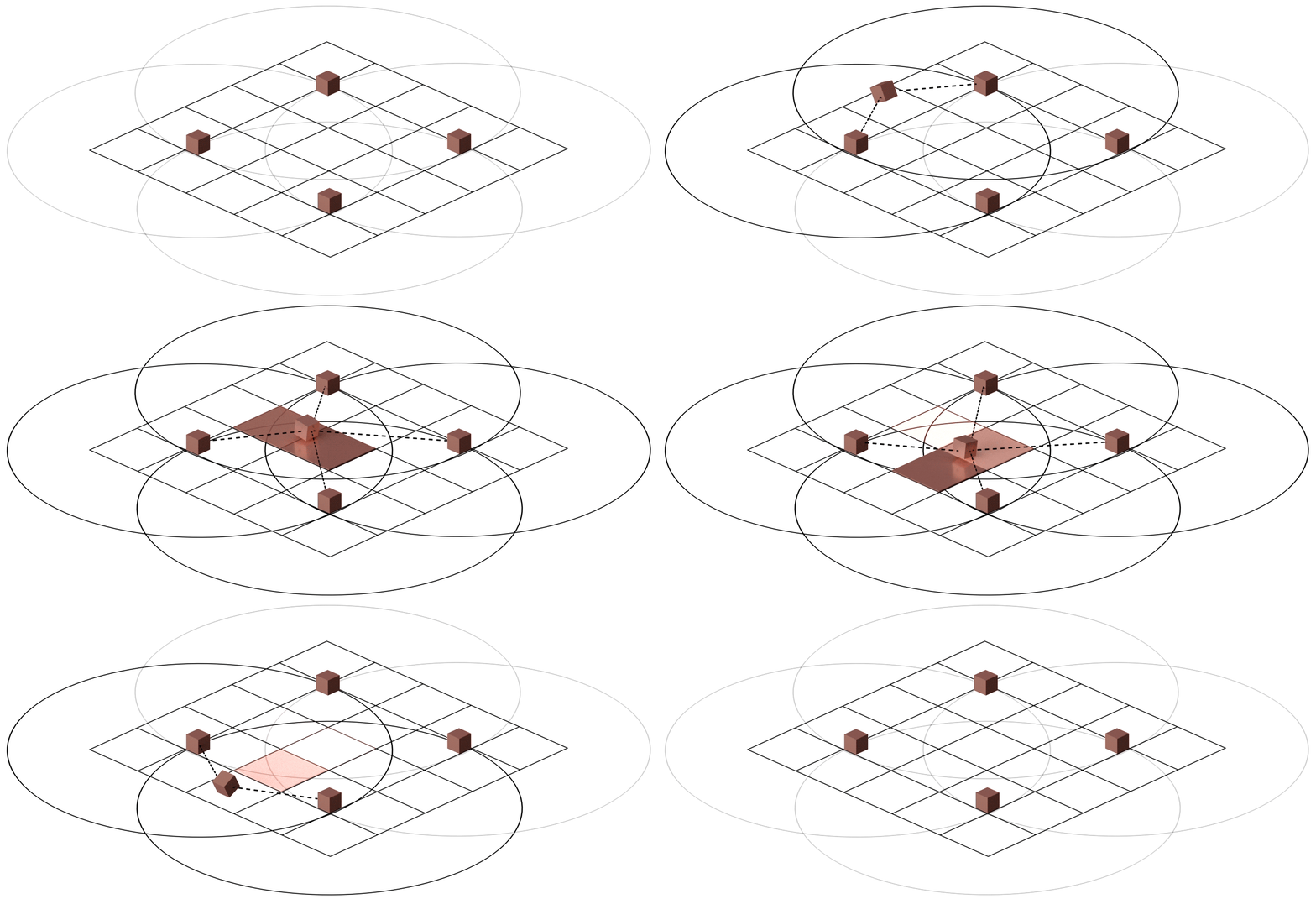 To Triangulate Position over Radio with Time of Flight a minimum of Four Zone Anchors are required for X,Y,Z and variance in time. Trilateration relies on the intersection of 3d spheres.
In FOAM, the anchors in a Zone are running a time synchronization protocol over radio which is self-stabilizing and Byzantine Fault Tolerant. The nodes can synchronize up to one clock tick, depending on the accuracy of their clocks, and determine the geometry of the network without an external input like GPS. As distance is computed as a function of signal timing from spatially discrete sources, to most accurately compute such positions precise clock synchronization is a required. . All Radio ToF algorithms rely on having precise clocks, some also rely on clock synchronization. The FOAM Proof of Location protocol utilizes a Byzantine Fault Tolerant clock synchronization algorithm to provide the best possible support for RF ToF algorithms.
Any receiver of the signals emitted by a Zone can localize themselves relative to the Zone. The Zone employs Synchronous consensus, nodes utilize the Time of Flight between the signals from other participants to order the signal arrival time and determine relative distance and location of all nodes in the network. Simply by operating correctly a Zone, with the necessary token deposit, a Zone Anchor can provide secure localization to receivers of their signals. Zones will offer Service Level Agreement smart contracts that define the acceptable amount of downtime before having their deposit slashed. Location customers can then purchase digital Presence Claims from Zones as a Proof of Their location.
The anchor nodes that make up a Zone need to keep a log of all the time stamped synchronized messages they receive in a very simple state machine, as well as update this log over time. Additionally, the anchors will need to share this state machine with the other nodes and come to consensus on updating the state machine. For this, the Zone will operate the Byzantine Fault Tolerant consensus algorithm called Tendermint developed in 2014 based on a Proof of Stake design. The main purpose and benefits to Tendermint are speed, consistency, safety, and instant finality.
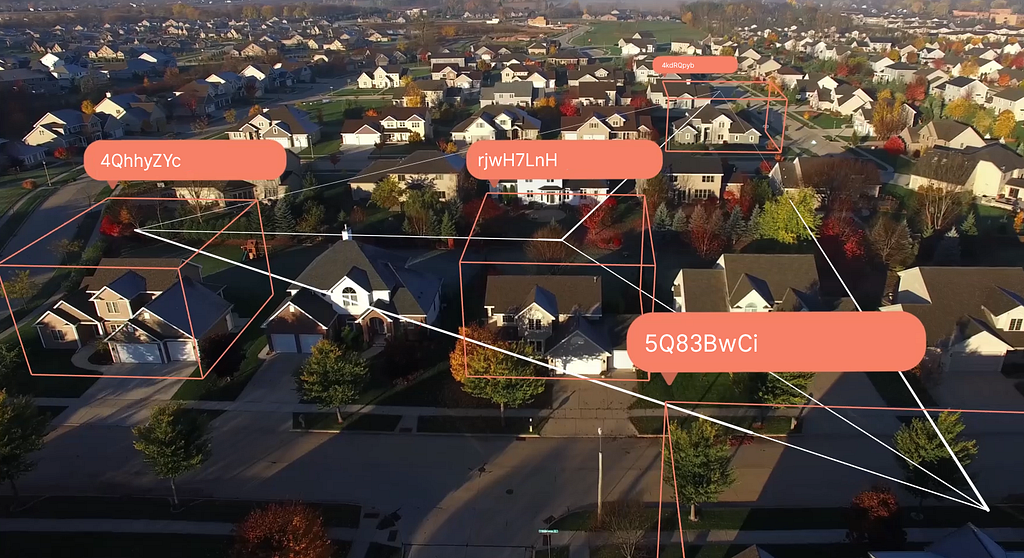 Simply by operating correctly a Zone, with the necessary token deposit, a Zone Anchor can provide secure localization to receivers of their signals
While the clock synchronization over radio and localization for nodes is determined with Synchronous consensus, the consensus algorithm for the replication of shared state machine for a single zone is partially synchronous. The synchronous radio time consensus interacts with Tendermint consensus through the Application Blockchain Interface(ABCI). In Tendermint:
Ultimately, to become a validator in replicating the shared state machine of a Zone, and by extension to become a node running the time synchronization protocol over radio, collateral in the form of tokens is needed as a safety deposit on a root or parent blockchain. This deposit is needed for the validator to attest they will follow the rules of the protocol without being malicious or faulty. This deposit is subject to being slashed– as in destroyed–if the participant is found to be acting Byzantine. The time log data produced by a Zone is not considered final until it has been verified for fraud by a computation engine running trilateration and other triangulation location algorithms on the Zone’s time data.
In this system, the security and consensus of the root chain is an asynchronous network. This can be the Nakamoto consensus of a Proof of Work chain like Ethereum or an established Proof of Stake blockchain like Casper or DFINITY. As such, FOAM employs Synchronous, Partially Synchronous, and Asynchronous consensus for Proof of Location. Further, Time Synchronization as a public good empowers a new class of emerging protocols such as , a system of software that will let communities set up decentralized ISPs. Althea can benefit from proof of time because it can revolutionize network routing protocols by allowing true latency measurements (right now everything uses round trip time, since you can’t rely on someone else’s clock). Clock synchronization and a reliable authority on time can have a massive impact on the efficiency of organizing the topology of a mesh network like Althea.
A single FOAM Zone that oversee’s the local time ultimately is fulfilling the Lattice of Space and Time. Cartography requires machine like clock procedures to produce space coordinates. FOAM hopes that the Cartographers on the protocol will contribute the necessary individual work, resources, and effort themselves at the time of launch and onwards to contribute to the ongoing community-driven growth and upgrade of this important cartography project. With the addition and use of necessary radio hardware time synchronization can continue its historic role of supporting more accurate location and map data.
Check out our and join our . Updates will be posted on R, and .
We welcome feedback from the community and are open to collaborations, so please get in touch.

was originally published in on Medium, where people are continuing the conversation by highlighting and responding to this story.
If you are new to cryptocurrency, you surely have heard about BTC and Ethereum.
They are the best crypto coins on the market and Proof of Work (POW) powers them.
However, in this article, we will focus on staking or popularly also known as Proof of Stake (POS) coins. To understand the concept, we first need to understand the underlying terminology behind them, i.e., POW and POS.
Let’s get started with Proof of Work (POW) coins. POW is a computer algorithm which is used by popular cryptocurrencies such as bitcoin, Ethereum, Litecoin, etc. POW works in a decentralized network and requires SHA-256 method to facilitate the process. It is all about computationally solving puzzles using computational power. POW is used to confirm transactions on the blockchain.
What is staking?
Proof of Stake (POS) also aims to solve confirmation of the decentralized consensus. It is an alternative to POW and works without energy consumption. So, how does it work? It works by simply keeping the coins in a staking wallet. By simply storing it, you will get a percentage and help the network confirm transactions.
POS is undoubtedly a better way to confirm transactions on the network as they do it in an environmental-friendly way. POS is only possible for coins that are pre-mined. So, you will only gain a fraction of the staking coins as a reward if you keep the coins in your wallet. The percentage and the time for which you need to keep the coins changes from coin to coin.
Note: Some coins uses both POS and POW which means that you can mine and stake the coin at the same time. For example, uses both POW and POS.
Can you earn crypto without a powerful mining rig?
So, does that mean that you can earn crypto without a powerful mining rig? The answer is Yes, you can! There are multiple benefits of staking and one is to not spend a lot of money in getting a powerful mining rig. If you do staking right, you will granted to make money. It is a better option than trading for crypto enthusiast who are not interested to take risks.
What are the popular staking coins right now?
Alright, you are now convinced that staking coins can really make you get good profit. So, Let’s list the popular staking coins.
NEO
NEO is also known as Chinese Ethereum. It is an open source project and is created for the distributed smart economy network. It has an annual return of approx 5.5%. By staking NEO, you get GAS (another cryptocurrency). GAS is the part of the NEO distributed ecosystem.
Staking Calculator:
Staking Wallet:
OKCash
OkCash is extremely popular among cryptocurrency staking community. At the time of writing, it is giving an annual return of 10%.
Staking Calculator:
Staking Wallet:
DASH
DASH is one of the oldest cryptocurrency. It is similar to bitcoin, but with additional features such as privacy and better transfer rate. If you decide to stake it, you can net an annual return of approx. 7.5%.
Staking Wallet —
ReddCoin(RDD)
If you are looking for a cheap coin to start staking, then ReddCoin can be a good choice. It is created for social media platforms and has an annual return of 5%. Also, there is no cap and you can HOLD a lot of coins of your choice.
Staking Wallet: https://www.reddcoin.com/#Wallets
Stratis(STRAT)
Stratis is a POS cryptocurrency platform focused on deploying apps created using C# and the .NET framework. However, it has the least annual rate compared to other popular staking coins at only 0.5–1%.
Staking Wallet:
FundYourselfNow(FYN)
FundYourselfNow offers help to people to raise funds for their projects that they are passionate about and to make their great ideas happen. They are currently holding a staking reward where you can enjoy 15% quarterly bonus till 2019. Get FYN tokens now from their on going starter program — more details .
Staking Wallet:
Some of the other good staking coins are , , and .
That’s it. We hope that you understand the difference between POS and POW, and more importantly, you have found yourself a staking coin to earn crypto without a powerful mining rig. Comment below and let us know!
Staking Series (5 part series — PART 2):
Staking Series (5 part series — PART 3):
Staking Series (5 part series — PART 4):
Staking Series (5 part series — PART 5):
Keen to find out more about FundYourselfNow? Join our crowdfunding revolution conversation on our group, or follow us on

Electrify has always stayed away from hubris and over inflation. When asked if we were going to lead a revolution in the energy industry, we reiterated our focus areas and avoided irresponsible claims. In building our business and our company, we are careful to steer clear of conceit or arrogance either. The power and value of an experienced mentor can trump hard work and grit and we can always use the guidance and advice from greater minds than ours.
As far as advisors go, we religiously sought out the ones who had “been there, done that”; subject matter experts with the ability to bulldoze paths that need to be laid, in order for Electrify to realise the vision we had set out to achieve. We are honoured to be able to count them as part of our team.
 Calvin Soh
Calvin Soh
Founder
Ninety Nine Percent
Calvin is an award-winning veteran in the advertising space, enjoying a distinguished career across top global agencies like Ogilvy & Mather and Saatchi and Saatchi, spanning roles as President and Executive Creative Director at Fallon Asia as well as Vice-Chairman and Chief Creative Officer at Publicis Asia. He is an expert in strategic market positioning and will provide counsel on all matters creative for Electrify. At OmiseGO, Calvin gives guidance on the same for the company’s digital wallet, as its Strategic Advertising and Marketing advisor.
 Wendell Davis
Wendell Davis
Product Development Lead
Omise Blockchain Labs and OmiseGO
The right advisor provides requisite guidance to accelerate companies in key areas. Wendell is the founder of , an early digital currency wallet and co-founder at digital asset marketplace . As part of the original Ethereum founding team, he is no stranger to the blockchain space. Wendell is advisor to is a Special Advisor at . His visionary expertise in product design within the blockchain space will be invaluable to the team.
 Jeffrey Char
Jeffrey Char
Director, Corporate Venture Capital
Tokyo Electric Power Japan (TEPCO)
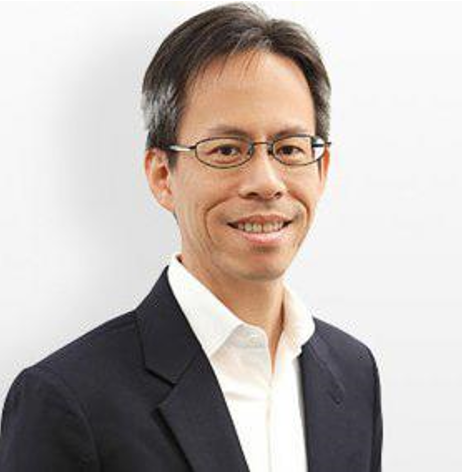
Founder and CEO at J-Seed Ventures, Jeffrey is a serial investor and entrepreneur. He is also Director, Corporate Venture Capital and on the Business Innovation Task Force at TEPCO, where he leads the company’s blockchain initiatives. Under his leadership, TEPCO became a founding member of the Energy Web Foundation. Jeffrey has extensive experience in market entry into Japan and is well-positioned to drive partnerships and ventures with Electrify.Asia.
With a stellar team of mentors and the fervour of our Tribe, exciting times are beckoning! We will be releasing more updates over the week with more partnership announcements to come. The validation we are receiving from both business and community has been nothing short of overwhelming.
From all of us at Electrify, we welcome you. This is our beginning.
was originally published in on Medium, where people are continuing the conversation by highlighting and responding to this story.
No Jargons, Just the right mix for cocktail conversation
 Photo by Jez Timms
The goal of this article is to make you have awesome conversations around blockchain based on things you can relate — without getting technical.
Many times, the why is more interesting than the how. The intent of this post is to answer the why. First, what is Blockchain?
Mob or crowd — the word choice matters.
Internet is a concept– you do not see it, you can feel its presence.
When I saw an application using the Internet for the first time in the 1990s, the internet became more real. Yep, once upon a time, email delighted me on the possibilities of faster communication.
Just like the Internet, Blockchain is a concept. You do not see it, you can feel its presence through its applications.
What is the equivalent application like e-mail for blockchain? It is bitcoin. A currency like US Dollar — except it is digital and not backed by any government.
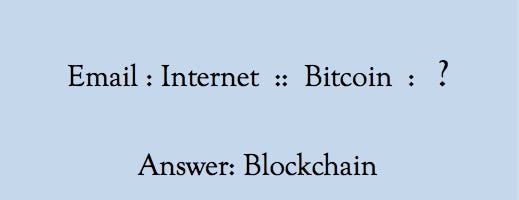
Blockchain and bitcoin start with a B. How to remember the concept from the application?
Application is something you see with your eyes and use frequently. bitcoin has the word coin you can see and use frequently.
If you are thinking, “I can see a chain too.” A chain is more sobering like a concept. Concepts like Internet can be abstract and difficult to assimilate.
On the other hand, when I saw the power of email first time, my synapses were firing off.
This jargon free video replicated the same feeling for me for the new paradigm.
The gymnastics of digital ledger entry by the faceless bookkeepers in the video, making sure all entries are right and making sure nobody screws it up is Blockchain.
That is all cool. Is there a formal definition of Blockchain?
The global agreement on the definition for Blockchain is yet to crystallize. Let me share the simplest definition I am comfortable with (slightly modified from ’s definition):
A blockchain is a decentralized technology — distributed and incorruptible digital ledger that is used to record transactions across many computers.
What do you believe are the key takeaway words here?
1. My first word is technology.
Blockchain is a technology — a technology concept. That’s it. Core of it is a digital ledger with protocols around it.
2. My second word is transaction.
The Internet reduced the friction for information sharing — think about library visit vs. Google search.
Blockchain could reduce the friction for transaction processing.
How? [this is a business how, not technical how]
I call it the back office bonanza. I found a great example in this
“For example, a typical stock transaction can be executed within microseconds, often without human intervention. However, the settlement — the ownership transfer of the stock — can take as long as a week. That’s because the parties have no access to each other’s ledgers and can’t automatically verify that the assets are in fact owned and can be transferred. Instead a series of intermediaries act as guarantors of assets as the record of the transaction traverses organizations and the ledgers are individually updated.”
What happens if there is agreed upon ledger that has all the history of transactions that all concerned parties trust? Suddenly, settlements transactions can happen in shorter time frame and lesser cost. Blockchain has the potential to be a back office bonanza around the world.
If Blockchain could be back office bonanza why did it start with a currency like bitcoin?
Simple answer — incentives for the bookkeepers.
Only with currencies, we pay [the middle men] with what we transact.
If you re-watch the video carefully — the banker takes a little cut for the trouble and so does a random computer bookkeeper at the end who raises his hand.
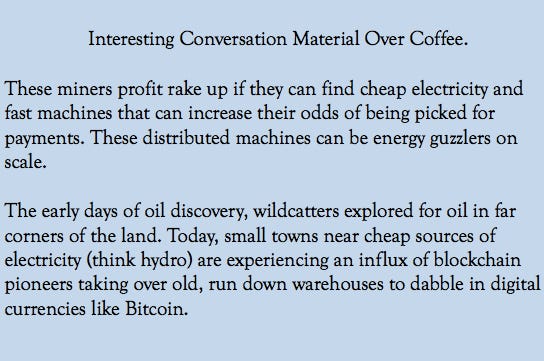
The random computer owner (if you are willing to indulge me- he is called a miner in Blockchain lexicon) gets paid with freshly created Bitcoins.
In other words, when bitcoin changes hands, these miners get paid in bitcoin. When stock ownership changes hands, it is a more complicated ball game.
Now, for the non-technical questions that are more interesting around a dinner table. Assume everyone has different backgrounds.
What are the application areas beyond bitcoin for Blockchain?
The best answers are often embedded in understanding why something was created in the first place.
Satoshi Nakamoto, the elusive inventor of blockchain, was motivated to replace the middlemen for transactions with technology.
And the application for currency transactions provided something that can cut across boundaries of countries and continents. Just like how Internet did for information.
At-least that is how it was during the early phase of Internet. As it become mature and the de-facto lifeblood of information — rule makers started to play a bigger role. Saturday Night Live video on Youtube cannot be seen by folks in other parts of the world due to geographic limits imposed by international laws.
I see a similar evolution path for Blockchain.
During these early days, what are the potential applications that can span geographies that are transaction centric and have a ledger feel to it?
Here are few.
Think about where we have a central ledger today — government land records, voting tally, digital identity, domain names registry — places where we verify authenticity of ownership.
Think about where it would be great to have a central ledger — all copyrighted photos that help reduce piracy that photographers would love to see happen. Authenticity of the organic vegetables you purchase and many more.
What happens if all these existing and ideal central ledgers are distributed in such a way that you do not need a central authority to administer it?
You are limited by your imagination on where a “distributed and incorruptible digital ledger” is useful.
You can read this one long, upbeat line from …
“For the first time in human history, two or more parties, be they businesses or individuals who may not even know each other, can forge agreements, make transactions, and build value without relying on intermediaries (such as banks, rating agencies, and government bodies such as the U.S. Department of State) to verify their identities, establish trust, or perform the critical business logic — contracting, clearing, settling, and record-keeping tasks that are foundational to all forms of commerce.”
All this really looks like the art of the possible, what are the realistic chances? Will banks and central ledgers be out of business?
Did the post office go out of business due to the Internet? Margins diminished for sure. At the same time, deliveries are finding resurgence after Amazon’s growth. What you used to get at a grocery store comes home. Delivery has convenience benefits.
Working with a human on the other side will always have convenience benefits. That comfort is the bet I am making.
In other words, everything will co-exist for different reasons. Advent of Blockchain, if done right, could reduce the transaction friction cost for the whole system in general.
All sounds great and let us assume Blockchain takes off like the Internet. What is the real tradeoff while embracing blockchain?
Trust.
Blockchain symbolizes a transfer of trust — from centralized middle-men to decentralized technology.
And trust is personal. It is hard to answer the question- should we decentralize or centralize trust?
If you re-watch the video again, the bookends of trust are clear.
At one end — today’s very few banks.
Tomorrow’s trusting all.
Today’s ‘very few’ conjures up images -Shylock from Shakespeare’s Merchant of Venice; immaculately dressed up bankers zooming the streets of New York and a friendly neighborhood banker who knows you by your first name.
Tomorrow’s ‘all’ reminds me of famous lines from Kurt Vonnegert. “Write to please just one person. If you open a window and make love to the world, so to speak, your story will get pneumonia.”
The truth would end up somewhere with a mixture.
Why?
The biggest benefit of the concept called Blockchain is transactions — a safe, secure way to append transactions in an “agreed upon” ledger that can potentially make settlements easy.
Whether the ledger is semi-centralized or semi-decentralized, public or private is going to be dependent on incentives for transaction service. The key question is how are the middlemen — banks in traditional world and miners in the digital currency case are compensated?
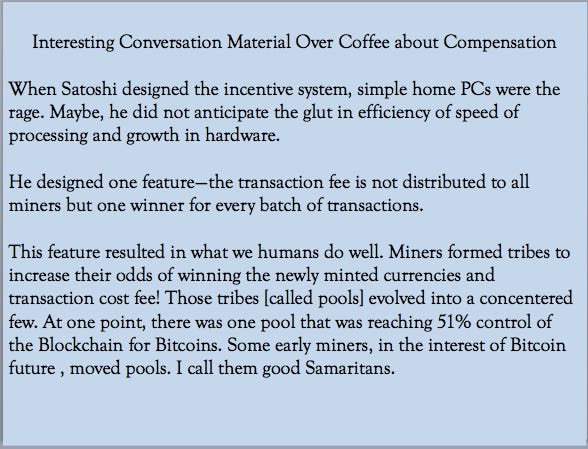
That brings us back to Satoshi and his brilliance. He crafted an incentive system that has helped fuel the growth of bitcoin. He ensured that there was enough “juice” for the new middlemen [miners] who can disrupt status quo.
I would split the incentives into two parts
1) the initial years of origin of bitcoin — the transaction cost was close to zero, but miners would be given new Bitcoins as compensation — like printing currency. That encouraged more miners in the ecosystem.
2) As time wore on, transaction scale happens, the amount minted was lowered (based on a formula) and the transaction cost took over. The miners get greater compensation from the buy- sell transactions.
What Satoshi had in mind was a global, open Blockchain like how Android for smartphone was developed.
Goldman Sachs, an American multinational investment bank and financial services company, is also into Blockchain. Their motive is different — how to reduce transaction cost for back office work. They are building a closed blockchain similar to iPhone.
Both models can exist, motives and incentives are different.
All the discussion about motives is good, one simple technical question — why is it called blockchain and not transaction ledger?
Chain part is straight forward. The transactions need to linked in a sequence that all agree. When you have multiple copies of the ledger — the sequence is as important as the transactions.
The chain is designed in such a way that even if one content of past transaction is manipulated, the secure chain link gets changed and other copies can spot it. In other words, the chain not only connects the sequence but the the code for the chain is designed based on the content — clever double purpose.
The word block is because transactions are added to the ledger in blocks (one page of ledger at a time) rather than one transaction at a time. It helps in scaling. Beyond this, I need to use technical jargons.
Bringing it all together
The internet reduced information friction — reduced the cost of transmitting information. Google and Facebook became the middlemen. Google’s vision was “to organize all of the data in the world and make it accessible for everyone in a useful way.” Facebook vision is to connect people all over the world. How they make money is through advertisements.
In the same flow of thoughts, let us piece together Blockchain.
Blockchain has potential to reduce transaction friction — reduce the cost of doing transactions. Miners are the new middlemen. The marketing blitz is trust. How they make money is spelled out in the incentive plan for bitcoin.
It is murky for other applications. As the incentive structure evolve along with applications, the future would be clearer for Blockchain.
In all this, what is in it for you and me?
Internet as a concept reduced our cost for information through various applications. Blockchain as a concept has potential to reduce our cost for transactions.
Will it live up to the promise? It all depends on the applications and the incentives for middlemen that makes it worth their time.
Karthik Rajan
Please add your follow questions in the comments section. I will answer them in a follow-up post and introduce the key jargons –if there is sufficient interest.
To read more about Blockchain on the technical side, here are folks whose work you can read:
If bitcoin interest you more, here are folks whose work you can read:
