July 13, 2026

Capitalizations Index – B ∞/21M

Financial Action Task Force Calls For Stricter Regulation of Virtual Asset Service Providers

Financial action task force calls for stricter regulation of virtual asset service providers

Financial Action Task Force Calls For Stricter Regulation of Virtual Asset Service Providers

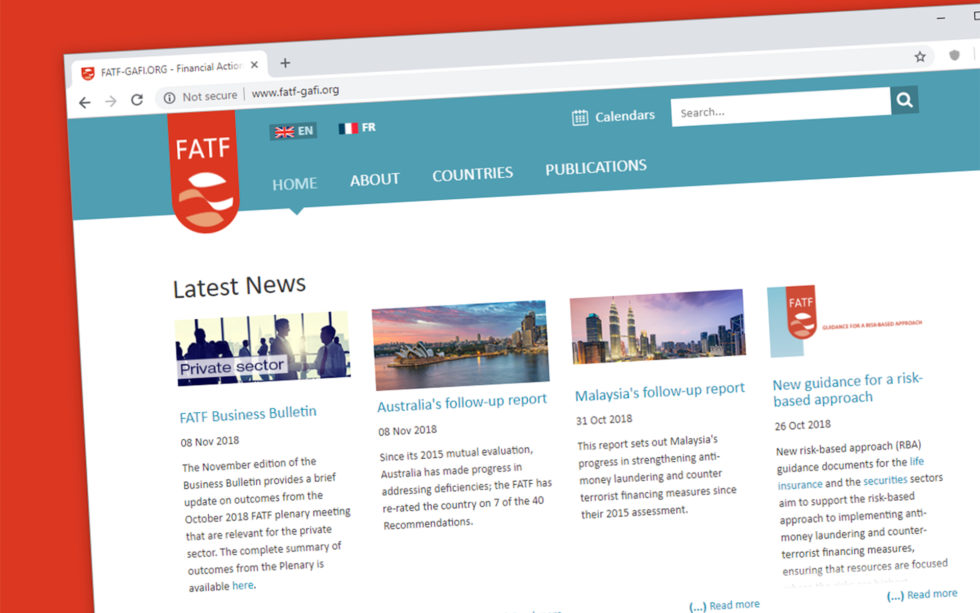
The Financial Action Task Force (FATF) — an intergovernmental organization founded to develop policies against money laundering and terrorism financing — is even more squarely setting its sights on regulating, supervising, and monitoring providers of services for digital assets. 


Specifically, FATF has admittedly been working on an Interpretive Note to Recommendation 15, which defines how the FATF standards apply to activities or operations involving virtual assets. As has been the case for quite some time, the discussion is firmly centered on the idea that cryptocurrencies are used for money laundering and terrorist financing — despite the fact that many, like bitcoin (BTC), feature a distributed public ledger that allows skilled investigators to trace immutable transactions that cannot be changed, altered, or deleted.

The Interpretive Note states that countries should define virtual assets as “property,” “proceeds,” “funds”, “funds or other assets,” or other “corresponding value.” As such,  “countries should identify, assess, and understand the money laundering and terrorist financing risks emerging from virtual asset activities.”

Virtual Asset Service Providers (VASPs), according to FATF, should be appropriately regulated and monitored. (Or, in another word, controlled.) “Countries should ensure that beneficiary VASPs obtain and hold required originator information and required and accurate beneficiary information on virtual asset transfers, and make it available on request to appropriate authorities,” states the Interpretive Note, while also stating that, “Countries should ensure that there is a range of effective, proportionate and dissuasive sanctions, whether criminal, civil or administrative, available to deal with VASPs that fail to comply with AML/CFT requirements.”
Financial action task force (fatf)

In short, a prominent financial regulator unsurprisingly wants cryptocurrencies — which pose a significant threat to legacy financial institutions, central banks, the status quo, and those who aren’t particularly fond of individual financial freedom — to be strictly regulated and monitored.

Who would have thought?

What do you think about The Financial Action Task Force’s directions regarding virtual assets? Let us know your thoughts in the comments below! 


Images courtesy of Shutterstock.

Published at Mon, 25 Mar 2019 04:00:01 +0000

Previous Article

Tor Digital Privacy Project Now Accepts Donations in Cryptocurrency

Next Article

Ethereum Price Analysis: ETH Could Jump If It Closes Above 100 SMA

You might be interested in …

Antonopoulos On Trust: Fake News ‘Is About To Happen To Money’

Andreas Antonopoulos has predicted that the world’s money supply will suffer the fate of information in the fake news era.


Money To Get Its Fake News Moment

In a talk originally held April 11 but republished Saturday, Antonopoulos said that in light of the multiple currency failures seen in recent times, consumers no longer know what gives cash in their pockets value. During the discussion Antonopoulos commented:

blockchain training conference Antonopoulos

What’s really interesting is what just happened in [the] news that has left an entire generation of people now unable to discern truth from fiction, easily manipulated through propaganda […] What I’m going to suggest today is this is about to happen to money.

Just like the information consumer watching television or reading news sources online, the debate about whom to trust and whether the reputation of a source means that source can be considered reliable is now transferring to the financial sector.

…And bitcoin Is Already On Consumers’ Radar

Antonopoulos highlights the currency failures in countries including Zimbabwe, Venezuela, and Ukraine as prime examples of central banks failing to uphold the promise that cash will be worth approximately the same tomorrow as today.

One day, that phrase which seemed so meaningful and strong and satisfying – ‘the full faith and credit of the United States of America’ […] – compare it to this one: ‘the full faith and credit of the National Bank of Zimbabwe.’ […] That sentence no longer has much weight to it.

In terms of bitcoin’s role in providing a haven away from trusting third party authority, Antonopoulos used India’s increased interest in the virtual currency following demonetization of 86% of its cash supply last November.

bitcoin is not going after replacing national currency; […] it’s doing something far more dangerous: it’s encouraging people to put their savings outside the system.

Germany: ‘If You Think bitcoin Is Safe As Fiat, Take Responsibility’

For those reading the news a month after Antonopoulos’ words, a warning against using bitcoin, this time from Germany’s central bank, now strikes an altogether less sincere tone.

“From our perspective bitcoin does not constitute a suitable medium for storage of wealth,” Bundesbank board member Carl-Ludwig Thiele told German newspaper, Die Welt, last weekend. “Just one look at the highly volatile exchange rate demonstrates that.”

In further comments even more ironic in light of Antonopoulos’ words about trust, Thiele continued:

Carl-Ludwig Thiele

Whoever nonetheless thinks bitcoin is as safe as the euro or dollar must take responsibility for that. All we can do is warn people about using bitcoin as a means of wealth storage.

What do you think about Andreas Antonopoulos and Carl-Ludwig Thiele’s opinions? Let us know in the comments below!


Images courtesy of Andreas Antonopoulos, Reuters, AdobeStock

The post Antonopoulos On Trust: Fake News ‘Is About To Happen To Money’ appeared first on Bitcoinist.com.