April 9, 2026

Capitalizations Index – B ∞/21M

Facebook Goes Down as Bitcoin Continues Mining Blocks With 99.98% Uptime

Facebook goes down as bitcoin continues mining blocks with 99. 98% uptime

Facebook Goes Down as Bitcoin Continues Mining Blocks With 99.98% Uptime

Social media giant Facebook and its Instagram and Whatsapp platforms went down for a couple of hours highlighting the stability of bitcoin and its decentralized architecture. 


Facebook Goes Down

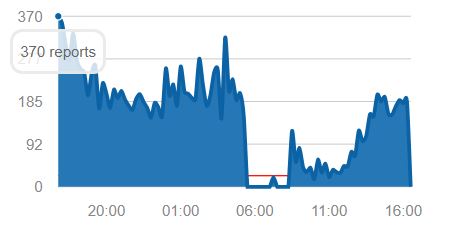
Social media website Facebook went down for a few hours on April 13th according to a monitoring resource downdetector.com.

Facebook goes down as bitcoin continues mining blocks with 99. 98% uptime

Whatsapp, the popular messaging app, and Instagram, a picture-sharing social media platform, both owned by Facebook, have also experienced outages.

According to a report by Business Insider, there were more than 9,000 people complaining about the issues and it was felt mostly across Asia and Europe.

As of yet, there’s no formal statement outlining the issues for the outage. However, a spokesman from the company said:

We’re sorry for any inconvenience.

Not The First Time and Not The Only One

It’s not the first time the social media website has experienced a notable outage.

Earlier in March, Facebook, as well as the abovementioned associated apps went down for over 24 hours.

The company did come up with a formal statement then explaining:

Yesterday, as a result of a server configuration change, many people had trouble accessing our apps and services. We’ve now resolved the issues and our systems are recovering. We’re very sorry for the inconvenience and appreciate everyone’s patience.

Facebook is not the only centralized company which has experienced technical issues depriving hundreds of thousands of users of its services.

Bitcoinist reported last summer that Visa, one of the leading payment solution providers with millions of people using it, experienced a “system failure”, leaving countless of its customers without access to their money.

bitcoin Stays Up, Always

Amid events of the kind, it can’t go without mention that bitcoin’s network boasts an uptime of 99.98% since its inception, highlighting the benefits of decentralization. If one or even hundreds of bitcoin nodes go offline, the network will continue working unabated.
Network nodes metcalfes law

On the other hand, as showcased above, centralized solutions are much more prone to experiencing downtime given their central point of failure.

In the case of Visa, it was a “system failure,” while in the case of Facebook’s March outage it was a “server configuration change.” bitcoin’s distributed network not only requires more resources to attack it than to defend it, but its funds are also further decentralized in wallets that are protected by private keys controlled by individual users.

What do you think of Facebook’s outage? Don’t hesitate to let us know in the comments below!


Images via Shutterstock

The Rundown

Published at Tue, 16 Apr 2019 01:00:35 +0000

Previous Article

BCH In Depth 4/15/19: Clean Bull Flag but so Much Drama

Next Article

Mining Price War in Sichuan (China) during the Flood Season

You might be interested in …

Kyber network - decentralizing the future

Kyber Network – Decentralizing the Future

Kyber Network – Decentralizing the Future Decentralized exchanges are the way of the future. Can Kyber make itself a big player? Support me on https://www.patreon.com/thecryptolark Follow me on https://steemit.com/@larksongbird Follow me on https://twitter.com/TheCryptoLark Secure your […]

Cybersecurity Firm Reports All Fortune 500 Companies Exposed on the Dark Web

Cybersecurity Firm Reports All Fortune 500 Companies Exposed on the Dark Web

Every Fortune 500 company has some level of exposure on the dark web, with technology and telecommunications firms ranking at the top of the list, according to a report published by Denver-base OWL Cybersecurity at the end of May, 2017.

The dark web, unlike the surface web — the internet most people know of and use every day — can’t be indexed using traditional search engines, such as Google or Bing. The cybersecurity company has built a database updated with “10 to 15 million pages per day, from more than 24,000 domains on the Tor network alone, as well as other darknet networks.” With the darknet content indexed and searchable in 47 different languages, OWL claims their dark web database is the “most comprehensive one of its kind in the world.”

In the study, the OWL picked each and every company from the 2017 Fortune 500 list and assessed them with an overall darknet footprint. OWL uses a specific algorithm for the purpose, rating postings on the dark web based on their potential for criminal use.

“To compile our Darknet Index, we ran each member of the 2017 Fortune 500 through the OWL Vision database. We focused on specific darknets for matches on each company’s website and email domains and then further adjusted the results based on computations of ‘hackishness,’” the report reads.

When valuable information is either stolen or hacked, the data is often offered for sale on the dark web, OWL stated. On dark web marketplaces and forums, criminals exchange illegal products and data — mostly sourced from hacks and breaches — for cryptocurrencies, such as bitcoin. Therefore, the cybersecurity company measured the exposure of the Fortune 500 firms by analyzing their presence on the darknet.

According to the researchers, in some instances, “private data for sale may have come from a breach at a Fortune 500 company, but it may not be identified as such.” OWL explained, for example, that multiple instances of credit card information up for sale on the dark web can come from various sources, including banks or retailers; however, information on the source of the compromised data is not always available or provided.

OWL ranked the Fortune 500 companies by their Darknet Index score — calculated by the cybersecurity firm’s algorithm — and also included the firms’ rankings on the Fortune 500 lists. Ranked by DARKINT (darknet intelligence), technology companies lead the list, with Amazon holding the top spot, but with telecommunications firms right alongside it.

The cybersecurity firm pointed out some key takeaways from their analysis. The researchers emphasized that all Fortune 500 companies have a presence on the dark web since “every single company in the Fortune 500 had a positive Darknet Index score.” OWL explained Amazon’s top ranking with the fact that the firm has a “massive internet presence and possesses a significant amount of customer data.”

The researchers were surprised by the comparatively positive rankings of financial firms, which are frequent targets of cybercriminals. OWL indicated that the financial industry’s significant investment in cybersecurity measures in recent years was the reason for the success. Other sectors in which the firms invested “heavily” in cybersecurity also had lower Darknet Index ratings, the researchers added.

OWL expects that by publishing such statistics in their report, they can help companies improve their cybersecurity. The cybersecurity firm enables companies with compromised data to monitor the stolen or hacked information on the dark web.

“Today, in an age where data loss is virtually inevitable, it is critical to look at the darknet as a key part of a complete cybersecurity program, enabling organizations to swiftly detect security gaps and mitigate damage prior to the misuse of data.”

The post Cybersecurity Firm Reports All Fortune 500 Companies Exposed on the Dark Web appeared first on Bitcoin Magazine.