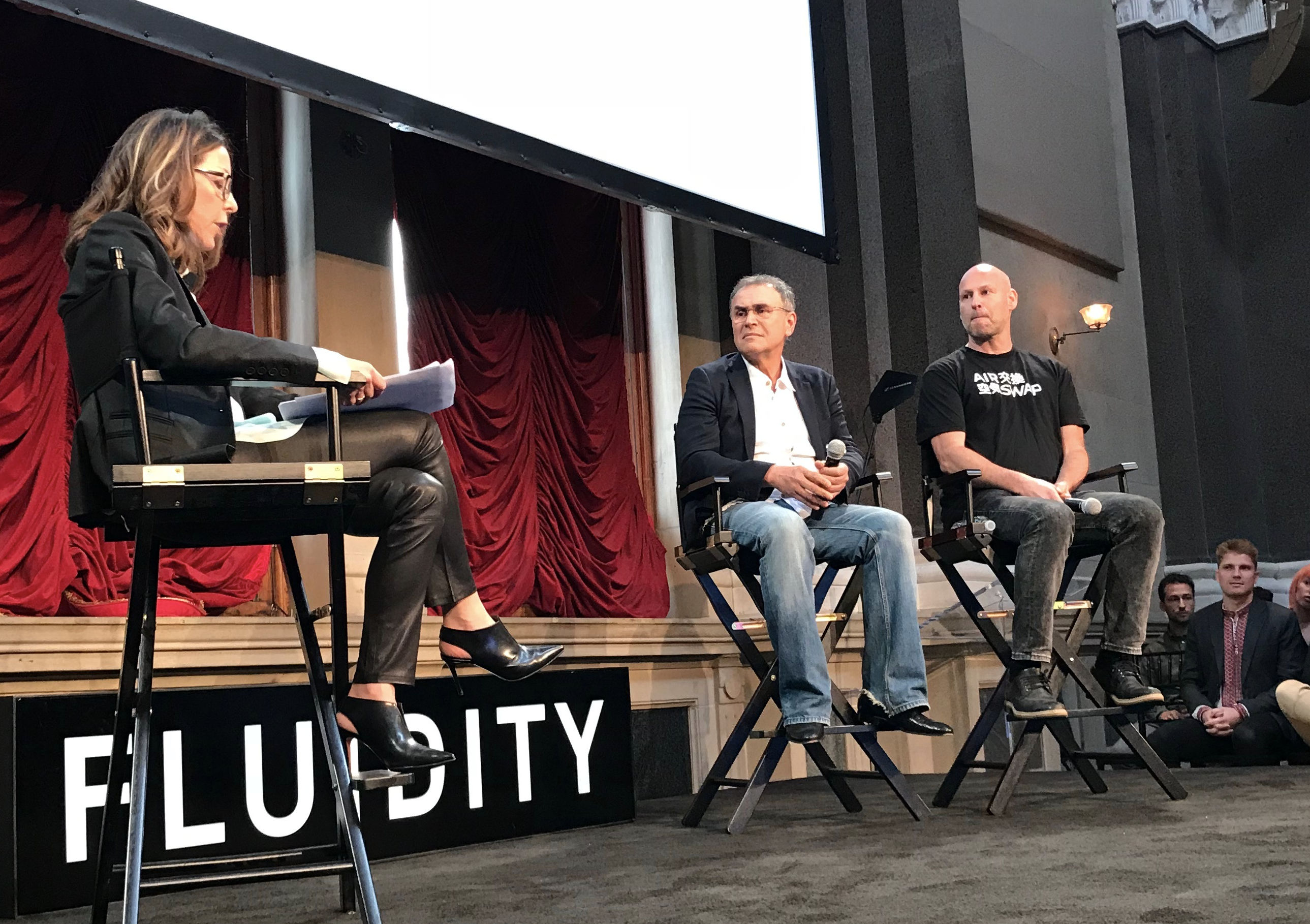
Nouriel Roubini was in full attack mode in his latest crypto debate.
“The entire crypto land is more unequal in terms of income and wealth than North Korea,” he said Wednesday afternoon, and the jabs didn’t stop there, with the former Clinton administration economist, better known as “Dr. Doom” for his prediction of the 2008 financial collapse, taking his criticism of all things crypto to new levels.
Still, this was perhaps to be expected. After onstage at the Milken Institute Global Conference earned him headlines, the organizers of the Fluidity Summit invited Roubini to go toe-to-toe with ConsenSys founder Joseph Lubin, with Roubini playing the bear to Lubin’s bull.
Long a cryptocurrency basher, Roubini didn’t make a different case this time, though his arguments were perhaps distinguished by their breadth and energy. (The moderator, former COMEX Chair Donna Redel, even went so far as to use a whistle on him at one point to rein in the conversation).
Alleging various miners, exchanges and cryptocurrencies have cultish followings, Roubini argued against the idea cryptocurrencies are decentralized, positing that these groups tend to have significant sway over the development direction a protocol takes.
Roubini told the audience:
“The whole point of the crypto world is to say we don’t believe in central banks … everything is going to be decentralized. I see totally the opposite in crypto land.”
As expected, Lubin came to the industry’s defense with point-by-point counter examples that articulated a broad thesis for how blockchain will enact change.
“We’re building systems that are fundamentally, atomically about collaboration,” Lubin said.
It was a capstone conversation to a day of cheerleading institutional investment in crypto. Perplexingly, some of Roubini’s toughest barbs seemed to thrill much of the crowd, though it’s hard to tell if this represented real sentiment or if crypto enthusiasts just love a good show.
Nevertheless, investor Jehan Chu of Kenetic Capital saw the crowd as very much on team crypto.
He told CoinDesk:
“This isn’t winning hearts and minds. Everyone is here to do business.”
Peace Offerings
And much of this is a credit to Lubin, who was more nuanced onstage, granting imperfections but attempting to couch them as technological waypoints rather than insoluble problems.
Lubin tried to even concede to Roubini on some of his smaller points. For example, he took on mining, saying, “I agree that the mining systems are susceptible to centralization.”
Promising that a proof-of-stake protocol for ethereum should be deployed soon, he said it will enable people to replace all that hardware infrastructure with “a bond, an economic bond on the blockchain.” He even argued that it will be more secure than bitcoin’s pioneering proof-of-work system.
In this way, some of the earlier panelists pointed to some of the very difficult challenges decentralization presents. Stefan George, the CTO and co-founder of Gnosis, a prediction market whose hinted at how big the year in crypto would be, expressed frustration at working with a slew of wallets with different configurations. “We all need to agree on one API,” he said.
And Alex Wearn of IDEX spoke more broadly to the competitiveness of decentralized applications. “It’s not going to happen unless usability pretty much matches the centralized experience.”
Roubini was less circumspect. He said that the dapps on the market are by and large pyramid schemes.
Each time Lubin described progress, Roubini dismissed it out of hand. For example, he argued that the crypto-iluminati have been saying for years that scaling problems could be fixed.
“I’ll show you the code,” Lubin offered. It was probably his biggest applause moment of the whole debate.
In another example, Roubini said “cryptocurrency” was a misnomer because it’s not really money. To be money, he argued, it has to be a unit of account, a means of exchange and reliable store of value.
Lubin countered by pointing out that MakerDAO has made a stable coin on ethereum that has, he said, something like $1 billion dollars in value in it. Even as ether tanked early this year, the MakerDAO token held steady at its peg with the dollar.
Roubini, however, was hardly impressed.
So who won?
Still, surprisingly, if the winner were measured by who got the most big laughs or big rounds of applause, it would go to Roubini.
In fact, Roubini’s biggest moment probably came when he first pointed out that there was no good reason for a business to limit customers with a token. He asserted that if every company only accepts tokens for its goods or services, there will be no way for people to know how to compare prices.
“You’re going into a world of ‘The Flintstones’ or barter,” Roubini said. “It’s totally inefficient. It’s never going to work”
That’s not to say Roubini was the only one in the room with doubts, though he may have been the only one committed to them. Even Lubin didn’t miss his chance to say something about forthcoming regulatory action, but he spun it the same way as everything else: a speed bump on the way.
“Although there will be some negative news around some of the projects that sold tokens, there will also so be some good news, and we will see a lot of that in 2018,” he said.
But again and again Roubini argued that ethereum itself should start policing scams and kicking them off the platform now, not addressing how that would run fundamentally counter to the censorship resistance ideology engineered into these platforms. But it did reflect the core idea that all of his arguments stemmed from.
He said:
“I do believe in centralization.”
So even if Lubin did win the debate, it seems clear he could never win over Roubini. Nor could Roubini ever win over him. That fundamental ambivalence, one widespread among smart people during what Lubin called “exponential times,” was well captured by another crypto diehard at the end of a prior panel.
“Some of this could be permanent that we’re putting on a blockchain,” Samantha Radocchia of the supply chain company Chronicled said. “I’d like to encourage thinking about that.”
Roubini v. Lubin photo by Brady Dale for CoinDesk.
The leader in blockchain news, CoinDesk is a media outlet that strives for the highest journalistic standards and abides by a . CoinDesk is an independent operating subsidiary of Digital Currency Group, which invests in cryptocurrencies and blockchain startups.
Published at Fri, 11 May 2018 03:11:17 +0000
Features[wpr5_ebay kw=”bitcoin” num=”1″ ebcat=”” cid=”5338043562″ lang=”en-US” country=”0″ sort=”bestmatch”]

![How to get bitcoin [btc] - 2019 method](https://ohiobitcoin.com/storage/2019/01/eqZXTZ.png "How to get bitcoin [btc] - 2019 method")