August 3, 2026

Capitalizations Index – B ∞/21M

Ethereum Price Weekly Analysis: ETH Preparing For Larger Breakout

Ethereum price weekly analysis: eth preparing for larger breakout

Ethereum Price Weekly Analysis: ETH Preparing For Larger Breakout

  • ETH price continues to face a strong resistance just below the $140 level against the US Dollar.
  • The price dipped sharply recently, but it recovered above the $134 support level.
  • There is a key bullish trend line forming with support at $132 on the 4-hours chart of ETH/USD (data feed via Kraken).
  • The pair remains supported on dips and it could still break the $140 resistance area in the near term.

Ethereum price is facing many hurdles versus the US Dollar and bitcoin. ETH/USD’s recent decline was brought back and it seems like buyers could be preparing for a larger rally.

Ethereum Price Analysis

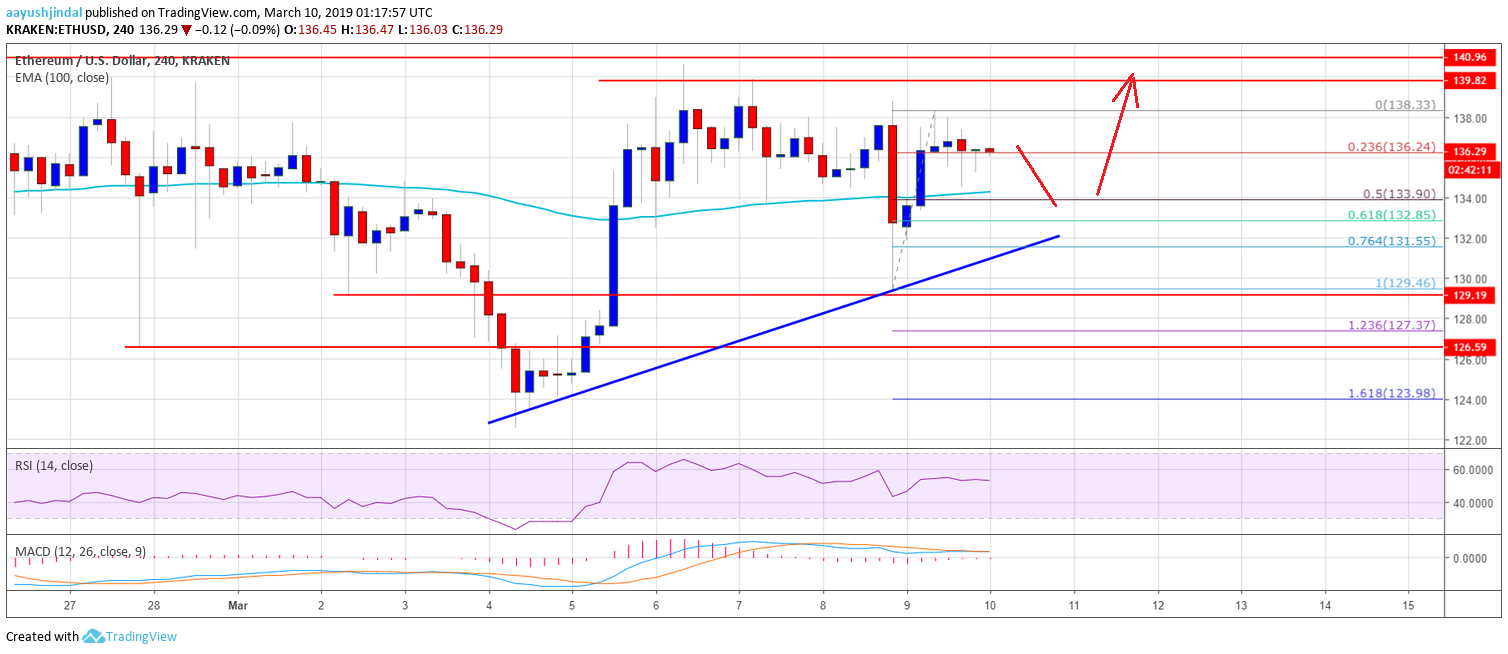
This past week, there were mostly swing moves within a range below the $140 resistance in ETH price against the US Dollar. The ETH/USD pair made many attempts to clear the $140 resistance area, but it failed to gain pace. Recently, there was a sharp bearish reaction below the $134 support level. The price declined heavily and broke the $132 support along with the 100 simple moving average (4-hours). However, the price found a strong support near the $130 level and later bounced back sharply.

It climbed above the $134 support and the 100 simple moving average (4-hours). It even traded above the $136 level, but sellers protected the $138 level. The price is currently ranging below the $138 and $140 resistance levels. It broke the 23.6% Fib retracement level of the last wave from the $130 low to $138 high. However, there are many supports near the $134 level and the 100 simple moving average (4-hours).

There is also a key bullish trend line forming with support at $132 on the 4-hours chart of ETH/USD. The 50% Fib retracement level of the last wave from the $130 low to $138 high is also near the $134 level to act as a solid support. Therefore, there are many supports near the $134 and $132 levels. On the upside, the price has to clear the $138 and $140 resistance levels to climb further higher.
Ethereum price weekly analysis eth chart

The above chart indicates that ETH price is placed nicely above the $132 and $134 supports levels. Having said that, a break above the $140 barrier won’t be easy. If buyers remain in action for a long time, they could sight a larger rally above the $140 resistance. In the mentioned case, the price may surge above the $145 and $150 resistance levels in the coming days.

Technical Indicators

4 hours MACD – The MACD for ETH/USD is about to move back in the bullish zone.

4 hours RSI – The RSI for ETH/USD is currently flat, but it is placed nicely above the 50 level.

Major Support Level – $132

Major Resistance Level – $140

Published at Sun, 10 Mar 2019 04:08:16 +0000

Previous Article

Andrew Yang’s Crazy UBI Plan: Give Lazy Freeloaders $12,000 Every Year for Doing Nothing

Next Article

China is Now Ahead of the U.S in Blockchain Technology

You might be interested in …

A New Era of Content Publishing and Licensing on the Blockchain

A New Era of Content Publishing and Licensing on the Blockchain

The internet and social media have unleashed unprecedented access to information. The time between content creation and widespread publication has become vanishingly small. Along with this ease of access and sharing, however, comes a lack of control over one’s own content. With a few clicks, content can be republished without reference to its original source, thereby obscuring who the authentic owner is.

What the internet has lacked up to this point is a network-based log of ownership that can keep pace with the exchange of information. Enter blockchain technology. While the first and currently most prominent application of this technology is an internet-based payment system, this will over time prove to be just one of many use cases.

One of the earliest non-financial applications of blockchain technology was a service called “Proof of Existence.” The service embeds a hash of a document into a block in the bitcoin blockchain. A user can use this embedded hash to prove that the document existed at the block height containing the hash without relying on a trusted third party, creating a decentralized timestamping service.

Po.et is a blockchain protocol that aims to expand on the concept of Proof of Existence to become a transformative tool for the publishing industry. In its early development, Po.et will be a platform on which written content can be timestamped using the bitcoin blockchain and be discoverable along with important metadata. Eventually, Po.et aspires to create a fully decentralized marketplace in which publishers, editors and content creators can interact with purchase and licensing agreements without the frictions that exist today.

The Inspiration

Max Bronstein, media and strategy lead for Po.et, said that the project was born out of some challenges faced at bitcoin Magazine. He stated that Po.et was designed to help answer “questions of ownership or attribution on the web,” including “who owns the work, who created it and whether or not the usage of the work is authorized.”

According to Bronstein, these questions are currently difficult to answer for many works, and the organizations that manage ownership and licensing information like Getty Images and Creative Commons often exist in silos without interoperability with other platforms.

Richard Titus, an entrepreneur who formerly helped lead digital content at BBC and the Daily Mail, joined the Po.et advisory board in July. He said, “Preserving an ecosystem of content creators, publishers and advertisers requires the establishment of ownership and Po.et is at the right stage of development to bring a true marketplace into existence.”

The Roadmap

The Po.et development team has divided their milestone iterations into three “eras”: Rosetta, Gutenberg and Alexandria.

“The Rosetta era represents Po.et’s potential to enable new understanding of written works, their authenticity, provenance and edit history through blockchain-based timestamping,” said Bronstein. The first era has already begun offering these timestamping services to publishers of written content. The document, along with standardized metadata, is stored on the BitTorrent network so that it can be discovered by any party interested in knowing its origins and authorized uses.

The second stage, the Gutenberg era, is projected to begin in April 2018. During this stage, Po.et intends to expand its platform to include custom licensing agreements for registered assets, revenue sharing and a written content marketplace. Payment channels will be utilized at this stage to enable cheap and instant micropayments for the agreements with a wide array of more than 40 publishers. One key application of these features may be an e-book metadata format that can serve as an alternative to the current costly standard for creating discoverable metadata for books: the ISBN system.

The third and final era, Alexandria, is slated to begin in July 2019. “The Alexandria era is when we expect Po.et to reach scale and become the first universal ledger for all types of digital assets, just as Alexandria was the home of the first world library and greatest repository of all human knowledge,” said Bronstein.

This stage will see the expansion of the Po.et platform beyond written content to include image, video and audio assets. Furthermore, Po.et hopes to introduce in this stage a fully decentralized marketplace open to all stakeholders with a reputation system to promote honest use of the network. In this stage, developers will be able to write and deploy smart contracts that interact with this open marketplace. One major use case of Alexandria could be brand licensing, an industry estimated to total over $250 billion in sales annually. The simplified process of verifying authenticity and negotiating terms with Po.et could open this market to smaller players.

The Early Adopters

bitcoin Magazine was the first to integrate the Po.et document timestamp into its platform — you can find a Po.et authentication badge at the top of this page. Other major digital media publishers in the blockchain space have signed on as alpha partners, including The Merkle, Crypto Insider, CoinSpeaker and ChainB.

Po.et has also forged a unique partnership with the LTB Network through which owners of the LTB Network’s LTBCOIN can swap their tokens for up to a total of 1 percent of the total Po.et tokens available.

Adam Levine, founder of the LTB Network, stated that “Po.et is an elegant solution to one of the biggest real world publishing problems. At the LTB Network, we’re excited to become one of the first fully integrated publishing platforms which will allow all written content to be published through and easily re-licensable with the Po.et project.”

Funding Po.et

Thus far, Po.et has secured financial investments from BTC Inc. and several blockchain notables, including Fenbushi Capital, led by Bo Shen, Feng Xiao and Vitalik Buterin; Simon Dixon and BnkToTheFuture; Michael Cao of block.one; and Matthew Roszak and Anthony Di Iorio.

Po.et will also be funded by a token sale taking place on August 8, 2017. At that time, 50 percent of the total supply will be sold off for bitcoin or ether.

POE tokens represent a proportional stake in the fees generated over the Po.et platform. While these fees are currently subsidized by the Po.et Foundation during the Rosetta era, they will eventually be generated by processing license payments and creating content licenses and then collected by the Po.et Foundation in future eras.

Disclaimer: bitcoin Magazine is an alpha partner of Po.et. BTC Inc., the parent company of bitcoin Magazine, is an investor in Po.et.

The post A New Era of Content Publishing and Licensing on the Blockchain appeared first on Bitcoin Magazine.