Ethereum Price Technical Analysis – ETH/USD Remains in Uptrend
Key Highlights
ETH price remained well supported and it recently traded towards the $540 level against the US Dollar.
There is a key bullish trend line forming with support at $510 on the hourly chart of ETH/USD (data feed via Kraken).
The pair is currently correcting lower, with supports on the downside near the $510, $500 and $490 levels.
Ethereum price is positioned nicely against the US Dollar and bitcoin. ETH/USD may correct lower, but it remains in an uptrend above the $490 support level.
Ethereum Price Support
The for ETH price above the $500 level against the US Dollar. The price extended gains and traded above the last swing high of $533. However, the move was contained and the price traded as high as $537.81. Later, a downside correction initiated and the price declined below $530. It also traded below the 23.6% Fib retracement level of the last leg from the $481 low to $537 high.
However, the downside move remains limited since there are many supports near $500. There is also a key bullish trend line forming with support at $510 on the hourly chart of ETH/USD. Moreover, the 50% Fib retracement level of the last leg from the $481 low to $537 high is also near $509. Therefore, a break below $509-510 won’t be easy. If sellers succeed in pushing the price below $509, it could trade back towards the $500 level. The is close to the $490 level and the 100 hourly simple moving average.
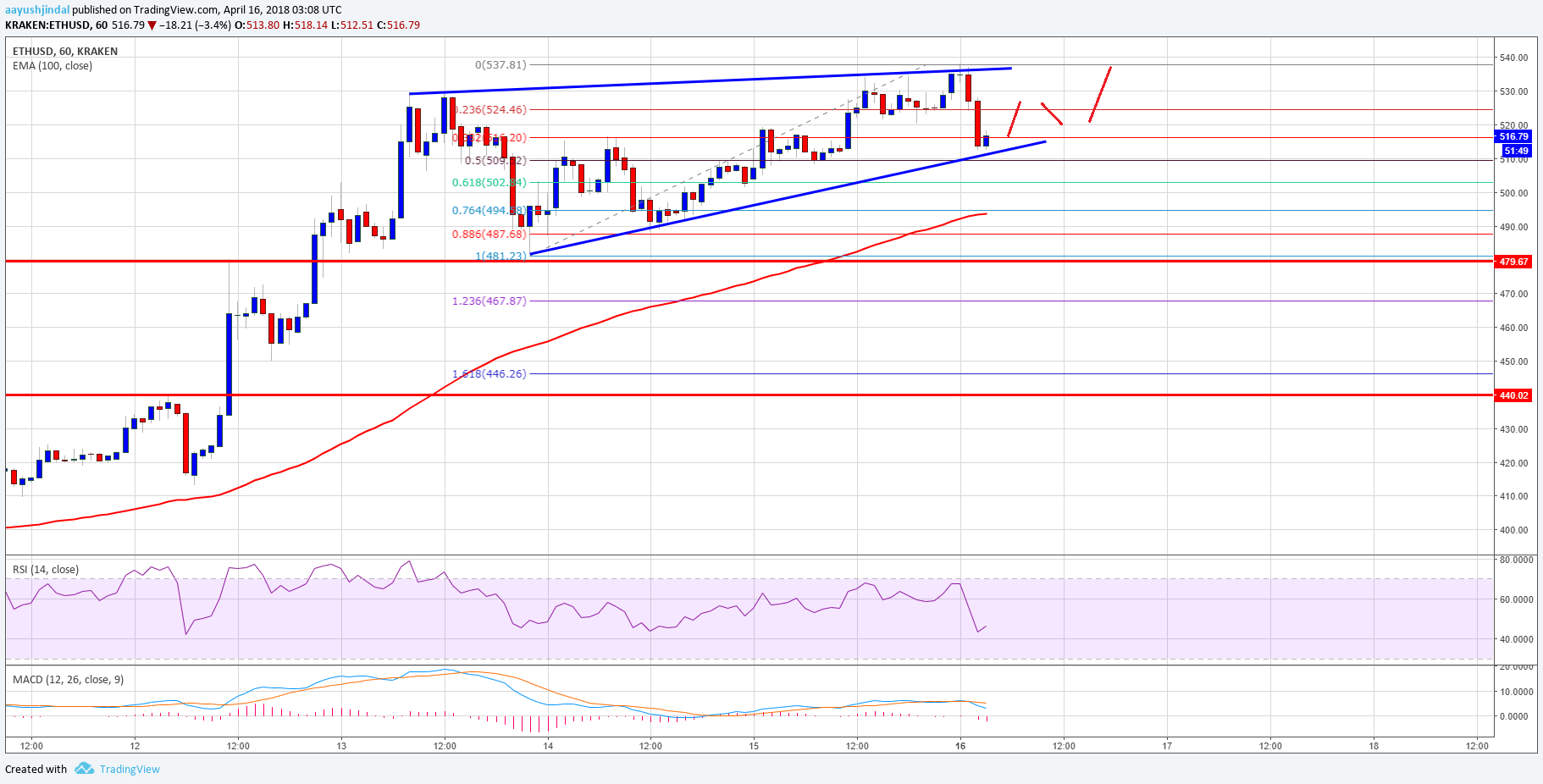
Looking at the , the current price action is positive above $490. However, the price must gain traction above the $535-540 resistance zone for more gains. Above $540 resistance, the chances are high of an upside break above the $550 level.
Hourly MACD – The MACD is currently in the bearish zone.
Hourly RSI – The RSI has moved down sharply below the 50 level.
At a gathering at the Microsoft headquarters in Beijing on Thursday, with about 200 people in attendance, , the first open-source blockchain platform developed in China, announced a complete rebranding of its blockchain solution, as well as a number of other developments detailing their ambitious plans forward.
One of the revelations was the platform’s new name and brand, NEO, which in Greek means newness, novelty and youth. The developers also highlighted the strengths of their advanced smart contract code, which will support decentralized commerce, digital identities and the digitization of many different assets. This rebranding of Antshares represents a new direction for the development of China’s blockchain community.
Currently, holders of ANS can now automatically generate Antcoins (ANC) in their Antshares wallets, which will be used as gas on the platform. The ANS asset symbol will become NEO in the 3rd quarter of 2017; meanwhile, the NEO team is working on new clients and a UI for the new NEO brand.
Throughout the day, there were presentations from participants including Microsoft representatives, NEO platform developers, and founders of partner platforms. Among the select attendees were several major potential investors, industry experts and blockchain enthusiasts, as well as members of the Chinese financial and mainstream media.
Presenters at the conference included:
Da Hongfei, founder of NEO
After announcing NEO’s new brand and strategy, Da Hongfei elaborated on the future of blockchain technology, where every asset will be digitized and programmable with smart contracts. Calling for the transparency and openness of data, he introduced concepts of the “Smart Economy” and new smart contract system, and announced that he is building a new multi-chain protocol for interoperability.
Da Hongfei’s top revelations at the conference were that:
NEO is collaborating with certificate authorities in China to map real-world assets using smart contracts;
NEO has received a new patent for cross-chain distributed interoperability;
NEO’s recent new startup partners include Bancor, Agrello, Coindash, Nest Fund, and Binance, with more partner announcements to come.
Erik Zhang, Core Developer of NEO
In his presentation, Erik Zhang discussed the evolution of Smart Contracts 2.0, and explained the main differences between NEO and Ethereum. One big contrast of these competing platforms is their programming languages. Ethereum requires developers to learn to program with Solidity. Neo, on the other hand, will support almost all programming languages via a compiler, including those on Microsoft.net, Java, Kotlin, Go and Python, greatly lowering the difficulty for developers to write smart contracts. By making its programming languages more inclusive, NEO hopes to attract a larger community of developers. Zhang also explained the mechanics of the NEO Virtual Machine, its execution engine and interoperability.
Slide Of The NEO Virtual Machine
Tony Tao, CEO of NEO and Founder of Nest Fund
Based on the concept of Ethereum’s The DAO, a blockchain-based investment fund, Tony Tao is about to release a whitepaper for a similar project. Called , and built on NEO’s blockchain, this fund will make improvements on the failures of The DAO. By offering a global bounty reward for any hacker who finds bugs, Nest will be audited by a worldwide peer review, and will then release its token for decentralized investing.
Srikanth Raju, Microsoft’s G.M of Developer Experience and Evangelism for the Greater China Region
According to Mr. Raju, blockchain technology will lead us into a new digital age, displacing traditional businesses and middlemen throughout many industries. He said that Onchain (the company that founded NEO) is “one of the top 50 startup companies in China”, and offered his support for their endeavors going forward.
Mr. Han Feng, Tsinghua University I-Center
Fostering innovation and entrepreneurship at the top university in China, Tsinghua University’s I-Center focuses on the large-scale integration of technology resources. Speaking for the university’s growing interest in supporting blockchain technology, Mr. Han Feng said that current systems of commerce are “outdated and insecure,” and that the internet is ready for an upgrade to a blockchain-based operating system. Calling for a fully-automated, blockchain-based, decentralized economy, he said we can expect a digital revolution in the years to come. This will include digital currency, decentralized storage, secure smart contract codes, IoT, AI, and many more innovations.
Chen Cheng Qiang, founder and CEO of Innospace
Located in Shanghai, Innospace is a business incubation company, with office spaces, meeting spaces, cafes and living spaces. At today’s conference, Innospace CEO Chen Cheng Qiang announced a ¥200 million CNY ($29.3 million USD) incubation fund, a collaboration between his company and the NEO blockchain team. Plans for the fund include the establishment of a new blockchain space in Shanghai, combining working spaces, startup incubation and acceleration services. According to Mr. Qiang, his company plans to provide the most successful entrepreneurship acceleration services in China.
Alex Norta, founder of Agrello
Coming all the way from Estonia, Alex Norta announced that his startup will be partnering with NEO to develop smart contracts for automation, self-execution, accuracy and transparency. Powered by AI, Agrello will be a platform for non-programmers to create their own legally binding blockchain-based smart contracts. Use cases for Agrello’s tech include renting and sharing, freelance contracting, orchestrating production flows, and reducing administration costs for multinational corporations.
Adam Efrima, COO of Coindash
With offices in Israel and Shanghai, will be a social trading platform for crypto assets, offering portfolio management tools for digital asset investors. Features of the platform will include portfolio statistics and management tools, investment automation, an ICO dashboard, and insights into other traders’ successful investing strategies. In the upcoming development of Nest Fund, a blockchain-based smart fund by the developers of NEO, Coindash will offer advisory and prediction tools for Nest’s modern investors.
Mr. Zhao Chang Peng, CEO of Binance
The former CTO of OkCoin, Mr. Zhao Chang Peng is starting his own digital asset exchange, hoping to compete with platforms like Poloniex. Calling his new platform Binance, this new exchange will only deal in coin-to-coin transactions, avoiding fiat pairs and therefore avoiding Chinese regulations. In order to maintain a standard in mature digital assets, Binance will only list coins that meet its strict criteria. With a launch planned for later this year, the platform’s first traded assets will be bitcoin, ether and NEO.
From the looks, sounds, and energy of the event, NEO has built up some strong momentum going forward. They have one the top blockchain development teams in all of China, with 50 million ANS ($325 million) to support their funding needs and a growing list of partners now aligning by their side. While it may take some time to steal the spotlight from Ethereum, we are sure to see more from this platform in the months to come.
Ethereum France Devcon4 : le bilan On sent d’entrée de jeu que la Devcon n’est pas une conférence comme les autres.. ! La quatrième édition de la conférence pour les développeurs d’Ethereum se tenait cette […]