Ethereum [ETH]: ProgPow is not only a technical discussion but also a political one, says developer
Programmatic Proof-of-Work [ProgPoW] has been one of the key topics of discussion in the Ethereum community, with some favoring its implementation, while others staunchly against it. Kristy-Leigh Minehan, a developer working on ProgPow, recently spoke about the reason behind the debate, in an interview with BlockChannel.
The discussion on the reason for the debate began with Minehan stating that ProgPow was not only a technical discussion but also a political one. This was followed by the developer listing the reasons why it concerned the technical side as well as the political side of the Ethereum community.
Under the technical aspect of the debate, Minehan stated that the first concern was regarding the kind of hardware they want to secure the Ethereum network with, GPUs or ASICs. She stated that GPUs were naturally decentralized, readily available and cater more to home miners, while ASICs were “usually only” sold to enterprises. The second was whether there was still a need for ASIC resistance, considering that ASIC resistance was one of Etheruem’s goal four years ago. She said,
“[…] things evolve over time. So, there’s a lot of discussion from both the developers, application users, stakeholders and miners about, is AISC resistance part of our vision for Ethereum’s future. The third piece is, do we even care about the Proof-of-Work portion of Ethereum anymore because Proof of Stake is ‘on the horizon’.”
This was followed by the developer speaking about the political discussion surrounding ProgPow implementation. Minehan stated that this discussion was with regard to the governance of Ethereum. She stated that on one hand, there were a lot of stakeholders and application developers who felt that their “opinion was not heard” and that the decision of ProgPow implementation was made “without their input”. While on the other hand, miners felt like they were not heard and that their contribution to the Ethereum network was not valued anymore.
She said,
“And, the third piece is that many people are really pushing back because one ProgPow is very technical. It does take a bit of understanding of GPUs intimately work about how hardware intimately works and that can cause a bit of confusion, stress, a little bit of chaos […]
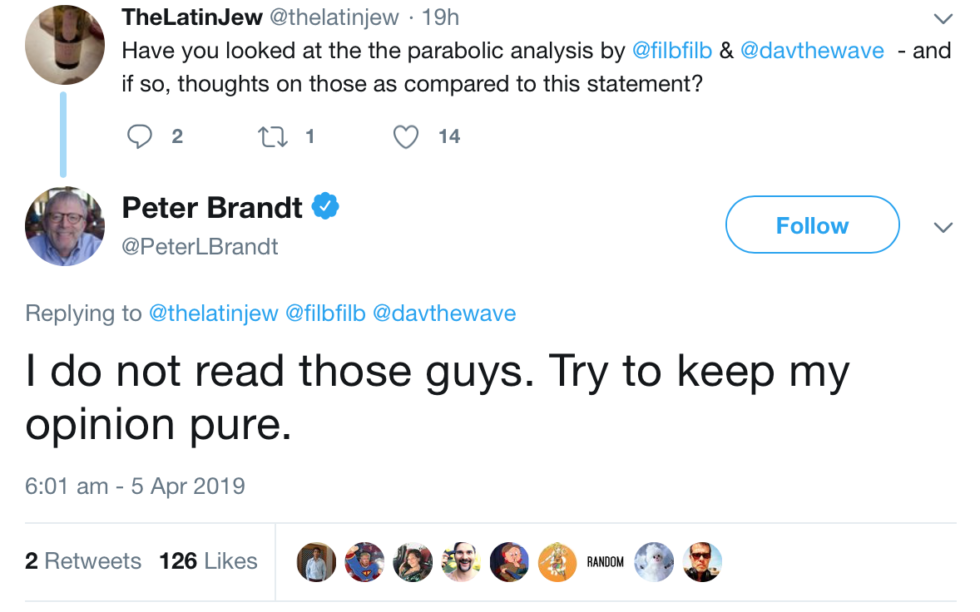
Peter Brandt: bitcoin Price Could Be Entering A New Parabolic Advance Veteran trader, Peter Brandt, who called bitcoin’s $20K top,” says it wouldn’t surprise him if bitcoin price enters a new parabolic phase. The Guy […]
Chairman of Interactive Brokers, Thomas Peterffy, has voiced concerns about the plan to launch a bitcoin Futures contract. According to their CEO, Terry Duffy, the CME Group intends to as early as the second week in December. However, Peterffy is worried about the implications of a crypto-based Futures market. For him, the violent swings associated with digital currencies and assets could spell disaster for investors, as well as the economy as a whole.
Interactive Brokers are themselves a CME clearing member and through an dated November 14, 2017, they requested that “the Commission require that any clearing organisation that wishes to clear any cryptocurrency or derivative of a cryptocurrency do so in a separate clearing system isolated from other products.”
For Peterffy, there is “no fundamental basis for valuation” of cryptocurrencies and the volatility common within markets is cause for concern. He highlighted the lack of a “mature, regulated and tested underlying market” and declared that determining the amount of funds necessary to margin such a product is “impossible”. For him, drastic movements in price could affect many more than just a few unlucky traders:
… a catastrophe in the cryptocurrency market that destabilizes a clearing organization will destabilize the real economy.
He continued:
“If the Chicago Mercantile Exchange or any other clearing organization clears a cryptocurrency together with other products, then a large cryptocurrency price move that destabilizes members that clear cryptocurrencies will destabilize the clearing organization itself and its ability to satisfy its fundamental obligation to pay the winners and collect from the losers on the other products in the same clearing pool.”
However, Peterffy and Interactive Brokers did suggest a way to mitigate the risk. They advocate keeping cryptocurrency derivatives entirely separate from other financial products. To protect the members of clearing organisations from the “unique risks in clearing cryptocurrencies” they should remain “isolated”.
Before signing off, Peterffy offered his and his company’s support to help CME investigate and safeguard against such supposed dangers:
We would be happy to discuss this with you or to provide any further information at your convenience.
People have already made fortunes from crypto fever and cryptofunds, and many more will make money as well. But not everyone.
The Cryptofund Lifeline
Like any rapidly developing market, the cryptocurrency industry , but there are only a few who can really use them. A significant share of the cryptocurrency market is owned by the those who mined it but have no idea how to handle it. Almost all of these people are at risk of ultimately losing their bitcoin or Ethereum.
Cryptofunds help people survive in this market. For a Blockchain neophyte, such institutions are a throwback. Today, a company doesn’t need any ‘linings’ to raise money transparently and distribute profit.
Indeed, the structure of these kind of organizations is reminiscent of conventional venture funds. But they do work and are indispensable for the new economy.
Financial Bridges
Market expertise is the main product of any cryptofund. Funds form a team of professional traders and analysts, i.e. of those who are considered useless by the majority of Blockchain partisans in new economy.
Blockchain is by transparent transactions, but it doesn’t necessarily mean the same for a business owner or a business model. Only experienced professionals can separate the wheat from the chaff and find reliable tools in a stack of hollow shells.
Cryptofunds play an important role in the cryptoeconomy. Among other things, they support new projects that create products and develop a Blockchain ecosystem. They also provide money to those who would probably never get a bank loan or investments from venture funds. It’s not necessarily because their projects are bad, but because neither banks nor VCs know how to work with blockchain projects and it’s doubtful that they’ll learn to do so anytime in the near future.
Meanwhile, a cryptofund’s global role is to raise money within the unregulated economy; it’s a bridge for institutional investors.
Explosive attracts investors longing for risk, but it doesn’t mean they have enough money, and institutional investors will never take a risk without funds’ expertise. Truly large-scale projects can’t survive without big money and long-term finance, and the cryptoeconomy isn’t yet able to set up a strong bond with the conventional economy.
I would emphasize that we’re talking about the future. Right now, the market is still too small for major investors, but current growth rates will not keep them away for long. And until then, individual investors are the main source of money along with growing cryptocurrency rates which inflate funds’ value with no external sources.
Strong And Weak Spots
There are several other growth drivers for cryptofunds, apart from the desire of cryptocurrency owners to make their money work:
Low setup and management costs. The difference from conventional funds is immense. Executives can easily take all the profit, while the cryptoeconomy has avoided this for the moment.
Near-instant entry and exit. Thus, many players buy discounted tokens at pre-sales and then sell part of them on the stock market after fund’s listing. There’s nothing wrong with that – it’s standard behavior for speculators and long-term investors.
Openness, transparency and tokenization of cryptofunds are their integral features as explained by technology platforms. No auditor or disclosure could give you such transparency and publicity.
It may seem that this way money flow should be unstoppable and without any restrictions (shutupandtakemymoney!). ICO evangelists think the same way, but in real life, there are some restrictions that hamper the development of cryptofunds and cryptotools.
Lack of trust in the system.Technology transparency means nothing if you don’t understand its principles. Many find it hard to believe that some ephemeral 0 and 1 somewhere on the internet can guarantee something. In several years people will still have no good understanding of the basics of the cryptoeconomy, but they’ll get used to it. And that’s already something.
There is no legal bridge to the traditional economy.Major players are simply afraid to enter the sphere with a legal gray area. It’s also a question of time – state grindstones run slow but hard.
Limited access to liquidity.Due to the legal vacuum, there are no reliable cryptocurrency exchanges at the moment. The existing ones are dangerous, slow and have almost no obligation to their clients. And reputation doesn’t seem to matter a lot in the cryptoeconomy yet.
Technical issues of tokenization.A platform defines cyber resilience, security and productivity. It’s essential to choose the right one, even though this is really difficult.
Smart contracts.Smart contracts can either lead to success or ruin the whole business. In this sphere, developers are in high demand, and as a result, they are overloaded with work, extremely expensive and work very slowly.
In Need Of Change
The first three problems are long term one and will be resolved as the cryptoeconomy develops. But the latter ones can be tackled by active players.
The market desperately needs a simple, legal, technology-based and out-of-the-box solution for cryptofunds. The company that can deliver it will not only have a chance to beat out the competition but to boost the development of the cryptoeconomy, producing benefits for everyone involved as well.
This article was written by Vladimir Smerkis, Co-founder of and .
What do you think about cryptofunds and the cryptoinvesting process in 2017? Let us know in the comments below!