July 21, 2026

Capitalizations Index – B ∞/21M

Ethereum (ETH) Price Tumbles Back In Bearish Zone, Sell Rallies?

Ethereum (eth) price tumbles back in bearish zone, sell rallies?

Ethereum (ETH) Price Tumbles Back In Bearish Zone, Sell Rallies?

  • ETH price failed to stay above the $158 and the $160 support levels against the US Dollar.
  • Tether drama sparked a strong declined below the $155 and $150 support levels.
  • Yesterday’s highlighted key bearish trend line is intact with resistance near $162 on the hourly chart of ETH/USD (data feed via Kraken).
  • The pair is back in a downtrend and sellers are likely to remain active near $155 or $160.

Ethereum price tumbled below many key supports versus the US Dollar and bitcoin. ETH price even broke the $150 support zone to move back in a downtrend.

Ethereum Price Analysis

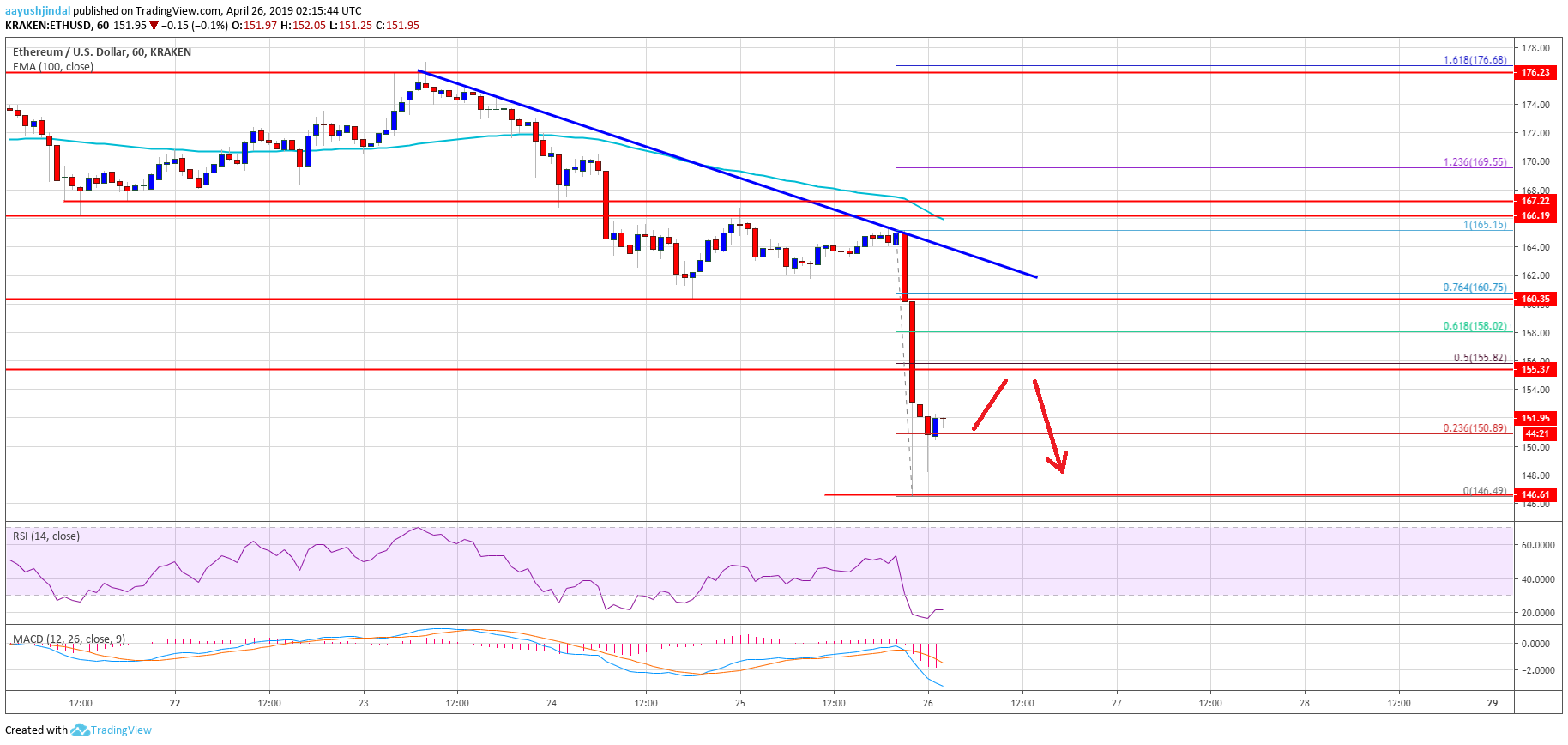
Yesterday, we discussed the chances of one last dip towards $158 in Ethereum price against the US Dollar. The ETH/USD pair failed to stay above the $160 and $158 support levels. There was a strong decline below the $155 support and the price settled well below the 100 hourly simple moving average. The decline was such that the price even failed to stay above the $150 support level. It traded close to the $146 level and formed a new weekly swing low.

At the moment, the price is correcting higher above the $150 level. It broke the 23.6% Fib retracement level of the recent decline from the $165 high to $146 swing low. It seems like the price is back in a downtrend and any recovery towards the $155 level may face sellers. The stated $155 level now coincides with the 50% Fib retracement level of the recent decline from the $165 high to $146 swing low. Above $155, the next major resistance is near the $160 level.

Moreover, yesterday’s highlighted key bearish trend line is intact with resistance near $162 on the hourly chart of ETH/USD. Below the trend line, the 76.4% Fib retracement level of the recent decline from the $165 high to $146 swing low is near the $161 level. Therefore, any major upside correction could face a strong selling interest near the $160, $161 and $162 levels. On the downside, an initial support is near the $145 and $146 levels. Below $145, the price could test the $125 support.
Ethereum price analysis eth chart

Looking at the chart, Ethereum price declined heavily below key supports near the $160 level. It is clearly trading in a bearish zone below the $160 pivot level. In the short term, there could be an upside correction, but sellers are likely to protect the $158 and $160 levels.

ETH Technical Indicators

Hourly MACDThe MACD for ETH/USD is likely to reduce its bearish slope in the short term.

Hourly RSIThe RSI for ETH/USD declined heavily and it is currently in the oversold zone near 20.

Major Support Level – $145

Major Resistance Level – $160

Published at Fri, 26 Apr 2019 03:28:51 +0000

Previous Article

Bitcoin Cash and Bitcoin SV fall prey to massive shorts

Next Article

Ethereum (ETH) Price Tumbles Back In Bearish Zone, Sell Rallies?

You might be interested in …

DELPHY Monthly Airdrop — December, 2018 – Delphy – Medium

Crypto New Media DELPHY Monthly Airdrop — December, 2018 – Delphy – Medium Crypto New Media Press Ada GaoBlockedUnblockFollowFollowing Dec 29 Time flies faster in the Crypto world. It’s almost end of December, and it’s time for […]

HiddenWallet and Samourai Wallet Join Forces to Make Bitcoin Private With ZeroLink

HiddenWallet and Samourai Wallet Join Forces to Make Bitcoin Private With ZeroLink

Ádám “nopara73” Ficsór, HiddenWallet developer and TumbleBit contributor, and “TDevD,” the pseudonymous Samourai wallet developer, are joining forces on a new privacy project: ZeroLink. ZeroLink is set to realize a trustless mixing scheme first proposed by Bitcoin Core contributor Gregory Maxwell years ago — but one that hasn’t been realized thus far.

According Ficsór, the ZeroLink framework, which utilizes a scheme known as “Chaumian CoinJoin,” is actually more straightforward than many of the alternatives that have been proposed.

“Back in 2013, there was this sort of obsession with decentralization. ‘Everything that can be decentralized will be decentralized’ was the slogan,” the developer recalls. “By now we realize that decentralization is actually not always that useful. As long as a mixer cannot steal funds or link transactions, that’s enough.”

CoinJoin

Each bitcoin transaction essentially sends bitcoins from one or several bitcoin addresses (really: “inputs”) to one or several bitcoin addresses (really: “outputs”). That’s how bitcoins “move” over the blockchain.

The problem, from a privacy perspective, is that the blockchain is completely public, which means that anyone can see which addresses are paying which addresses. If these addresses can be linked to real-world identities, it can reveal a lot about who transacted with whom, and perhaps for what.

CoinJoin, the well-known coin-mixing scheme first proposed by Maxwell in 2013, is a potential solution to this problem. A CoinJoin transaction is basically a combination of several transactions merged into one big transaction. In other words, it includes inputs from several different users, and the bitcoins move to outputs controlled by several different users. As such, it’s not clear which bitcoins moved where. All users effectively paid all users.

While that’s great, the next problem is that whomever or whatever combines the different transactions into one CoinJoin transaction can be a central point of failure from a privacy perspective. That person (or that server, or whatever it is) still knows which bitcoins moved where. So if that individual is either corrupt or corruptible, the problem isn’t really solved.

“For CoinJoin to live up to its promise, even the entity that creates the transaction must not learn which addresses are paying which addresses,” Ficsór noted.

ZeroLink

ZeroLink provides a privacy framework for wallets that can be used for different mixing schemes. And it defines its own mixing technique as well: an implementation of CoinJoin referred to as “Chaumian CoinJoin.”

With Chaumian CoinJoin, users both send and receive equal amounts of bitcoin from a CoinJoin transaction, so everyone receives each other’s coins. This obfuscates the trails for all of these coins.

In practice, ZeroLink users will require two types of wallets: a pre-mix wallet and a post-mix wallet. As the names suggest, the first type holds coins that are to be mixed, while the latter is where the mixed coins end up.

Users then connect their pre-mix wallets to the ZeroLink tumbler and provide an input (“from” address) and an output (“to” address), which they both control. But importantly, the outputs are disguised (“blinded”) using a mathematical trick. So while the tumbler knows where all bitcoins are sent from, it does not yet know where bitcoins are sent to.

At the heart of the trick, the tumbler then cryptographically signs all blinded outputs, using a type of cryptographic signature introduced by David Chaum: a “blind signature.” This allows data to be cryptographically signed even if it is disguised. And importantly, these signatures can be checked against the original, unblinded data as well to see if the blinded data and the unblinded data match.

Next, all users connect to the tumbler again, but this time through some type of anonymity network, like Tor. They will then provide the tumbler with the unblinded versions of the outputs. Using the cryptographic signatures it just created, the tumbler can check that all revealed outputs match all blinded outputs. If they do match, the tumbler knows that all the outputs it received are legitimate, and thus were provided by the same users that also provided the inputs to send funds.

The tumbler then adds the revealed outputs to the CoinJoin transaction. And it sends this transaction back to all users, for these users to sign with their bitcoin private keys. Doing so validates the transaction. (The users should of course double check that the amounts and their outputs check out, to be sure they receive as much as they send.)

Finally, the tumbler broadcasts the CoinJoin transaction to be included in a bitcoin block. As a result, all users end up with different bitcoins than they started with: all bitcoins were mixed, and the blockchain trails broken.

While all this is actually relatively straightforward compared to some alternative schemes, and to a large extent already suggested by Maxwell back in 2013, the process has never been realized. This is probably because it was long thought to be too vulnerable to attacks, Ficsór thinks.

“When Maxwell first published the proposal, bitcoin transaction fees were practically non-existent. Because of this, it would be relatively easy and cheap to launch denial of service attacks against a CoinJoin mixing system. An attacker can just keep providing valid inputs, but refuse to sign when he should. That invalidates the whole transaction, and wastes everyone’s time.”

Interestingly, this attack vector is now to some extent resolved simply because it would be too expensive to keep it going. In order to maintain the attack in a way that it’s not easily countered, an attacker must provide new inputs for each round, meaning he must be able to keep moving bitcoins to new addresses to do so. “Assuming $1 transaction fees, that could cost up to $1,000 a day,” Ficsór pointed out. “In this particular context, high fees are a blessing in disguise.”

Development

Ficsór is currently about to help wrap up the development of another highly anticipated privacy tool, TumbleBit, for Stratis’s Breeze Wallet. This is expected to take another three months.

After that, he plans to focus on realizing ZeroLink, while TDevD may even start working on the framework sooner. Concretely, three new codebases need to be developed: the pre-mix wallet, the tumbler and the post-mix wallet.

“The tumbler needs to be developed from scratch. But it should be relatively easy to add the pre-mix wallets to any existing open source wallet. The same is true for the post-mix wallet implementations, though for privacy reasons not all wallets are a good fit,” Ficsór said.

His own HiddenWallet as well as Samourai Wallet are “fully committed” to implementing and deploying ZeroLink into production, Ficsór said, while Breeze Wallet may be interested as well.

Optimistically, an initial implementation of ZeroLink could be live before the end of this year.

For more information on ZeroLink, see Ficsór’s blog post on the project (which also includes a donation address) or ZeroLink’s specification.

The post HiddenWallet and Samourai Wallet Join Forces to Make Bitcoin Private With ZeroLink appeared first on Bitcoin Magazine.