The rate at which new transaction blocks are being added to the is back on the rise after the network’s successful upgrades, Constantinople and St. Petersburg, last week.
According to analytics site Etherscan, the daily block count increased more than within a 24-hour period after the upgrades, implemented as , were accepted onto the main network.
The spike in block numbers is a direct result of Improvement Proposal (EIP) 1234 activated last Thursday, which was designed to effectively disable a piece of code in the software known as the “difficulty bomb,” for a period of 12 months. Meant to encourage the platform to transition to a new proof-of-stake (PoS) consensus algorithm, the code has incrementally been increasing the difficulty of the network and slowing block creation since of last year.
Now delayed, the effects of the bomb look to have rapidly reversed. reports within just a day of hard fork activation, block creation times on have decreased from roughly 19 seconds to 14.
Core developers are now looking ahead to a new set of EIPs for inclusion in the next hard fork, Istanbul.
The timeline for Istanbul has yet to be solidified by developers, though former core developer suggested back in January possible mainnet activation for sometime in October of this year.
Still, as highlighted by Taylor Monahan, CEO of crypto tool MyCrypto, in a recent interview with CoinDesk, preparations for a hard fork a are getting increasingly difficult as the ecosystem scales to include more companies, developers and users.
“I’m always worried whenever there’s a fork because there’s so many moving pieces,” said Monahan. “You have the miners. You have the hardware or the nodes. You have Geth, Parity, Harmony and all the different client softwares. You have the exchanges, wallets and everything in between. There’s a lot of places where things can go wrong.”
Such concerns have also been voiced considering how to extend their services to incorporate the buying and selling of ’s native , ether.
Smooth activation
The latest hard fork activation on , however, was comparably smooth.
Likely due to the multiple attempts for its release as Monahon points out, the large majority of stakeholders on don’t look to have had any difficulty upgrading to the new software.
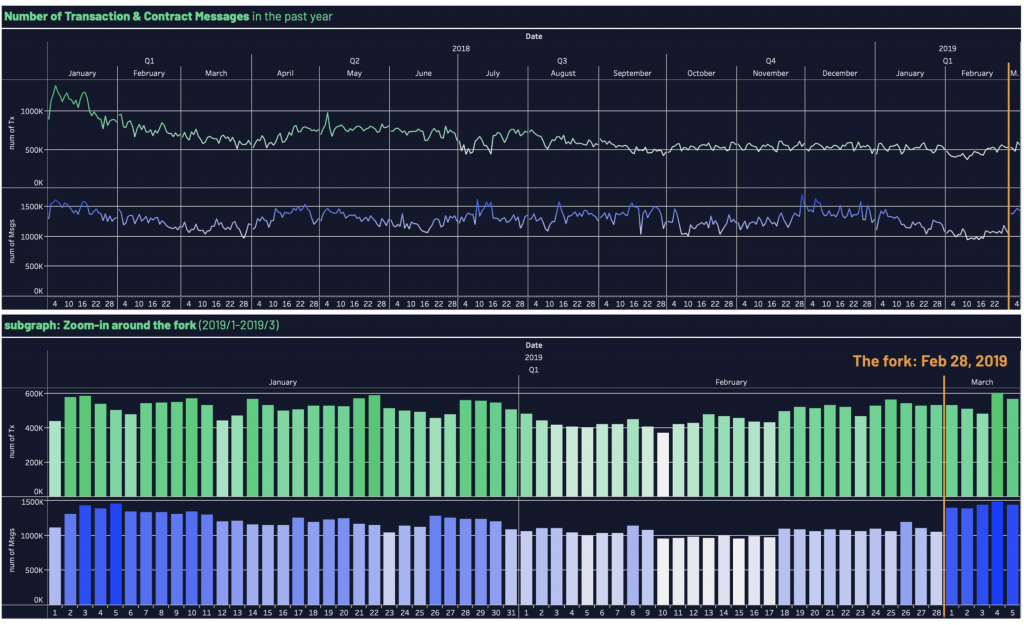
analytics platform Alethio reports that no large fluctuations in either transaction volume or number of smart contract message calls were identified from when the hard fork activated to present day.
Number of transactions and smart contract messages on around the time of the Constantinople and St. Petersburg hard fork. Courtesy of .
As seen on , the network hashrate – a measure of the total computational power being contributed by miners to create new blocks and validate transactions – also barely saw a notable change after activation of Constantinople and St. Petersburg
This indicates that most miners on the network upgraded their computer servers (also called nodes) to mine on the newly upgraded chain, as opposed to a chain running older software.
At present, the hash rate of the network according to hard fork monitoring site is 132,986 GH/s [CHECK BEFORE PUB]. Comparatively, those miners who are still contributing hash power to the non-Constantinople and St. Petersburg activated chain have a combined hash rate of 1,777 GH/s [CHECK BEFORE PUB].
As a result of the remaining hash power on the old version of the , a total of 19 wasteful blocks have been mined since hard fork activation on Thursday according to Foundation security lead Martin Holst Swende.
“These blocks have been mined on the old mainnet chain, presumably having failed to update the miner software for the Constantinople fork – a waste of money,” wrote Swende in a public note.
As such, while the majority of the nodes on did upgrade successfully, an important caveat to note is that a small but persistent number of miners have yet to migrate to the current upgraded .
To these small but select few, Foundation security lead Swende urges in a public :
“A few miners are wasting energy on [an] old chain. Please update ASAP.”
Charts via Shutterstock
Published at Fri, 08 Mar 2019 05:19:11 +0000