 The Essentia review — Part 3
In layman’s terms, Essentia takes old data platforms, sources, and providers, and uses blockchain technology to make that data available in new, exciting, and more useful ways to their users. But to succeed at this, a token is necessary. Enter the ESS Token.
There are many functions and features that using the ESS token will enable. Additionally, enhanced functionalities will be added in as Essentia continues to grow and develop. Once fully developed, it will work through provisions like masternodes, which need ESS tokens to lay stake. This will be one of the means of true network decentralization.
Once developed fully on the framework mentioned, ESS tokens will enable masternodes with resource allocation, anti-spam, anti-abuse blockages, and high-level security compensation and rewards for both internal and external resources and services. Also, the token will assist with such tasks as generic currency exchange, distributed governance, incentivizing new and onboarded Essentia users, and reputation building of the overall platform.
ESS Tokens will be a vital part of the Essentia Framework. They incentivize positive, active participation in the program, while simultenaously thwarting negative impacts and cultivating a transparent system of rewards. As stated in their token documentation: “This utility token, as the fuel of the Essentia ecosystem, will make the framework more accessible and enjoyable by all users, whilst providing a fair means of pricing for enhanced features and services”.
Hard Facts on the ESS Token Sale
Symbol: ESS | Initial Value: 1 ETH = 15000 ESS | Type: ERC20
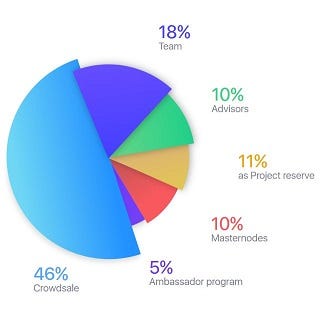 Token Distribution
Distribution:
46% of the tokens are up for sale18% are reserved for team members as listed in part 210% are reserved for advisors as listed in part 211% are used as a company reserve fund10% are allocated for the base amount of masternodes5% are used for the ambassador programs
The Token Sale date is to be announced, however you can already. If you signed up to their whitelist you can additionally join their Telegram and receive a small amount of ESS as a gift. Through completing tasks like sharing the project on social media platforms you will also increase your participation rank, meaning you can contribute earlier than others once the mainsale starts.
My view of Essentia
In the data analytics world, more is better. Companies are scrambling already to find replacements for clunky and dying legacy systems. These same companies are working hard to try and be at the forefront of blockchain technology in their specific niches. Essentia is geared towards marrying the two in a simplified, public process.
The concept of massive data storage and integration on a single, easy to use platform is hard to wrap one’s head around, especially after years of running from data source to data source, performing data cleansing, and working tirelessly to try and get numbers and sources to match with one another. The real world applications of a service such as Essentia are limitless — allowing us to envision a bright future that lays ahead for the team, advisors and investors.
Thanks.
Additional information about Essentia can be found on their .
Get the latest ICO updates on !


The value of bitcoin fell below $7,000 during Wednesday trading, with a number of other major cryptocurrencies recording a drop in value as well.
Data from CoinMarketCap shows that the number one digital currency dropped by as much as $6,825, pushing its market cap down to $115.7 billion. Second-placed ethereum is down by 7.34 percent, at $385, a far cry from its more than $1,400 it attained at the beginning of the year. Litecoin, on the other hand, has slumped by 11 percent in the past 24 hours and is currently trading at just over $119.
However, according to Mati Greenspan, senior market analyst at eToro, the price drops are less to do with fears of a global war trade between China and the U.S., and is more likely down to traders trying to assign value to their portfolio assets.
In a phone interview to , Greenspan explained:
“I think that there is a big connection in the way that people are managing their portfolios and the cryptocurrencies have been increasingly correlated with the stock markets especially in the last few weeks. This (comes) as more and more brokers add bitcoin, the liquidity bridges are being built.”
Fears of a global trade war between the two nations comes at a time when China has reportedly revealed new tariffs against 106 U.S. products. As a result, it’s thought that this has brought on fears of a trade war.
According to Charles Hayter, chief executive of CryptoCompare, due to the fact that crypto assets such as bitcoin aren’t backed by the traditional banking system, investors are turning to safer investments, adding:
“In the grand scheme of things, cryptos lie on (the) extremely risky end of the spectrum and are for times of hot money. The hint of a trade war puts a bit of fear into the mix and as we all know markets correlate in various periods depending on the exogenous factors.”
News of prices slumping comes amid news that bitcoin has experienced the worst first three months of the year, dropping as much as 48 percent since the beginning of the year. It remains to be seen whether the market can rebound from its current low. However, with pressure to regulate the market, among other factors impacting industry prices, it doesn’t seem like it will be an easy climb back up to previous highs.
The post appeared first on .
Users can express their opinions on the outcomes of different issues by buying shares in a given outcome. The system operates, as with other prediction markets, on the principle that the ‘wisdom of the crowd’ is a superior forecasting tool than individual views. By allowing participants to win, and lose, real money, Augur incentivizes individuals to express their convictions on a given subject. Augur was one of the first Ethereum-based ICOs, raising $5 million in October 2015.
History and Launch
Co-founded by Joey Krug and Jack Peterson, Augur has been under development since 2014, with both alpha (2015) and beta (2016) versions of the platform having been released on the Ethereum testnet. Open Zeppelin’s team completed security audits of Augur Core and the first official trading market is planned for early 2018, with the full platform slotted for staged deployment pending the initial market’s successful release.
Notable advisors for the team include Vitalik Buterin, founder of , Elizabeth Stark, founder of , and Dr. Robin Hanson, an economist at who has published works on prediction markets.
Prediction Markets
Prediction markets are held to generate accurate odds, informing users how likely it is that a given market’s outcome will occur. Augur is a platform where users can create and participate in prediction markets. Within the system of smart contracts, users wager on the outcome they believe will take place, winning money when correct and losing money when incorrect. At any given time, an outcome’s share price can be interpreted as an estimate of the probability of that event occuring. Prediction market advocates claim such estimates are accurate, or are superior to other forms of forecasting, such as experts, models, or polling. Studies cited by Augur include and .
At a high level, the life cycle of an Augur prediction market includes the following:
Creation: A market creator spends REP, Augur’s token, to create a market for a question, such as ‘Will the Warriors win Sunday’s match?’ The creator defines the possible outcomes that can be wagered on, such as ‘Warriors win, Warriors lose, draw, or match cancelled’, and all questions include a default ‘invalid’ outcome. The market’s cogency is guaranteed via a ‘validity bond’, a sum set aside by market creators at the market’s creation and forfeited should market reporters return an outcome of ‘invalid’. This process incentives market creators to form markets based on well-defined events with unambiguous outcomes.
Additionally, the market creator picks a resolution source, such as ESPN.com, that reporters will treat as providing the truth about the event’s outcome. The market creator also chooses a designated reporter, who first declares the event’s tentative outcome within three days of the event’s completion. A ‘no-show’ bond, funded by the market creator and forfeited on a tardy designated reporter response, incentives a responsible choice of the designated reporter.
Trading: Users buy and trade shares in a market’s outcomes, with each share prices adding up to a set amount. Markets can support Boolean, scalar and categorical outcomes, each having different associated sets of shares. Unlike some , Augur’s token is not used as a prefered currency in such wagering. Augur plans to use Ether at first, then integrate ‘stablecoins’, coins whose value is tied to fiat currency, for ease of use. Prediction markets built on volatile cryptocurrencies could produce skewed data, such as when participants’ decisions are influenced by their speculative beliefs about the future price of their token holdings and not only their local knowledge. Augur’s plans to integrate stablecoins should help mitigate this issue.
Forecasting: Forecast generation occurs simultaneously with trading. An outcome’s share price is interpreted as the odds of that event occuring. For instance, in a simplified win/lose scenario, a 20 cent share price for the Warriors losing is interpreted as the market’s judgment that a Warrior’s loss has a 20% chance of occuring. Augur claims the superiority of such estimate is justified by the ‘Wisdom of the Crowds’ principle, which holds that the average prediction made by a group is superior to that made by any of the group’s constituents.
However, there are reasons to be skeptical about this justification. One might question whether share price really reflects an aggregated judgment attributable to ‘the crowd’, since the aggregation method doesn’t appear to guarantee proportional representation. As such, share price can reflect more the judgment of a few participants with deep pockets and less the judgment of the ‘outvoted’ majority.
The argument also depends on interpreting share price as an aggregate of individual predictions, yet the aggregation method doesn’t guarantee this either. Users can mistakenly buy shares, can stake for outcomes they can make or prevent from happening, and can stake to influence other users, all of which affects share price but none of which constitutes predicting. , a rival project, illustrates this in one of its use cases. Gnosis suggests that market creators needing software testing can stake for ‘no exploits will be found’ in a market asking ‘will software exploits be found’, thus incentivizing debugging.
Finally, even assuming that a share’s price represents the group’s prediction, there’s a question of how to interpret this collective judgment’s content. A share price, 20 cents, could be interpreted as a judgment that ‘the Warriors have a 20% chance of losing’, but it can also be interpreted as ‘ESPN has a 20% chance of reporting a Warriors’ loss’, among other things. The question then is how to support a given interpretation of what the crowd’s wisdom actually holds.
Reporting: Part of what makes Augur a decentralized prediction market is how an event’s actual outcome is determined. Rather than have a central entity state whether the Warriors won, Augur’s protocol relies on distributed reporters to verify what occured. By staking REP to the outcome allegedly made by the resolution source, REP holders collectively confirm that the source resolved a given way; ESPN did in fact state ‘Warriors win’.
For performing this service, REP holders become eligible for a portion of the platform’s trading fees. To expedite market resolution, the designated reporter’s stake provides the market’s tentative outcome and is used to settle the market, unless sufficient dissent among other reporters is reached.
If such dissent exists, a market fork occurs—a disruptive process whereby all non-resolved markets are put on hold and new ‘universes’ capable of supporting their own subsequent prediction markets are created for each outcome. The outcome recieving the majority of REP is considered the market’s outcome, though REP staked to this universe can become worthless should users believe that such REP holders were mistaken and take their business to the outcome universe containing trustworthy reporters.
A market fork would have significant usability consequences. Besides disrupting all markets for 60 days, the generating universe’s REP token would become locked, spawning at least three new tokens, one for each possible market outcome (minimally outcome A, outcome B, and the invalid outcome.) Exchanges and wallets would need to decide which of these new tokens to support. Depending on whether market creation and trading continue to occur in a universe, a spawned universe’s token could become worthless. Should trading continue in multiple universes, the available work that a token holders has a right to perform would be a fraction of what it previously was.
Settlement: When the market’s outcome is determined, winning shares become redeemable and losing shares become worthless.
Token Details
As mentioned earlier, Augur’s token, REP, is not a prefered currency used in the actual prediction market, but rather grants holders the right to contribute to the prediction market’s resolution process. By performing this service, REP holders will receive a percentage of a given market’s trading fees, proportional to the quantity of REP tokens staked. Diligence in reporting is incentivized by this setup, as tokens staked to non-consensus outcomes are effectively lost––such REP is redistributed to users staking for the consensus outcome. In the optimal case, the sum value of work, performed exclusively by token holders, will grow with overall platform growth and drive token prices up.
Greater security is the primary value purportedly added to the platform via REP holders’ work. Rather than having a single entity determine a market’s outcome, Augur envisions thousand of reporters participating, ideally independently verifying outcomes, making the platform more resilient to mistakes and manipulation. Whether reporters’ work will add value in the way Augur intends remains to be seen, as achieving such security crucially depends on how many end up performing the labor entitled by REP holding and how such reporters actually go about resolving market outcomes, factors that are out of Augur’s control to an extent.
At first glance, the question of how Augur will ensure that REP holding remains sufficiently diversified looks pressing. Presuming that a REP token holder will perform the reporting service, the outcome resolution processes of a centralized prediction market and Augur become more homogeneous as more REP tokens are concentrated in the hands of a few individuals or organizations. Should a few entities end up holding most REP tokens, this would undermine Augur’s claim to a distributed resolution process.
Understood this way, the challenge for Augur is ensuring that REP tokens are widely distributed. Yet the presumption that the REP holder will perform the reporting service may be inaccurate. While the Augur white paper states that “Anyone who owns REP may participate in the reporting and disputing of outcomes”, it is unclear what would prevent REP owners from delegating that work to other individuals. The issue arising from delegation is that, if a thousand REP holders delegate the reporting task to the same entity, then the resolution process is not clearly disanalogous to that of a centralized prediction market So, if delegation is possible, then Augur’s challenge is less a matter controlling token distribution and more a matter of controlling labour distribution.
The Augur platform claims to be more secure because the process is decentralized. REP holders delegating work can undermine how decentralized the process is. Yet the process still could arguably be considered secure for other reasons: REP owners are incentivized to delegate an honest central entity because their staked tokens are at risk of being burned. In this case, Augur is secure because of the game theoretic incentives the platform builds into the reporting system and not because of the process’ decentralization.
Game Theory Applications
As illustrated above, Augur’s project is notable for its application of game theoretic incentives. The project employs various bond structures that work together to economically incentivize honesty in all parties. Some significant incentive mechanisms employed include:
Validity bonds: Validity bond incentivizes market creators to create markets based on events with objective, unambiguous outcomes. A validity bond is paid in ETH and is returned to the market creator if the market resolves to any outcome other than invalid.
No-Show Bonds: No-show bonds incentivizes market creators to choose a reliable designated reporter, improving markets resolution speed. A no-show bond is returned to the market creator if the designated reporter reports within the allotted 3-day window following the market event’s conclusion.
Dispute bonds: Dispute bonds incentivize reporters to dispute incorrectly reported tentative market outcomes. Participants noting that a tentative outcome is incorrect can stake REP to an alternative outcome, which disputes the tentative outcome if enough REP is staked. Dispute bond sizes are determined in such a way as to ensure a 50% rate of investment for reporters who successfully dispute false outcomes
Forking: Market forks are at the heart of Augur’s incentive system. Augur maintains that, since its market forking process can be trusted to determine the truth, the threat of a fork incentives participants to behave honestly. The outcomes that wins in a fork should correspond to objective reality when attackers are economically rational and the market cap of REP is large enough—Augur’s whitepaper offers detailed formal arguments for this conclusion. Forking itself has significant negative effects on the platform, such as a 60 day suspension of market activity and a splintering of the REP token, so stakeholders have strong reasons to resolve market outcomes without escalating to a fork.
Official Resources
The post appeared first on .