
 Verschiedene Ökonomie-Fakultäten an brasilianischen Universitäten beschäftigen sich mit Kryptowährungen. Zudem gibt es weltweit viele Forschungsprojekte und Masterstudiengänge zur Thematik. Auch in Deutschland gibt es bereits einige Initiativen. Die brasilianische Hochschule Fundação Getúlio Vargas in São Paulo startet einen Masterstudiengang mit Fokus auf Kryptowährungen. Kryptos an brasilianischer Hochschule angekommen Berichten zufolge bereitet das brasilianische Bildungssystem seine Studenten auf…
Der Beitrag erschien zuerst auf .
A few days ago, ran a story on the Monero hard fork and how it might show if the blockchain had been secretly hijacked by ASIC miners. Suspicions over the way in which hashrate of the Monero blockchain had increased dramatically toward the end of 2017 when there was a general boom in the market led to speculation that there may already be secret ASIC miners on the network.
As a result, the development team at was desperate to make sure that the scheduled hard fork made the blockchain even more resistant to ASIC mining.
The and its place in the crypto ecosystem is one that is at the heart of the crypto evolution. Pioneers of cryptocurrency and blockchain technology held to libertarian ideals and philosophies which was greatly centered on decentralization. ASIC mining, however, undermines this decentralization philosophy as it creates the opportunity for monopolization and mining centralization.
Proponents of ASIC argue that a truly libertarian ecosystem is one in which no one is prevented from being able to express their economic potential. Thus, the practice of making blockchains immune to ASIC is seen as being anti-libertarian.
Examining the Evidence
On quite a number of discussion threads on Reddit, the online forum, members of the crypto community have been airing their views on what has been observed since the recent Monero hard fork.
The Monero hashrate decreased by about 80 percent after the hard fork. Before the hard fork, the hashrate which refers to the computing power expended during the mining activity stood at about 1,030 Mh/s. After the hack, it plunged all the way down to about 157 Mh/s. At the time of writing this article, the hashrate is somewhere around 525 Mh/s.
Source: https://bitinfocharts.com/comparison/monero-hashrate.html#3m
Some have tried to this significant drop in hashrate after the hard fork saying that operators of botnets might have been unable to join the hard fork update. There is, however, a great deal of skepticism to this explanation as the majority of responders tend to agree on the fact that the drop shows the activity of secret ASIC mining on the blockchain prior to the hard fork.
This is further confirmed by the fact that the latent hashpower has moved to the forks of Monero (yes, there’s four clones on the same, old Monero network) that resulted from the decision to boot ASICs from the network. “The 800 Mh/s that’s moved over the Monero Classic are not miners,” Riccardo Spagni, lead maintainer of Monero, in a recent interview, saying that it is the ASIC manufacturers.
The clone network, Monero Original, has at the time of writing, while Monero Classic and the other clones have a smaller hashrate.
Indeed, the overwhelming consensus among forum commenters on Reddit is that ASIC miners were secretly embedded in the network and that might have even gone onto of the network.
Implications
At present, Monero was temporarily the most beating even Ethereum, but the difficulty will take a while to stabilize. The changes that have been made to the CryptoNightV7 PoW algorithm used on the Monero blockchain seen to have catapulted the coin to the top of the charts, as the difficulty falls and profitability for hobbyist miners returns.
However, there are still concerns as to whether there are other blockchains that are secretly being monopolized by ASIC mining. According to a by a user with the moniker the realization that there was a mining monopoly on the Monero blockchain is an unpleasant one. In fact, it was suggested that 33 percent of Monero’s hashrate was under control by one actor, opening up a possible 51 percent attack if there were no change in the protocol.
On a lighter note, BaikalMiner announced a offering a buy one, get five offer which shows the effectiveness of the move by the Monero community. While the cryptocurrency community pointed out the short-termism of the move, there are longer-term solutions being discussed, for instance, a randomized Proof of Work that would change with every block.
Tevador and Howard Chu have proposed similar ideas, with the former :
“…the PoW would change with every block, and if the instruction set is broad enough to cover the majority of what current CPUs/GPUs implement in hardware, then any potential ASIC would be basically a CPU/GPU with similar performance.”
Going forward, Monero will eventually open up to ASIC mining, but Spagni said in an :
“Until we get to a point where ASICs are commoditized, the onus on us as a community, and a digital currency, is to resist them for as long as we can.”
The post appeared first on .
was one of the pioneer projects that showcased the potential of the Ethereum network to the cryptocurrency community. Back then, in 2016, developers were beginning to come to terms with the ability of the blockchain to support decentralized applications (DApp). Now, the developers of this potentially revolutionary project are ready for the beta release, and as expected, it is causing a stir in the crypto community.
The Golem DApp
The Golem project is a that will allow users to monetize their idle computing power in exchange for GNT tokens. At the onset of the project, it was envisioned as the , a global marketplace where people can offer their idle computing power for rent. The project was one of the premier ICOs on the Ethereum network. During its November 2016 ICO, it raised valued at $8 million at the time in less than half an hour. The project has been in development since then.
The goal of the Golem project is to make heavy-duty computing processes like machine learning, big data calculations and computer-generated images (CGI) rendering to become less expensive and more accessible. When fully implemented, it will function as a decentralized data center; , providing a more secure network superstructure for the internet.
The Beta Launch
According to a on the project website from April 10, the Brass Beta release of the Golem project has gone live. After being in development for about two years, the project team has decided that it is time for the mainnet launch of the platform. While announcing the launch, the team acknowledged that this new milestone opens up the project to new risks. The project team, however, maintains that such risks are necessary for the development of the platform.
The Golem Brass Beta release has one use case which is for CGI rendering. Users that wish to render a Blender or LuxRender scene can use the Golem Brass Beta to distribute the CGI processing across many CPUs and GPUs. Rendering computer animations is known to be a time-consuming endeavor which requires a great deal of computing power especially for complex scenes with high vertex counts.
The next step in the process is to create a dedicated plugin for the Blender software to make the Golem-Blender interface more manageable and efficient. All of this is geared towards making Golem become a modular and self-contained system that can handle a complex process like machine learning. The newly released Beta version comes with mainnet support, which means that users can connect Golem to the blockchain and spend GNT tokens in exchange for computing power. As with other transactions on the Ethereum blockchain, fees (‘gas’) must be paid to enable all transactions.
As part of the Beta release, the development team has also launched a bug bounty campaign where users can identify issues with the software and earn GNT tokens. The other planned releases are Clay Golem, followed by Stone Golem, and then Iron Golem. Part of the parameters being tested is scalability which continues to be a big issue in the Ethereum blockchain.
Expectations and Price Movements
The Golem team has taken a considerable amount of time to finally release a product that users can test. As a result, there is being shown by followers of the project that seemed to have caught the imagination of blockchain enthusiasts early on. On numerous forum posts on Reddit, the majority of the responses has seen users congratulating the development and expressing a desire to test out the new beta release.
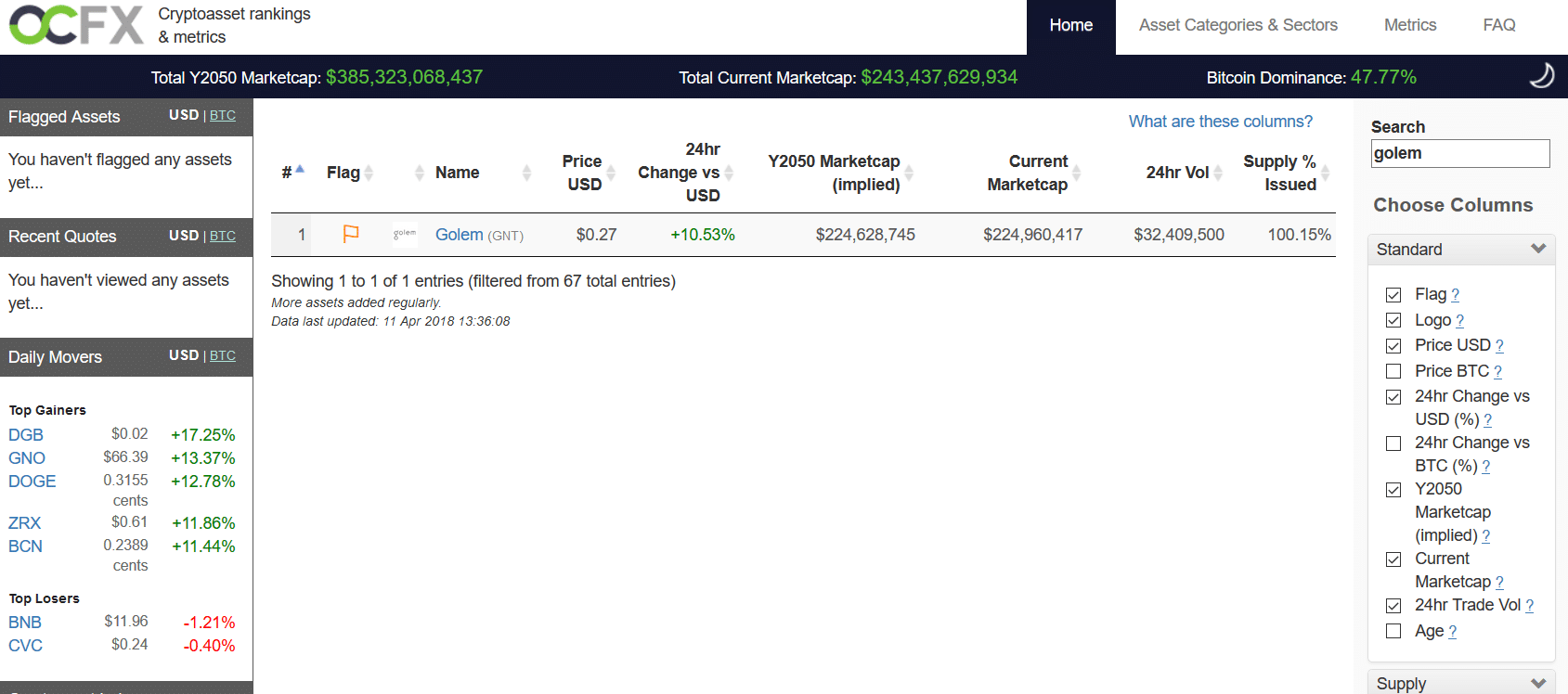
According to , the price of the GNT token has increased by about ten percent in the last 24 hours, as at the time of writing this article. Immediately after the announcement went public, there was a spike in the price of GNT tokens from just over $0.25 to more than $0.27 in a matter of minutes. Since the announcement, the price seems to have settled around $0.27. Golem has a current market cap of $226 million.
The post appeared first on .

