The views and opinions expressed here are solely those of the author and do not necessarily reflect the views of Cointelegraph.com. Every investment and trading move involves risk, you should conduct your own research when making a decision.
The market data is provided by the exchange.
Chinese stocks led the way last week for global developed equity markets with the rising 89.86 or 2.81% to close at 3,289.02. Keep in mind though that Chinese markets were closed till Thursday and this performance reflects only two days of trading due to the Chinese New Year holiday. Regulators on Friday, Feb.23, that they would take over Anbang Insurance and the index was still able to advance against the news, a sign of strength.
The remaining six markets tracked in the table below mostly had positive but unexciting performance, while UK’s was the one negative market.
Overall, equity markets continue their counter-trend rallies following generally sharp drops off highs earlier in the month.
In Japan the index was the second strongest performing market last week, rising 172.53 or 0.79% to end at 3,289.02. On Friday signs of inflation were reported with the CPI inching up 0.9% in January from a year earlier. The third best performer was the US with the index gaining 15.08 or 0.55% to wrap up the week at 21,892.78. Downward pressure was seen for most of last week with the S&P 500 trading largely sideways before strength came back by Friday. The index closed strong, at the high for the week and a three-week closing high.
Hang Seng Index: Three-week closing high
The ended at a three-week closing high, which is a sign of strength, up 151.80 or 0.49% for the week at 31,267.20. Since the 2016 swing low of 21,488.80 the index has been progressing higher in a relatively well-formed parallel trend channel.
Two weeks ago the bottom trend line of that channel was tested as support, along with the 100-day moving average and 78.6% Fibonacci retracement, and it held, subsequently ending a two-week 13.01% correction. As of last week’s 31,477.90 high the index had bounced 8.06% from that low and retraced at least 50% of the prior decline.
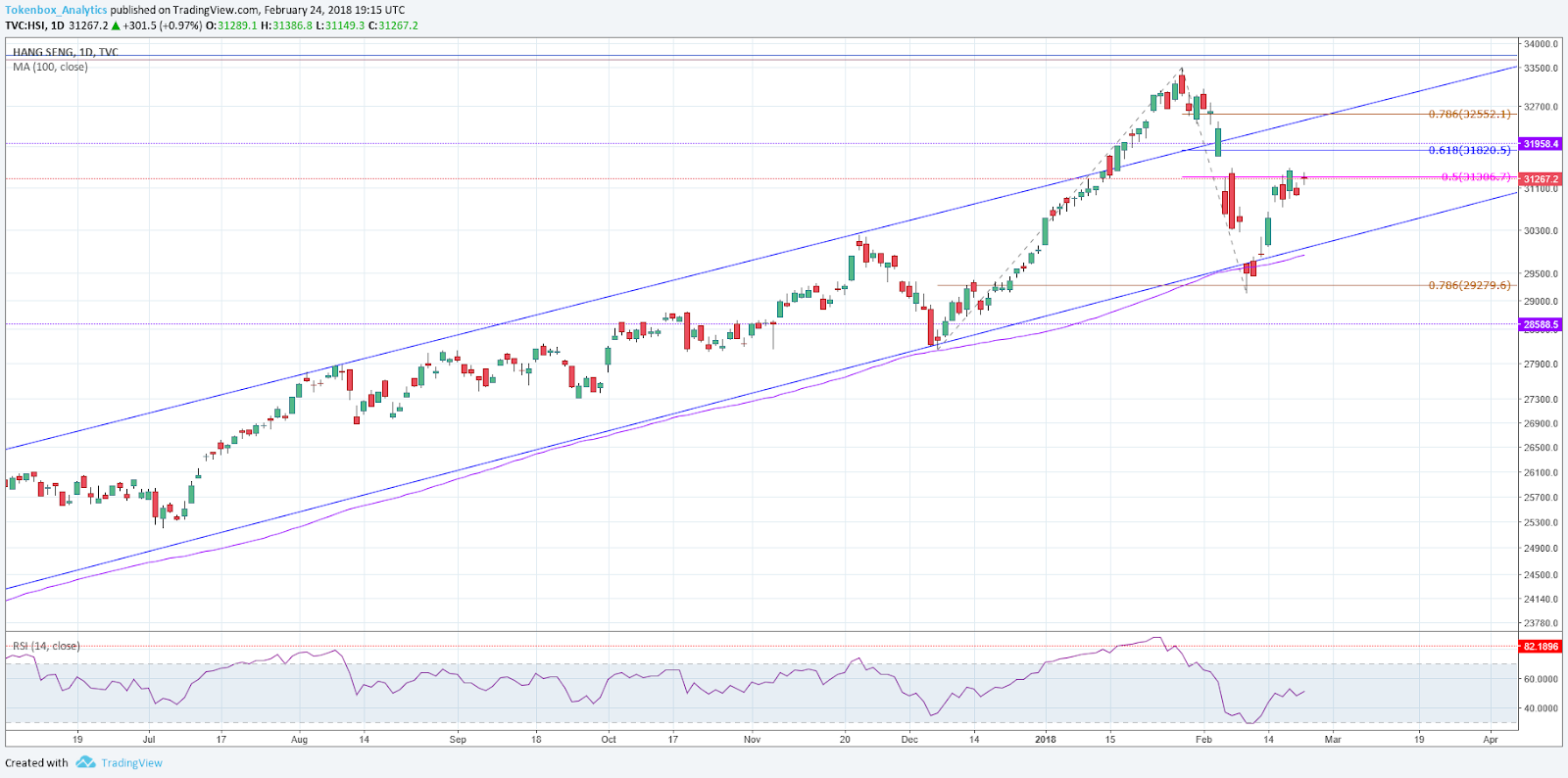
For the past five days, the Hang Seng has been consolidating within a range. Therefore, a move through the bottom of last week’s low at 30,720.50 likely leads to further weakness and a possible test of the recent bottom from three weeks ago. A move through the top points to a continuation of the bounce into the 61.8% Fibonacci retracement at 31,820.50, which would complete a gap fill from the decline at 31,712. This is followed by a price zone from around 32,394.9 to 32,552.10, consisting of the three-week high and 78.6% Fibonacci retracement, respectively.
BSE 30 Sensex Index: finally bottoming?
The Index has been technically lagging the other equity indices as it has barely budged off its recent 34,008.42 swing low. That low was reached three weeks ago along with support of the lower parallel channel line, the 100-day moving average, and the 78.6% Fibonacci retracement. It ended an 8.13% decline off the record high of 36,443.98 from two weeks prior. Last week the Sensex was up 131.39 or 0.39% to end at 34,142.15.
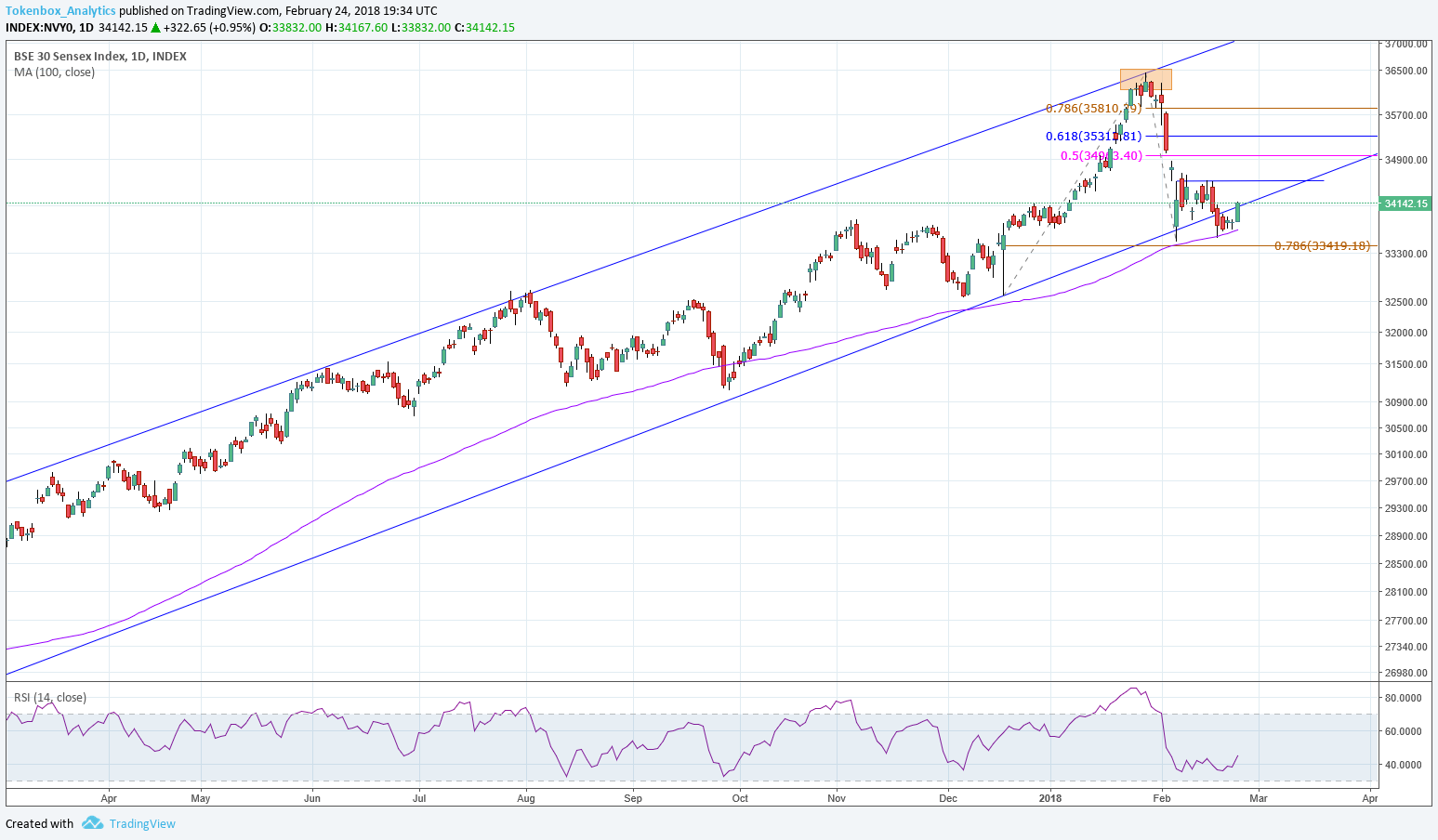
Nevertheless, the bottom developing in this index may be more reliable than what is being exhibited in the other indices as a potential double bottom trend reversal pattern has formed. The three-week low was tested as support with last week’s 33,554.37 low and the index bounced from there to close near the high for the week. This is short-term bullish behavior, and it is occurring at a strong support zone given the confluence of indicators noted in the paragraph above. A breakout of the double bottom occurs on the move above 34,535.
Cryptocurrencies: All weaken together
Leading were weak across the board last week and clearly underperformed equity markets. Regardless, the moves were mild historically. It is interesting to note that some of the top cryptocurrencies remain correlated as to direction. In other words, since moving into corrective mode from record highs, they have been generally moving up and down, of course to different degrees, somewhat together.
We will continue to watch the evolving relationships in the coming weeks for signs of a leading index and divergence. Further short-term weakness would not be surprising in the coming week or two as cryptocurrencies continue to sort out a sustainable bottom. So far the recoveries have been V-shaped and are not as reliable as consolidation bottoms of some sort.
was the worst performer last week, falling $0.39 or 18.4% to close at $1.71. Two weeks ago the pair broke out of a bullish descending wedge pattern, and last week it pulled back towards the top downtrend line of the pattern to test it as support. That process has not yet completed as a short-term downtrend (7-days) remains. Therefore, the expectation is for the cryptocurrency to turn back up once the pullback is complete.
exhibited similar price behavior last week as it pulled back to its 100-day moving average support, $791.04, at last week’s low of $787.0. That followed a breakout of an internal downtrend line two weeks ago. Last week the pair was down $84.82 or 9.0% to end at $852.56.
bitcoin: Watch for continued retracement lower to Fibonacci support levels
was the stronger performer last week, down only $29.90 or 0.30% to end at $10,166.10. Since hitting a bottom at $5,920 three weeks ago, the pair has rallied as much as 98.96% as of last week’s $11,780 high, 50% retracement. That rally included a breakout of an internal downtrend line.
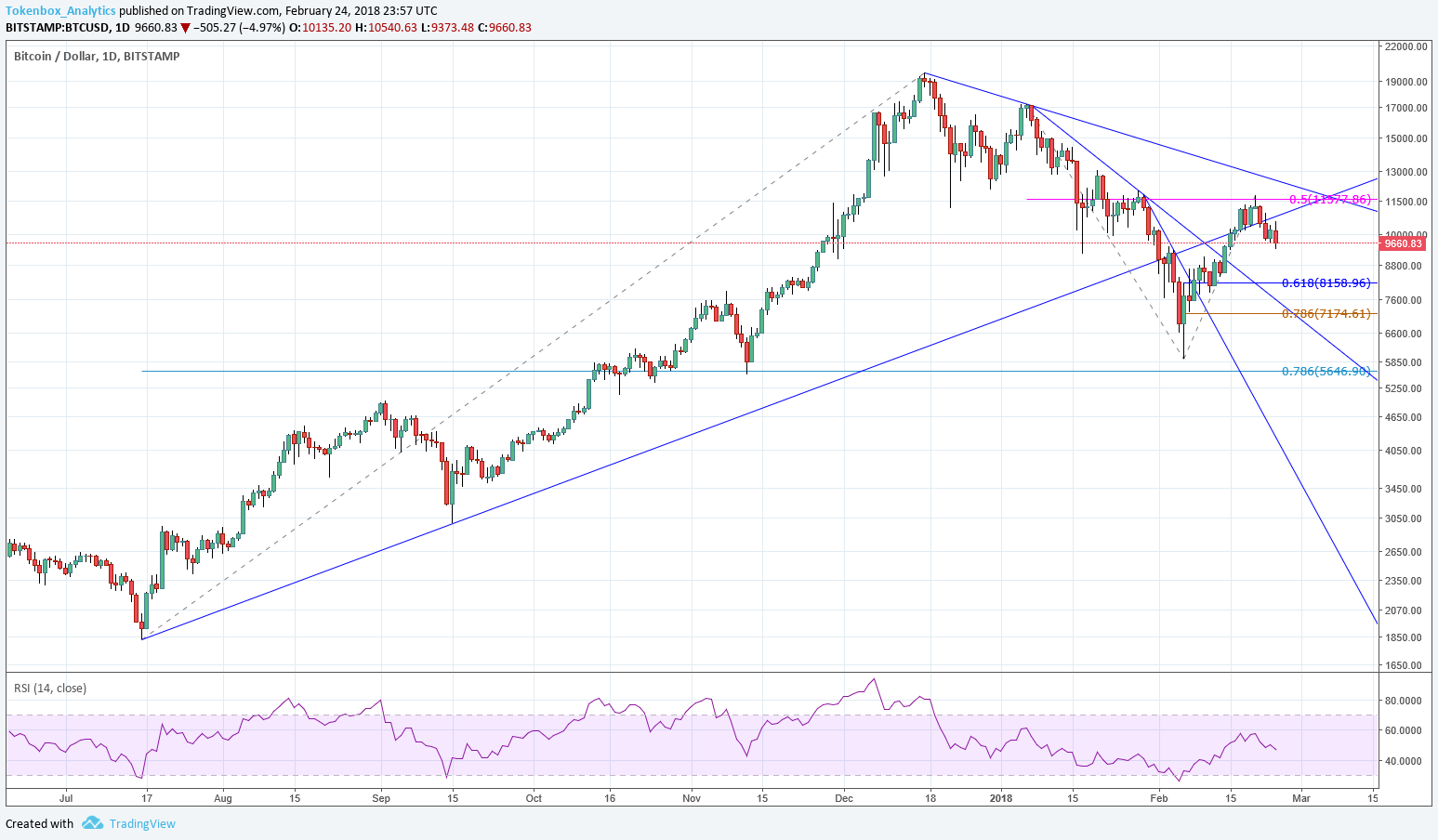
Since hitting last week’s high bitcoin has been pulling back. Next watch for support to be found that can turn the cryptocurrency back up for a second leg up off the $5,920 bottom and possibly get above last week’s high. The 61.8% Fibonacci retracement is at $8,158.96, and the 78.6% retracement is at $7,174.61. Watch for support to be seen at either of these price areas.
bitcoin Cash: Looks to be heading lower
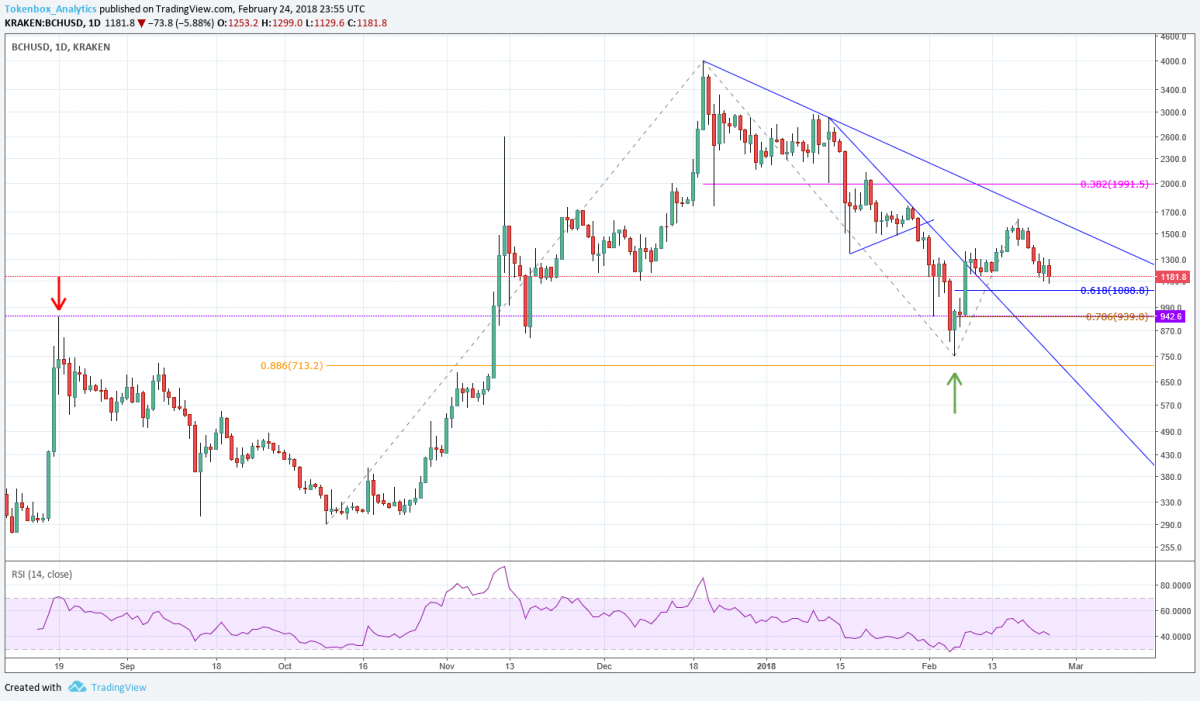
continues to show relative weakness on a technical basis. Year-to-date it is the third weakest performer with a drop of 47.8%, and last week it fell $277.30 or 18.1% to end at 1,255.60. It broke out of its internal trend line two weeks ago and rallied into resistance at $1,636.80 before slipping into a retracement, which is where it remains. At that high, the pair was 118.24% above the bottom of the recent correction at $750.0. From the December peak of $4,000.1, the price had fallen 81.25% at that low.
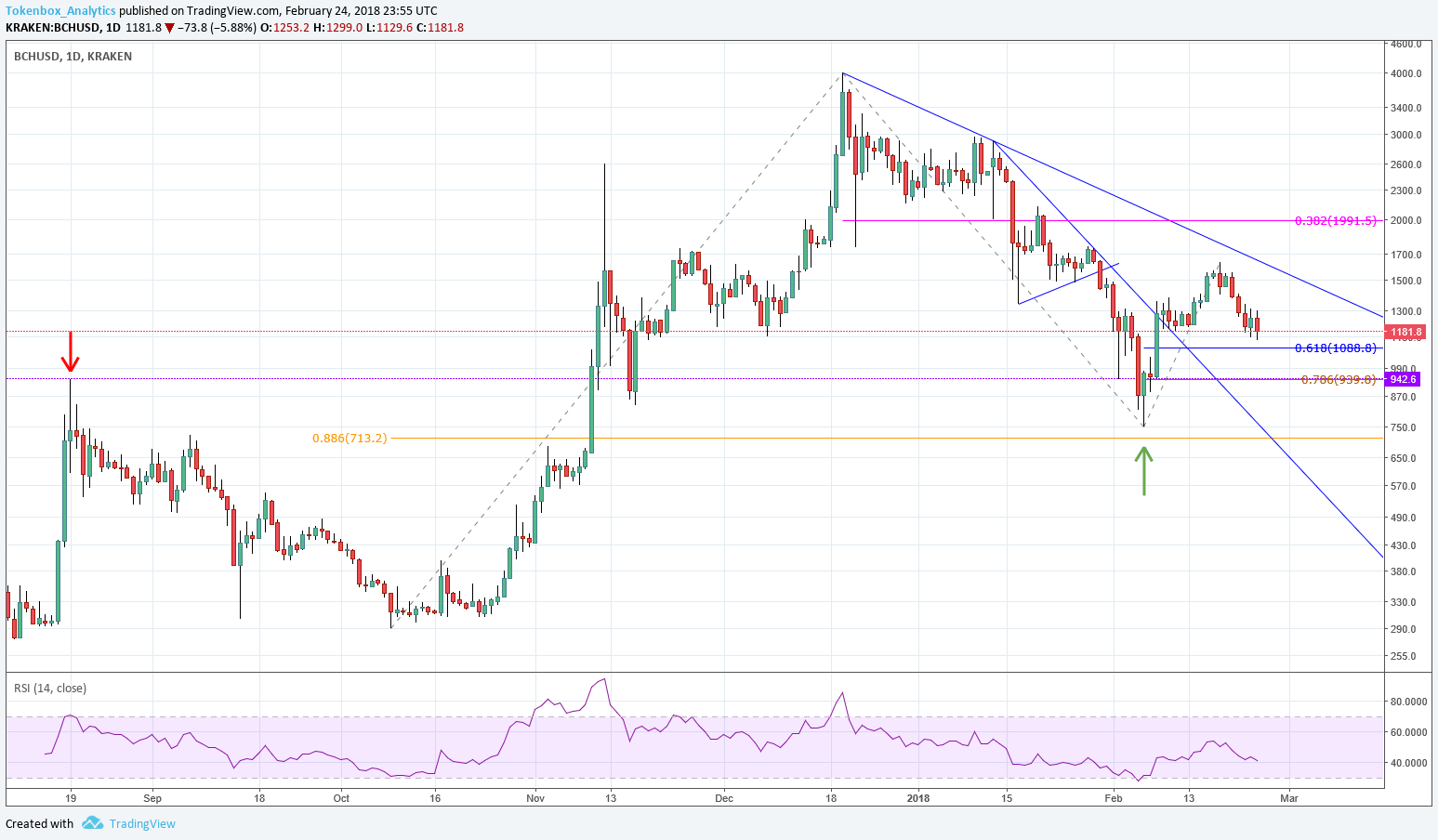
Next watch for a continuation of the decline into potential support at the 61.8% Fibonacci retracement of $1,088.80, followed by the 78.6% retracement at $939.80. Once the pullback is complete, the cryptocurrency can be expected to further recover along with the rest of the cryptocurrency sector.
The market data is provided by the exchange; the charts for the analysis are provided by .
Published at Mon, 26 Feb 2018 01:29:17 +0000
bitcoin[wpr5_ebay kw=”bitcoin” num=”1″ ebcat=”” cid=”5338043562″ lang=”en-US” country=”0″ sort=”bestmatch”]