 “Einsteinium” is a synthetic element with symbol “Es” and atomic number 99. It is the seventh transuranic element, and an actinide.
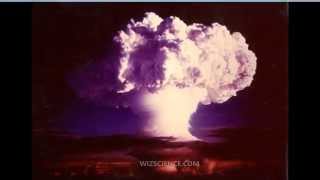
Einsteinium was discovered as a component of the debris of the first hydrogen bomb explosion in 1952, and named after Albert Einstein. Its most common isotope einsteinium-253 is produced artificially from decay of californium-253 in a few dedicated high-power nuclear reactors with a total yield on the order of one milligram per year. The reactor synthesis is followed by a complex procedure of separating einsteinium-253 from other actinides and products of their decay. Other isotopes are synthesized in various laboratories, but at much smaller amounts, by bombarding heavy actinide elements with light ions. Owing to the small amounts of produced einsteinium and the short half-life of its most easily produced isotope, there are currently almost no practical applications for it outside of basic scientific research. In particular, einsteinium was used to synthesize, for the first time, 17 atoms of the new element mendelevium in 1955.
Einsteinium is a soft, silvery, paramagnetic metal. Its chemistry is typical of the late actinides, with a preponderance of the +3 oxidation state; the +2 oxidation state is also accessible, especially in solids. The high radioactivity of einsteinium-253 produces a visible glow and rapidly damages its crystalline metal lattice, with released heat of about 1000 watts per gram. Difficulty in studying its properties is due to einsteinium-253’s conversion to berkelium and then californium at a rate of about 3% per day. The isotope of einsteinium with the longest half life, einsteinium-252 would be more suitable for investigation of physical properties, but it has proven far more difficult to produce and is available only in minute quantities, and not in bulk. Einsteinium is the element with the highest atomic number which has been observed in macroscopic quantities in its pure form, and this was the common short-lived isotope einsteinium-253.
Wiz Science™ is “the” learning channel for children and all ages.
SUBSCRIBE TODAY
Disclaimer: This video is for your information only. The author or publisher does not guarantee the accuracy of the content presented in this video. USE AT YOUR OWN RISK.
Background Music:
“The Place Inside” by Silent Partner (royalty-free) from YouTube Audio Library.
This video uses material/images from https://en.wikipedia.org/wiki/Einsteinium, which is released under Creative Commons Attribution-Share-Alike License 3.0 http://creativecommons.org/licenses/by-sa/3.0/ . This video is licensed under Creative Commons Attribution-Share-Alike License 3.0 http://creativecommons.org/licenses/by-sa/3.0/ . To reuse/adapt the content in your own work, you must comply with the license terms.
Wiz Science™ is “the” learning channel for children and all ages.
SUBSCRIBE TODAY
Disclaimer: This video is for your information only. The author or publisher does not guarantee the accuracy of the content presented in this video. USE AT YOUR OWN RISK.
Background Music:
“The Place Inside” by Silent Partner (royalty-free) from YouTube Audio Library.
This video uses material/images from https://en.wikipedia.org/wiki/Einsteinium, which is released under Creative Commons Attribution-Share-Alike License 3.0 http://creativecommons.org/licenses/by-sa/3.0/ . This video is licensed under Creative Commons Attribution-Share-Alike License 3.0 http://creativecommons.org/licenses/by-sa/3.0/ . To reuse/adapt the content in your own work, you must comply with the license terms.