
A Stanford student has submitted a letter of complaint to the Graduate School Board stating that a resident economics professor grossly misrepresented bitcoin during a guest lecture on blockchain and the future of finance, while openly promoting Ripple as a better alternative.
Also read:
Questionable Academic Integrity
When Stanford student Conner Brown entered a lecture hall at the Stanford Graduate School of Business in January 2019 to attend a guest lecture by Susan Athey, Economics of Technology Professor at Stanford, he got more than he bargained for. So much so that he felt compelled to write the school board:
During the presentation from Dr. Athey there were multiple misstatements that were concerning to me. I understand that she is a respected professor at Stanford and that these may have been accidental; however I also believe that it is in the best interest of our academic environment that we ensure high caliber discussion and peer review.
He added: “My concerns revolve around misstatements around bitcoin in comparison to Ripple’s token called XRP. I would also like to raise concerns about potential conflicts of interest in a professor making false statements while simultaneously promoting a product that claims to solve these problems and being paid by that company.”
The lecturer in question is an who’s previously held a chair at Harvard. The professor, tasked with teaching an upcoming course in cryptocurrencies at Stanford University, might have been assumed to be an expert in her field.
Her decision to shill Ripple while criticizing bitcoin has been attributed not to ignorance, but to the fact that she sits on Ripple’s Board of Directors, which she joined back in 2014.
Professors shilling tokens is the 21st century version of “you must buy my book to take this course” 😂
— Andrew Bentley 🇺🇸✌🏻 (@Abentley77)
A Litany of Errors
In his , which reads like a college-level introduction to bitcoin, Conner Brown articulates the points where Athey’s presentation was misguided. These arguments include:
- Conflating mining nodes and full validating nodes on the bitcoin network and thus claiming that bitcoin is “controlled by a small group of miners in China.”
- Claiming that bitcoin accounts are “secured economically and not cryptographically.”
- Claiming that “bitcoin wastes electricity by stealing from rivers to solve useless math problems.”
- Claiming that Mexican financial institutions are using Ripple technology.
- Claiming that Ripple does not sell XRP, they only “routinely disperse” the token.
- Showcasing outdated bitcoin wallets from circa 2013 without mentioning ensuing technological advancements.
- Claiming that if you enter the incorrect bitcoin address, the funds disappear without mentioning that modern wallets have QR code functionality to prevent this.
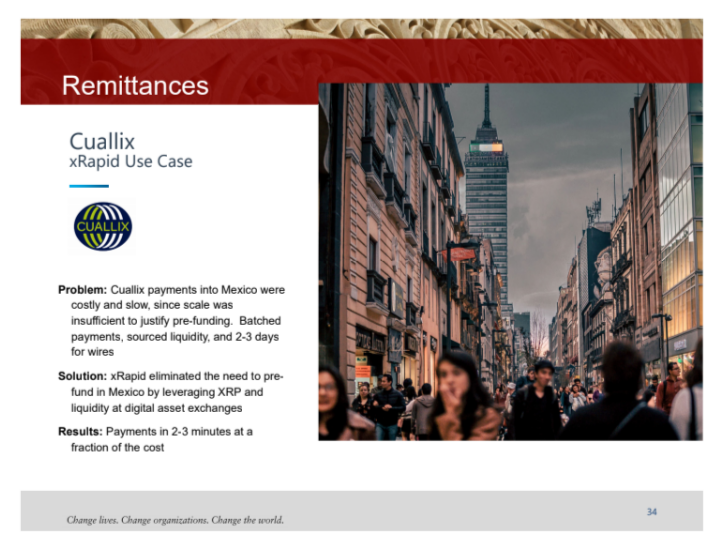
Brown proceeded to debunk each statement in turn, citing well-known research and research papers. Being a diligent student of bitcoin and of life, he really did his homework:
I called the company that Ripple has publicly stated uses the technology and asked them if they use “xRapid” or any services provided by Ripple, their response was “No.” I’ve attached the audio clip below.
With Great Commercial Power Comes Great Academic Responsibility
To chalk up Athey’s blunders to innocent — even ignorant — mistakes would seem impossible given that he’s an economist at one of the most prestigious universities in the world, lecturing on a topic she’s meant to . Athey has been on Ripple’s Board of Directors for the past five years, a company she’s to be associated with:
…all of those problems can potentially be addressed, and indeed startups are working on all of them within the bitcoin community. However, it made me wonder whether there wasn’t a simpler way to solve this problem, one that still took advantage of the fundamental innovation from bitcoin, a secure ledger. As I was grappling with these questions, I learned about the Ripple protocol. I realized that it addressed all of these problems.
Worse still, her promotion of XRP within an academic setting doesn’t appear to be the first time, as this Twitter user mentions:
Very well written points. i heard her speak last year at uchicago and also mentioned some ripple comments at the time which I thought were questionable. Thank you for speaking up.
— Calvin Chu (@radicalvin)
In the face of what appears to be a blatant promotion of an altcoin she has a vested interest in, Athey has brought not only her own but also Stanford’s academic integrity into question.
Ripple’s , which has entered schools, sounds eerily in tune with what Brown and his classmates experienced. As the company’s SVP of Global Operations Eric van Miltenburg describes it:
We are placing full faith in these universities, knowing that the students and faculty are the most capable individuals in the field. We want to help accelerate what is already a spark by turning that into a flame to help these schools move forward.
Ripple Is More Relevant Than bitcoin
A month after receiving no response to his letter from Stanford, Brown took to Twitter to relate his experience.
Posted below is an email that I sent to the Stanford GSB after a presentation in one of my classes. My professors refused to talk in person after bringing this to their attention. Over a month later I still have heard no response, other than "we will get back to you on this."
— Conner Brown ⚡️ (@_ConnerBrown_)
Athey responded, stating that she’d never received the complaint letter. At Brown’s request, she shared a of her presentation:
Here are my slides. Unlike what you might think from Conner's post, the lecture and slides are very high level, intuitive, as this was MBA class with no background in blockchain. Just trying to give the big picture as well as some of the challenges.
— Susan Athey (@Susan_Athey)
Software engineer and founder of bitcoin Advisory, Pierre Rochard, was not impressed:
Without the audio, just based on the substantive content of the slides, this presentation comes off as a Ripple (XRP) infomercial.
— Pierre Rochard [⚡️] (@pierre_rochard)
Athey defended her focus on bitcoin’s early days without mentioning its current technology status, stating:
The slides are all describing bitcoin early days and ~10 min was approx. The talk begins with stripped down, basic tech, basic wallet, no bells/whistles, high level. Not intending to take any stand on today's performance or lightning or any current debates!
— Susan Athey (@Susan_Athey)
She then added that her references to XRP (which she says she was transparent about) are particularly relevant to the here and now:
Point taken. But, in MBA class, guest speaker is *supposed* to talk about what they personally know. This class about future of finance; Ripple is natural since it has bank/FI customers. I had multiple slides on smart contracts, discussed Ethereum etc.
— Susan Athey (@Susan_Athey)
Whatever Athey’s intended agenda, with cryptocurrencies increasingly placed on the curriculum of tertiary institutions, it’s of utmost importance that a faculty’s representation of the technology is fair, equal, and unbiased. On this occasion, there would appear to be a prima facie case for asserting that the professor overstepped the mark.
What’s your take on Brown’s criticisms of Athey’s lecture? Let us know in the comments section below.
Image courtesy of Shutterstock.
Need to calculate your bitcoin holdings? Check our section.

Published at Sat, 02 Mar 2019 01:35:08 +0000


