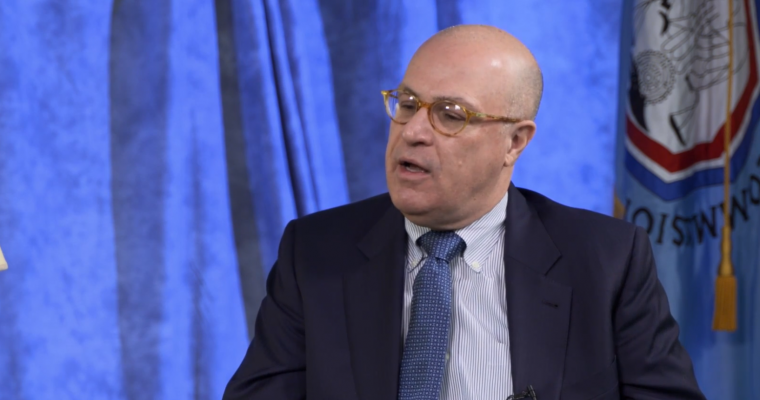
As FinTech continues to reimagine new business models for finance, a high-profile financial regulator believes it can also be used to enforce derivative laws more effectively.
J. Christopher Giancarlo, the chairman of the US Commodity Futures Trading Commission (CFTC), highlighted distributed ledger technology (DLT) and how it can automate regulations for derivative markets while speaking at the D.C. Fintech Week Conference at Georgetown University this Wednesday.
Quantitative Regulation
DLT-powered Quantitative Regulation, according to Giancarlo, could help regulators to oversee markets more efficiently while saving costs. Combined with machine learning algorithms, it can be employed to identify the segments of markets where high risks or unrecognized counterparty vulnerabilities are rising. Also, the CFTC chair noted that Quantitative Regulation could standardize and distribute critical information to market actors – including regulators.
“We can also envision the day where rulebooks are digitized, compliance is increasingly automated or built into business operations through smart contracts, and regulatory reporting is satisfied through real-time DLT networks,” Giancarlo explained. “The machines here at the CFTC would have the ability to communicate regulatory requirements and consume and analyze the data that comes in through such systems.”
The comment came at a time when financial regulators across the world are attempting to match up their with the velocity of FinTech innovations. As Giancarlo put, CFTC is looking into an active form of regulation, which can respond to real-time challenges posed by new technologies. He specifically mentioned decentralized markets and disintermediated traditional actors while referring to the said challenges.
Giancarlo confirmed that the CFTC has “the ability to keep pace with those who attempt to defraud, distort, or manipulate,” hinting it may have already started building systems that will automate derivate market regulations.
Digitizing Rule-Sets and Reporting Real-Time Data
Giancarlo stressed how their machine learning and DLT systems would be able to 1) digitize rules and regulations and, 2) consume, process, and analyze data in real-time. Moving the CFTC to such a technology would enable it to analyze data as it gets reported. It would further allow the regulatory agency to study the impact of certain provisions and how they can be modified to ensure an optimal outcome.
“Rather than rely on static rules and regulations that were put in place without knowing exactly the consequences or results they would drive in the market, we may be able to measure data, real-world outcomes, and success in satisfying regulatory objectives,” Giancarlo envisioned.
The full speech of J. Christopher Giancarlo is available at this .
Featured image from Shutterstock.
Follow us on or subscribe to our newsletter .
Published at Sun, 11 Nov 2018 07:30:34 +0000