May 9, 2026

Capitalizations Index – B ∞/21M

#DelistBSV’s domino effect: Crypto-enthusiasts ask ‘how much power should exchanges have?’

#delistbsv’s domino effect: crypto-enthusiasts ask ‘how much power should exchanges have? ’

#DelistBSV’s domino effect: Crypto-enthusiasts ask ‘how much power should exchanges have?’

Binance, the largest cryptocurrency exchange by trading volume, was in the spotlight for taking the decision to delist the currently 14th largest cryptocurrency, bitcoin SV.

This move had a domino effect, with several other exchanges announcing that they would also be supporting the move by delisting the coin from their platforms. This includes top exchanges such as ShapeShift and Kraken’s Twitter poll on the same.  Since then, the coin saw a massive drop of over 28% in its value on the weekly chart, according to CoinMarketCap. In the past 24 hours, the coin has plunged by over 21%. However, this decision made by top-notch exchanges brought up questions pertaining to the control and impact centralized exchanges have.

The #delistBSV series began when Craig Wright and Calvin Ayre served a legal notice to a prominent member in the cryptocurrency space. According to the initial announcement, the first person to receive the notice was a Twitter user, Hodlonuat, as he had previously stated that Craig was a “fraud” for claiming to be Satoshi Nakamoto, the Creator of bitcoin [BTC]. In this regard, the letter stated that the Twitter user had to issue a public apology to Wright, failing which he would sue him on the “grounds of defamation”.

This, in turn, led to a majority of the cryptocurrency enthusiasts speaking up against Wright and in support of Hodlonaut, with several adding the name to their own display name on Twitter and claiming to be Hodlonaut. This also led to Changpeang Zhao, the CEO and co-founder of Binance, affirming that Wright “is a fraud” and that they would delist the coin if this “sh*t” continued.

Interestigly, the game of serving legal notices did not just end there. Days after the announcement, Peter McCormack, the host of WhatBitcoinDid, and Vitalik Buterin, the Creator of Ethereum, also received a letter issued by Craig Wright and Calvin Ayre. McCormack, as a reply to the legal notice, stated that Wright was “definitely not the person behind the pseudonym Satoshi Nakamoto”.

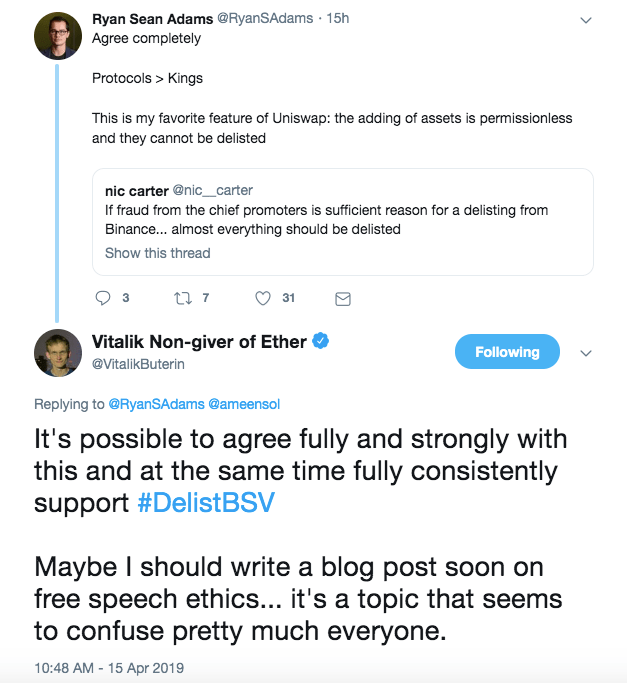
While a majority of the crypto-enthusiasts stand for #delistBSV, some shared their opinion on the impact that centralized market places had on the cryptocurency space. This included Nic Carter, the co-founder of Coinmetrics, who spoke about the events on his social media handle. He said,

“If fraud from the chief promoters is sufficient reason for a delisting from Binance… almost everything should be delisted. We’re still in the wild west era of cryptocurrency, like it or not totally unregulated, unaccountable exchanges are the kingmakers. I for one am excited for this to change.”

Nic Carter also stated,

“I let out a smirk when I read the news but celebrating this is a bit short sighted. Exchanges are part of a troika (along with coin promoters and coin rankings sites) that all profit by extracting wealth from unsophisticated investors.”

Source: twitter

Source: Twitter

The post #DelistBSV’s domino effect: Crypto-enthusiasts ask ‘how much power should exchanges have?’ appeared first on AMBCrypto.

Published at Wed, 17 Apr 2019 01:08:13 +0000

Previous Article

Brazil Trades a Record 100,000 Bitcoin in 24 Hours

Next Article

Brazil Trades a Record 100,000 Bitcoin in 24 Hours

You might be interested in …

Pune blockchain corporate workshop

Pune Blockchain Corporate Workshop

Pune Blockchain Corporate Workshop What To Expect: Mode of Delivery – The classes are held both online and in physical classrooms. Audience – We have a global audience that logs in to work hand in […]

Cardano Blockchain's First Use Case: Proof of University Diplomas in Greece

cardano use case

Greek graduates may soon be able to prove their qualifications by way of a blockchain.

GRNET, the national research and education network of Greece, is working on a pilot project with blockchain research and development company IOHK to verify student diplomas on Cardano, a blockchain that launched in September.

The project is notable because it is the first official use case of Cardano, a proof-of-stake-based cryptocurrency and soon-to-be smart contract platform currently under development by IOHK.

The GRNET app will be built on Enterprise Cardano, a private or permissioned ledger version of Cardano. Unlike a public blockchain, where anyone can join in and participate, a private blockchain allows only a restricted set of users to validate block transactions.

So far, three Greek universities are participating in the project. While IOHK is providing the decentralized database, GRNET is providing the web front end and support and will bring together other universities participating beyond the pilot.

Funding for the project comes in part from Horizon 2020, a European program for research and innovation. Development of the prototype is already under way, Aggelos Kiayias, IOHK’s chief scientist, told bitcoin Magazine.    

Why Diplomas?

Given IOHK’s deep ties with academia, it is no surprise to find the company working on a project that involves universities. But why diplomas?

Putting diplomas on a blockchain takes the paperwork out of the process and makes it easy and simple to check if someone holds a degree.

Typically, when a student graduates, they receive a paper copy of a diploma signed by the dean and co-signed the university’s registrar. All of the students’ transcripts and records are stored in the university’s centralized database.

To confirm that a graduate has the degree they claim to have, an employer has to check the official diploma or call the university. The labor-intensive process makes it too easy for unqualified applicants to slip under the radar.

Putting documents and records on the blockchain eliminates opportunity for fraud in that it allows graduates and universities to “issue a proof that a qualification exists that is undeniable,” said Kiayias. “This is a point of reference that can be agreed [on] by everyone.”

Cryptographic Proof

But to protect student privacy, instead of putting an entire diploma on the blockchain, GRNET plans to put only a cryptographic hash of a diploma on the blockchain.

Digital documents are easy to alter in ways that are undetectable to the human eye. But as long as the digital version shown to an employer hashes to the same output as what is stored on the blockchain, that proves the document is the original, unaltered version.

“We cannot put any plaintext on the blockchain, as diplomas and transcripts are personal information. We only put hashes; we may put entire diplomas and transcripts, but they will always be encrypted,” Panos Louridas, GRNET consultant and associate professor at Athens University of Economics and Business, explained to bitcoin Magazine in an email.

This is not the first effort to store diplomas on the blockchain. In October, MIT announced its own pilot project to verify digital diplomas using the blockchain.   

But Louridas claims the GRNET pilot is different from prior projects in that it stores the entire chain of verification steps on the blockchain. Each step would be recorded as its own immutable transaction on a separate block in the blockchain.  

“You don’t really need a blockchain to store diplomas: a simple system with some digital signatures by the host institution would do,” he said. “We want to be able to record that somebody has asked for proof of a degree, that the proof has been granted, that the proof has been forwarded to a verifier, and that the verifier can verify that the degree is valid, and nobody can dispute any of the above steps.”

The three Greek universities taking part in the pilot include Aristotle University of Thessaloniki, Democritus University of Thrace and Athens University of Economics and Business.


The post Cardano Blockchain's First Use Case: Proof of University Diplomas in Greece appeared first on Bitcoin Magazine.