All real estate websites are not created equal. With 43 percent of homebuyers starting their home search online and 92 percent of them using the internet is some way, agents must find a way to compete on a high level.
Real estate agents aren’t typically technology people, and their lack of website development knowledge can often be detrimental to their success.
Search engine optimization (SEO) is equally important. An agent may have the most impressive website out there, but if there is minimal traffic being driven to the site it really doesn’t matter. It’s like having an amazing sports car that stays parked in the garage. Agents also need to consider the challenge of competing with national websites that spend millions on online marketing.
A lot of these agents that can’t compete are simply lacking resources. This includes an adequate budget, or the knowledge of where to turn to get the best advice and technology.
National brokerages have one main goal in mind to brand their company name. A lot of realtors that do lack resources feel almost forced to work under a national company to compete in the website and SEO race.
There are pros and cons to being independent or working with a national company. There may be literally hundreds of agents representing that same company which makes it difficult for the agent to establish their own brand and identity.
The question is if the benefits of working with a national company outweigh the franchise fees that can range from six to ten percent. There is no getting away from that expense and as the agency grows that percentage continues to eat away at profits. Imagine having more technology at the local brokerage level, without spending the 100k per site to build a technology-based solution from the ground up. The national sites come with franchise fees, but the decadent nature of mega-brokerages keeps them from advancing on the cutting edge of individual market web presence.
The ultimate solution for an agent would be to keep their independence while still having the technology support and lead generation. and are incorporating high tech platforms backing local websites to decentralize the entire industry. The Boon platform provides access to the developers needed to bring the online real estate presence to the 21st century.
Deedcoin will provide a website with advanced platform capabilities for their brokers that allow for the application of advanced technology to help generate customers. Boon Tech will provide the developments through full stack, data gathering, AI programming, webmasters, and integrations with to customize the website tools for each agent to fulfill their needs. Deedcoin will pay up to half of the cost to implement those developers based on the Deedcoin redeemed from customers in their area.
The website, again, is the sports car, but Deedcoin and Boon Tech get it out on the open road with the constant upgrades required to win the race individually in 600 markets.
One of the most important roles in a real estate relationship is the Comparative Market Analysis (CMA). Performing a CMA provides the information needed on other homes selling in the area to determine an asking price. Using developers from the Boon platform to program data gathering tools and algorithms will find relevant properties at a faster, more accurate rate to allow agents to make more specific recommendations to customers. The webmaster services provided through Boon Tech will also incorporate AI. It will collect local event info, syndicate real estate news and post content to maximize SEO capability.
There is also a feature that allows the agent to email local leads that are generated through the content campaigns and localize customer tools. It enables the agent to improve response time to clients and utilizes chat bots. The AI has schedule management capability for the agent. There is a feature that eliminates language barriers with AI technology that allows live translations in real time.
For advanced clients that the agent services, the technology identifies articles that target investment opportunities and has a feed of new listings based on the client’s specs for buying.
Real Estate is a very competitive industry. Agents across the country are continually trying to gain any advantage they can to be successful. The Boon Tech and Deedcoin partnership allows agents to compete will any sized brokerage while providing the best service that modern online technology technology can provide.
Disclaimer: BTCManager does not endorse any content or product on this page. While we aim at providing you all important information that we could obtain, readers should do their own research before taking any actions related to the company and carry full responsibility for their decisions, nor this article can be considered as investment advice.
The post appeared first on .
, one of India’s top business conglomerates is the first victim of a “cryptojacking” attack that occurred In April 2018. The attack was first detected in some of the conglomerates overseas subsidiary’s, but it quickly spread to manufacturing and other companies closer to home within days.
First in India, but Illicit Mining Is a Long-Standing Problem
Over 2,000 computers were in this new form of malicious activities, where the victim computers saw their processing power used to mine cryptocurrency for the hackers. Not only was processing power used, but the electricity subsequently as well, leading to virtually free tokens for the pirates.
The hackers mined Monero () – a cryptocurrency that has gained widespread usage on the dark web due to its anonymity. Compared to , it is still under the radar, allowing hackers to transact XMR freely.
Monero could be used for transactions or exchanged for other cryptocurrencies that are more widely accepted such as bitcoin and litecoin (). There is no word on how much Monero the hackers mined.
Furthermore, no data was stolen or corrupted, which shows that hackers had a purely financial incentive. Business was not disrupted, and means operations can go back to return to normal. A spokesperson reported that they “also ascertained that there was no data loss due to this activity. As an added assurance, we initiated a detailed forensic investigation which is nearing conclusion in respect of root cause analysis and preventive actions.”
The incident could’ve been worse, but thankfully the organization had advanced threat management systems in place that helped limit the spread of the attack and quickly handled the situation after detection.
The conglomerate’s spokesperson said:
“Aditya Birla Group has advanced threat management systems that are constantly monitoring and protecting business-critical applications and infrastructure in all Businesses. Recently, the advanced threat detection systems of our Group alerted us of suspicious activity on some desktop systems. Based on this, our internal team immediately carried out an investigation and deployed countermeasures to isolate and eliminate the cause of this activity.”
These events follow a massive cryptojacking campaign, where over 300 websites were manipulated into mining Monero as well. While the problem is not as big as , where documents are encrypted, and the password is only given once cryptocurrency is sent, this scaled attack does show the problem is growing.
The post appeared first on .
Every couple of decades a new form of technology emerges from niche tech circles to mainstream implementations and is usually coupled with a community that firmly believes in the innovation setting a new benchmark in the world. Not advances survive, but those that do, set the ball rolling for new economic movements as the disruption is accompanied with innovative products, cutting-edge applications, and widespread job creation.
Blockchain to Play a “Big Role” in Traditional Sectors
Echoing the sentiment is Steve Chiavarone, a Wall Street trader, who believes that the rise of will play a “big role” in driving economic growth. Despite the tech still largely in an “emerging” state, Chiavarone sees the blockchain powering supply chain industries and administrative functions, among many others.
Speaking on CNBC’s Trading Nation, Chiavarone :
“This is going to be one of five key technologies — along with automation, robotics, A.I. [artificial intelligence] and the Internet of things that drive this next industrial revolution.”
Although the crypto-industry’s pioneer currency struggles to break $10,000, after touching approximately $20,000 in December 2017, Chiavarone maintains an overall bullish view of the market and is undeterred by the current bearish sentiment.
According to Chiavarone, the future of like Facebook, Google, Amazon, and Netflix lies in blockchain processing power, alongside serving industries ranging from to .
While the reason for naming the tech-giants was not mentioned, Chiavarone may indeed be on the right track with these thoughts. Facebook also on May 9, 2018, their intentions to implement blockchain technology in the company, appointing David Marcus, who previously worked on is on the board of , as head of the blockchain team.
Industries Largely Interested in Blockchain Technology
Chiavarone adds that interest from institutional players is undeniably high, and to most, bitcoin is the first gateway to the blockchain and cryptocurrency domain. The trader mentioned in particular as a major investor in the space, citing the organization’s “boast” at Davos about their blockchain inclination.
To many, the luster of blockchain technology for the financial sector is understandable, as it enables account verification, instant remittances, and immutable records. To others, blockchain marks the advent of a fourth industrial revolution, coming after manufacturing lines and the internet, as the technology is regarded as foundational rather than exclusively disruptive.
Results of a public vote on CBNC validate these thoughts, as a majority of readers voted “yes” to “Do you see blockchain technology helping corporate America?”
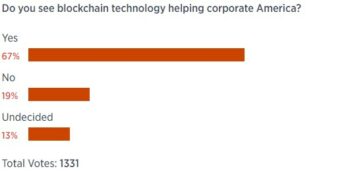
(Source: )
In conclusion, Chiavarone states:
“It has an ability to replace reconciliation, which is expensive and requires back office and time and paperwork with more instantaneous verification. And, that will allow business to flow more efficiently and it’ll allow costs to be cut and net savings to be passed along.”
The post appeared first on .