
March 24, 2026

Capitalizations Index – B ∞/21M

Cryptopia Lost Almost a Tenth of Its Assets in January Hack

Cryptopia lost almost a tenth of its assets in january hack

Cryptopia Lost Almost a Tenth of Its Assets in January Hack

Cryptopia lost almost a tenth of its assets in january hack

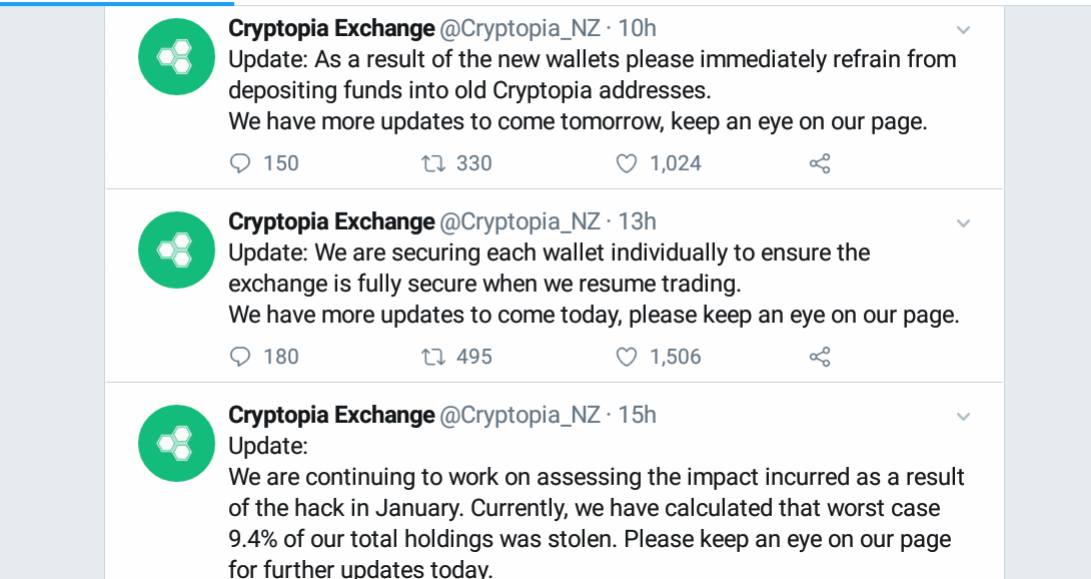
New Zealand cryptocurrency exchange Cryptopia has published a series of tweets detailing the extent of the losses it suffered during an attack by hackers in January. It said: “We have calculated that worst case 9.4 percent of our total holdings was stolen.”

Also read: 125-Year Old Swiss Bank Julius Baer Enters Cryptocurrency Market

‘Securing Individual Wallets’

The Christchurch-based exchange explained that it is “continuing to assess the impact incurred as a result of the hack,” but did not provide the value of the heist in dollar terms.

Since Jan. 15, when Cryptopia announced the cyber attack, details about the theft have largely remained unclear and the amount lost has not been made public. The exchange has kept a tight lid on information, claiming the theft was now a police matter, much to the chagrin of thousands of customers.
Cryptopia lost almost a tenth of its assets in january hack

However, data analytics company Elementus estimated that the hackers made off with $16 million worth of ethereum and ERC20 tokens. The company described the theft as “weird” as it was conducted carefully, in a series of small transfers targeting individual wallets. Normally hacks tend to be quick one-time events, with attackers taking advantage of a vulnerability and then immediately trying “to launder the money in one shot,” it said.

Even after police had moved in, the hacker reportedly continued with the attack on the New Zealand trading platform, stealing $181,000 worth of ethereum from about 17,000 wallets. Elementus postulated that it is possible future hackers may try and copy the Cryptopia technique in order to avoid detection.

In a series of tweets on Feb. 27, Cryptopia claimed to be “securing each wallet individually to ensure the exchange is fully secure when we resume trading. As a result of the new wallets please refrain from depositing any funds into old Cryptopia addresses.” The exchange said it would provide more updates starting Thursday, Feb. 28.

Investors Unhappy

While many users welcomed the break of silence from Cryptopia, others laughed off the thought of making new deposits into an exchange still smarting from a multi-million-dollar attack. “They are afraid to open because they know everyone will withdraw. And that’s the end of that exchange,” said @cryptojokerrr.

Cryptopia lost almost a tenth of its assets in january hack

Jason Smith (@iwearahoodle) stated: “Not sure deposits into Cryptopia are going to be the main problem.” Another user said: “Don’t worry we don’t deposit we need withdrawal.”

On Feb. 14, Cryptopia reported that it had been granted access to its building by the New Zealand police as investigations continued. Police spoke of how the investigation “was progressing well” at the time. A detective inspector with the New Zealand police stated then: “The focus is on identifying those behind this offending and retrieving the stolen cryptocurrency. This investigation is expected to take a considerable amount of time to resolve due to the complexity of the cyber environment.”

What do you think about the Cryptopia saga? Let us know in the comments section below.


Images courtesy of Shutterstock and Cryptopia.


Express yourself freely at OhioBitcoin.com’s user forums. We don’t censor on political grounds. Check forum.bitcoin.com

Tags in this story

Cryptopia lost almost a tenth of its assets in january hack
Jeffrey Gogo

Jeffrey Gogo is an award winning financial journalist based in Harare, Zimbabwe. A former deputy business editor with the Zimbabwe Herald, the country’s biggest daily, Gogo has more than 15 years of wide-ranging experience covering Zimbabwe’s financial markets, economy and company news. He first encountered bitcoin in 2014, and began covering cryptocurrency markets in 2017


Published at Wed, 27 Feb 2019 23:40:12 +0000

Previous Article

French Public Investment Bank invests in crypto trading software Kryll

Next Article

Binance Coin [BNB], Litecoin [LTC] can now be used to purchase Exodus, the HTC crypto-phone

You might be interested in …

Creating Intrinsic Value in Cryptocurrencies

Particl Thumb 2

The investment banker Jamie Dimon caused a stir when he declared
recently
that bitcoin will collapse because it is “worth nothing.”
bitcoin’s current market value, he claimed, is driven almost entirely by speculation,
rather than by any real and present intrinsic value that bitcoin actually
provides.

Casting aside the debate over whether bitcoin
has intrinsic value or not, it seems fair to say that Dimon doesn’t know the
cryptocurrency market well. If he did, he might have noted that bitcoin is only
one of dozens of major tokens available. Some tokens were designed with
intrinsic value as a specific goal.

Background

Particl, which was created last spring, is
building a decentralized eCommerce platform, a framework for third party apps,
and a suite of privacy tools to go with it.

PART solves various privacy problems associated with BTC, such as
the ability of third parties to trace transactions. Adding multiple cryptographic
proofs like Ring Signature Confidential Transactions (RingCT) and Confidential
Transaction (CT) plus trustless mechanisms like MAD escrow, Particl provides
100 percent anonymity to people who buy and sell using PART.
While the Particl privacy platform and upcoming Marketplace supports
most major cryptocurrencies, PART serves as its utility token.

PART
and Intrinsic Value

The value of bitcoin has risen astronomically over the past
several years in part because people believe bitcoin will one day be widely
used and provide services that other forms of currency cannot. For this reason,
the growth in value of bitcoin has far outpaced actual bitcoin adoption.
PART is different. PART’s value is based on more than the
potential future worth of the Particl Platform or PART tokens. People who own
PART tokens derive immediate benefits from them, including the following.

Token Flexibility

PART is a flexible cryptocurrency, especially with respect to the
level of privacy and anonymity users wish to have.

Voting Rights

PART ownership confers voting rights within the PART community.
The future development of the Particl Project and its privacy platform is
decided by users who own PART tokens. In this sense, PART tokens have an
intrinsic value that is absent from a cryptocurrency like bitcoin, where the
ability to propose or vote on platform changes is not linked to coin ownership.

Passive Income

PART tokens generate passive income for their owners through
working for the network (staking) and from fees collected from privacy DApps
built on the platform like the upcoming Marketplace. PART is an inflationary
token, therefore its supply increases by 5 percent in the first year and
decreases by one percentage point until the fourth year, when the inflation
rate reaches 2 percent. Inflation is then maintained at a 2 percent rate
indefinitely.

Utility Coin

Default transactions on the Particl network are pseudo-anonymous
like bitcoin. The network is Proof of Stake (PoS) so only default and stealth
addresses can stake PART. Exchanges and services also transact with the network
using public PART addresses.

If they wish, PART users can benefit from features like RingCT in
order to gain a privacy experience equivalent to using a token like Monero, which
created RingCT. Alternatively, they can use PART tokens with CT blinding
features applied to hide amounts sent between addresses.
This flexibility adds to PART’s intrinsic value because it allows
PART to be used for different sorts of transactions and is 100 percent based on
user preference. If — as proponents of bitcoin
pointed
out
in response to Dimon’s criticisms — bitcoin provides intrinsic
value in part by enabling transactions that traditional currency can’t, then
PART’s ability to accommodate a range of transaction types and use cases makes
it even more valuable.
 
In each of these ways, simply owning PART tokens generates
additional income independent of increases in the market value of the tokens on
an exchange.
 
Last but not least, as noted above, PART serves as the utility
coin on the Particl Platform. Sellers who use Particl Marketplace are always
paid in PART tokens (even though buyers can use any cryptocurrency of their
choice). In addition, like Ethereum, any decentralized application built on
Particl’s platform will transact using PART which also goes to stakers.
PART is therefore intrinsically linked to the Particl Platform. As
the adoption of the overall platform grows, so does the value of PART.

If you want to make the case that cryptocurrencies have intrinsic
value based on services they provide today, PART is a good subject to work
with. More so than bitcoin, PART derives its value from benefits that it
provides to all token holders natively, on its own privacy platform. Owning
PART is the furthest thing from speculating on tulip bulb futures (a historical
blunder to which Dimon compared bitcoin) as you can get.

The post Creating Intrinsic Value in Cryptocurrencies appeared first on Bitcoin Magazine.